First Seen
2024-09-12T22:50:47.407220+00:00
detailed-analysis (gemma3_27b-it-q8_0)
Okay, let's break down this meme from an "Anti-Oligarch" perspective, utilizing the requested theoretical lenses where applicable. The meme is explicitly critical of Elon Musk, a figure widely associated with immense wealth and power, and its categorization under "Anti-Oligarch" suggests a condemnation of concentrated power.
Visual Description
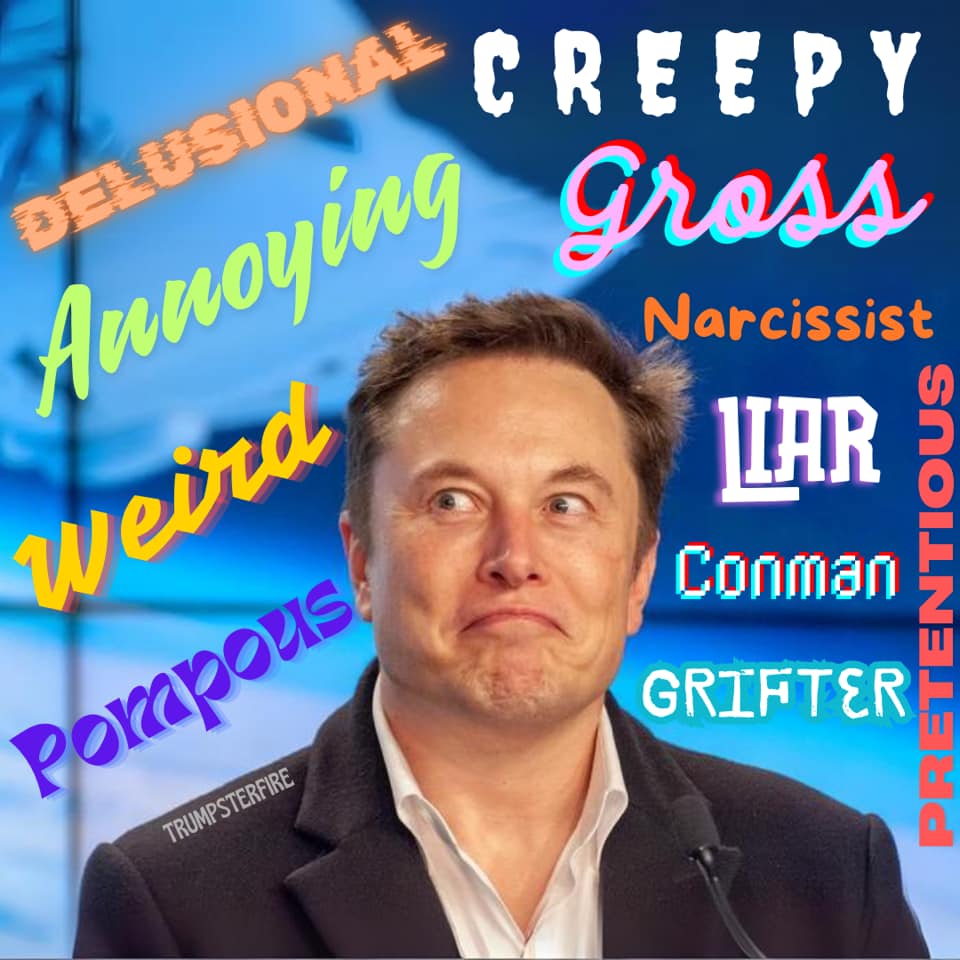
The image features a portrait of Elon Musk, dramatically overlaid with numerous labels in bright, contrasting colors. The labels are pejorative, directly attacking his character and motivations: "Delusional," "Annoying," "Weird," "Pompous," "Creepy," "Gross," "Narcissist," "Liar," "Conman," "Grifter," and "Pretentious." The text placement is chaotic and aggressive, visually "assaulting" Musk's image. The presence of the watermark "TRUMPSTERFIRE" is somewhat confusing, but suggests the meme originated from a source with possibly populist, anti-establishment leanings. The overall effect is one of intense personal and moral condemnation.
Critical Theory
This meme embodies a core tenet of Critical Theory: a critique of power structures. Musk, as a major tech CEO and extremely wealthy individual, is a power structure. The labels applied to him aren’t simply personal attacks; they're accusations of abusing that power – of being dishonest ("Liar," "Conman," "Grifter"), self-absorbed ("Narcissist," "Pompous"), and generally lacking integrity.
Critical Theory, rooted in the Frankfurt School, emphasizes the way dominant ideologies legitimize existing power imbalances. The meme suggests that Musk performs a persona of genius and benevolence, but beneath that façade lies manipulation and exploitation. It rejects the idea that his wealth is purely a product of innovation and hard work, and instead points to a potentially exploitative and/or unethical accumulation of power. The aggressive presentation of the labels indicates a rejection of his “cultural authority” and a refusal to accept the narratives he constructs.
Marxist Conflict Theory
From a Marxist perspective, the meme is a direct expression of class conflict. Musk represents the bourgeoisie – the capitalist class that owns the means of production and exploits the labor of others. The labels used—"Grifter", “Conman,” “Liar"—imply that Musk’s wealth has been attained through deceptive practices and the extraction of surplus value from labor.
The Anti-Oligarch framing emphasizes the inherent contradiction within capitalism: the concentration of wealth and power in the hands of a few. The meme can be read as a visceral rejection of this concentration, and a call to challenge the legitimacy of Musk's authority. It is a symbolic act of resistance against a figure who embodies the perceived injustices of the capitalist system.
Foucauldian Genealogical Discourse Analysis
A Foucauldian analysis would focus on the discourse surrounding Musk. Foucault argues that power is not simply repressive but is productive; it creates knowledge, norms, and subjectivities. Musk has been carefully constructed through media narratives (often by himself) as a visionary, a disruptor, and a progressive.
This meme attempts to interrupt that discourse. The labels are a counter-discourse, actively deconstructing the image of Musk as a benevolent genius. The “truth” of Musk isn’t inherent but produced through various power/knowledge regimes. The meme tries to expose the “truth” (as the meme-maker perceives it) beneath the curated public persona. The seemingly random collection of negative labels reflects the fragmented and contested nature of this discourse. The meme’s aim is not to offer a new, coherent narrative but to disrupt the existing one and reveal its inherent instability.
Postmodernism
Postmodernism would focus on the breakdown of grand narratives and the subjective nature of truth. The meme reflects this by rejecting the idea of a singular, objective “truth” about Musk. The multiple, conflicting labels (“Creepy”, “Gross”, “Pompous”) suggest that his character is fluid and dependent on perspective.
The meme's visual chaos and lack of a single, unifying argument align with postmodern aesthetics. It’s a rejection of authoritative discourse in favor of a fragmented, subjective expression of dissent. The meme does not prove Musk is a “Liar” or a “Grifter”; it asserts these qualities as one possible interpretation, acknowledging the inherent ambiguity of meaning.
Summary
From an Anti-Oligarch perspective, this meme is a potent expression of resistance against concentrated wealth and power. It utilizes critical, Marxist, Foucauldian, and Postmodern frameworks to deconstruct the image of Elon Musk as a legitimate authority figure and expose what it perceives as the exploitative and unethical foundations of his wealth and influence. The meme’s aggressive visual style reinforces the urgency and intensity of this critique.
simple-description (llama3.2-vision_11b)
The meme depicts Elon Musk with a shocked expression, surrounded by a list of words that describe him, including "anti-oligarch" and various insults. The image implies that Musk is a self-proclaimed anti-oligarch, but the surrounding words, such as "pedo guy" and "f*cking terrible", suggest that he is actually the opposite.
detailed-analysis (gemma3-27b-vision)
Okay, let's break down this image using the requested theoretical frameworks. It's a highly charged visual, and lends itself to multiple readings.
Visual Description
The image presents a close-up portrait of Elon Musk, his head and shoulders filling the frame. He is wearing a dark suit jacket and a white shirt. The background is a blurred, deep blue. What’s most striking is the image is heavily overlaid with colorful, bold text labels like "Delusional," "Annoying," "Weird," "Pompous," "Creepy," "Gross," "Liar," "Conman," "Grifter," "Narcissist," and "Pretentious." The text is angled and scattered across the image, creating a sense of overwhelming and accusatory criticism. The term "TRUMPSTERFIRE" is in small white letters in the bottom left corner. The overall effect is intentionally provocative and negative, clearly designed to portray Musk in a disparaging light.
Foucauldian Genealogical Discourse Analysis
This image can be examined through a Foucauldian lens as a manifestation of a discourse surrounding Elon Musk. Michel Foucault emphasized that knowledge isn't neutral but is produced within systems of power and language.
- Genealogy: The labels themselves (Liar, Conman, etc.) aren't simply objective truths but are products of a history of interpretations and evaluations. Tracing the genealogy of these terms would reveal how they've been used to categorize, control, and marginalize certain figures—in this case, someone like Musk. The "TRUMPSTERFIRE" tag may indicate a specific context of political critique and a link to perceptions of Donald Trump.
- Power/Knowledge: The image demonstrates the interplay of power and knowledge. Those creating and disseminating this image wield the power to define Musk, to label him, and to shape public opinion. The labels become "truths" through repetition and association, even if they lack concrete evidence.
- Discipline and Surveillance: While not explicit, the image can be seen as contributing to a wider disciplinary regime. Criticizing and labeling public figures like Musk (especially those with significant influence) can be seen as a form of social control, reinforcing norms and expectations.
- The subject: The subject (Musk) is constituted through discourse—defined by the labels and criticisms leveled against him. His image becomes a surface onto which these criticisms are projected.
Critical Theory
From a Critical Theory perspective, particularly drawing on the Frankfurt School, this image points to several issues:
- Critique of Celebrity Culture: The image reflects a critical stance towards the uncritical elevation of individuals (like Musk) to positions of power and influence. The labels challenge the narrative of him as a visionary or innovator.
- Ideology: The image attempts to deconstruct the ideology surrounding Musk—the often-positive portrayal in mainstream media and popular culture. The labels attempt to expose what the image-maker sees as the underlying manipulation and problematic aspects of his persona and actions.
- Culture Industry: The image itself can be seen as a form of counter-culture, challenging the dominant narratives produced by the "culture industry" (the mass media and commercial culture).
- Commodification: By deconstructing Musk's carefully crafted public image, the creator resists the commodification of personality and the pursuit of celebrity status.
Marxist Conflict Theory
Applying a Marxist lens, this image can be interpreted as a manifestation of class conflict and critique of capitalist power structures.
- Power Dynamics: Elon Musk is a prime example of a capitalist figure wielding immense economic and political power. The labels ("Conman," "Grifter") suggest a critique of his methods of accumulating wealth and influence. The image argues that his success is predicated on exploiting others.
- False Consciousness: The image-maker is accusing Musk of projecting a false image of himself – a carefully constructed persona to mask his exploitative practices. This image aims to break through what Marxists call "false consciousness" - the acceptance of the dominant ideology that benefits the ruling class.
- Alienation: Though not directly depicted, the image can be interpreted as a commentary on the alienation inherent in capitalist systems, where individuals are reduced to commodities and their actions are driven by profit rather than human need.
- Critique of Capital: The "grifter" label hints at an accusation of fraudulent dealings, potentially related to Musk's ventures. This is a direct attack on the inherent instability and potential for abuse within capitalist systems.
Postmodernism
From a Postmodern perspective, this image revels in the instability of meaning and the breakdown of grand narratives:
- Deconstruction: The image actively deconstructs the image of Elon Musk, dismantling the idealized or heroic narratives often associated with him. There’s no attempt to offer a coherent alternative, only a fragmented assault of negative labels.
- Simulacra and Simulation: The image suggests that the public image of Musk is a simulacra – a copy without an original. The labels point to the artificiality and constructed nature of his persona.
- Meta-Narrative Rejection: The image rejects the notion of a single, objective "truth" about Musk. It’s a subjective interpretation, presented as one among many possible readings.
- Irony and Parody: The sheer intensity of the labels could be read as ironic or parodic, mocking the tendency to elevate certain individuals to god-like status.
Queer Feminist Intersectional Analysis
While not the primary focus, a Queer Feminist Intersectional approach can add another layer of meaning:
- Power and Gender: The image, while focused on a male figure, can be read in relation to broader power dynamics. Musk’s public image often projects a sense of authority and dominance, traits traditionally associated with patriarchal power structures. The image challenges this authority.
- Critique of Masculinity: The labels ("Pretentious," "Narcissist") can be seen as challenging traditional notions of masculinity, which often prioritize self-confidence and ambition.
- Intersectionality: This image, by portraying a powerful man in a negative light, could be interpreted as a form of resistance against systemic inequalities and the concentration of power in the hands of a few.
- Subversion: The act of layering so many negative labels over his image can be viewed as a form of subversion—a deliberate disruption of dominant narratives and a challenge to established power structures.
Important Note: These interpretations are not mutually exclusive. The image is complex and can be analyzed from multiple perspectives. The specific interpretation will depend on the lens through which it’s viewed and the context in which it’s presented.
simple-description (llama3.2-vision)
The meme is a photo of Elon Musk with a mix of words and phrases written in a playful, handwritten font above and around his head. The words include "Annoying", "Creepy", "Gross", "Narcissist", "Liar", "Conman", "Grifter", and "Sociopath", among others. The image is meant to be humorous and satirical, poking fun at Musk's public image and reputation.