First Seen
2024-09-12T22:49:54.239157+00:00
detailed-analysis (gemma3_27b-it-q8_0)
Okay, let's break down this meme from an Anti-Oligarch perspective, utilizing the requested theoretical frameworks where applicable.
Meme Analysis: Elon Musk and "Free Speech" – An Anti-Oligarch Perspective
Visual Description
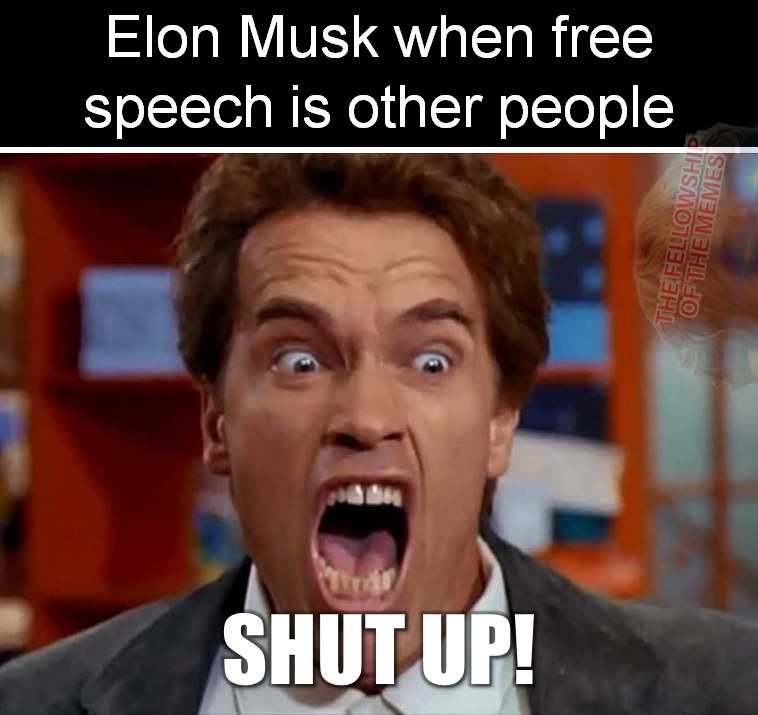
The meme features a screen grab of Jim Halpert (played by John Krasinski) from The Office. He is pictured in a highly exaggerated expression of frustrated outrage, mouth wide open, as if shouting. Overlaid on the image are the words "SHUT UP!". The caption above reads "Elon Musk when free speech is for other people." The presence of the watermark “THE FELLOWSHIP OF THE MEMES” suggests this meme circulates within a community that recognizes and actively critiques power structures.
Foucauldian Genealogical Discourse Analysis
From a Foucauldian perspective, this meme deconstructs the discourse around "free speech" as employed by Elon Musk. Musk, a prominent oligarch, champions "free speech absolutism," but this meme suggests that his commitment is entirely conditional. It's not a genuine principle but a tool wielded to justify his own control and influence.
Foucault’s genealogy examines how concepts like "free speech" have been historically constructed and deployed to maintain power relations. The meme implicitly argues that Musk’s version of “free speech” isn’t about universally-protected expression; it's about his ability to speak without constraint, and to define the terms under which others can. The image of Halpert screaming silences rather than empowers speech, highlighting the irony. The power isn't distributed equally—Musk isn't advocating for truly unrestrained communication but for a system that protects his own voice above all others.
Critical Theory
This meme speaks directly to the core concerns of Critical Theory. Specifically, it challenges the idea of a neutral public sphere. Musk’s acquisition of Twitter (now X) and his claims about "free speech" have demonstrated a shift in how the platform operates, often favoring certain viewpoints while suppressing others, even under the guise of removing 'hate speech'.
The meme highlights the power imbalances inherent in digital spaces now dominated by wealthy individuals. Critical Theory argues that seemingly neutral structures (like social media platforms) often serve to reproduce existing power hierarchies. Musk's actions demonstrate that the “free speech” narrative is a justification for centralized control, rather than a means of fostering democratic discourse.
Marxist Conflict Theory
From a Marxist perspective, the meme illuminates the conflict between the ruling class (represented by Musk) and those subject to their power. Musk’s wealth and influence allow him to dictate the rules of engagement in online spaces, shaping the information landscape to benefit his interests.
This isn't about a philosophical debate over "free speech"; it's about class struggle. Musk's platform is not a neutral arena for ideas; it’s a territory where he seeks to consolidate his power. The meme mocks the hypocrisy of someone who enjoys vast privileges while simultaneously demanding silence from those who challenge his position. It's a visual representation of the bourgeoisie attempting to silence the proletariat.
Postmodernism
While not the primary lens, postmodernism can offer some insight. The meme challenges the notion of a grand, unifying narrative of “free speech.” Postmodernists argue that such universal concepts are often constructed to mask power dynamics.
The meme deconstructs Musk’s proclaimed commitment to "free speech," revealing it as a contingent and self-serving claim. It rejects the idea of an objective truth about what constitutes "free speech" and emphasizes the subjective and contextual nature of power. The very act of using a meme, a form of fragmented, ironic communication, aligns with postmodernist sensibilities.
Queer Feminist Intersectional Analysis
While not explicitly central, it’s worth noting that those most likely to be silenced by Musk’s version of “free speech” are often marginalized groups – people of color, LGBTQ+ individuals, feminists, etc. The demand for “free speech” is often used to justify the proliferation of hate speech and harassment, which disproportionately targets these communities.
An intersectional lens recognizes that these forms of oppression are interconnected. Musk’s actions, even if framed as defending "free speech," have a concrete impact on the safety and inclusion of marginalized individuals online.
In conclusion: This meme is a potent piece of anti-oligarch commentary. It effectively utilizes humor to expose the hypocrisy of Elon Musk’s public stance on “free speech,” revealing it as a means of consolidating power rather than a genuine commitment to democratic expression. By unpacking the meme through these theoretical frameworks, we can better understand how seemingly benign concepts can be weaponized to maintain existing inequalities.
simple-description (llama3.2-vision_11b)
The meme is a humorous image of a shocked and outraged face, with the text "Elon Musk when free speech is not for him" and "Elon Musk when free speech is for him". The meme is a satirical commentary on the double standard of Elon Musk, who often advocates for free speech but also frequently censors others on his platforms. The meme is a lighthearted way to poke fun at this hypocrisy.
detailed-analysis (gemma3-27b-vision)
Okay, let's break down this meme through several critical theory lenses.
Visual Description
The meme utilizes a still image of actor Chevy Chase, portraying a highly exaggerated expression of outrage. His mouth is wide open in a shout, eyes bulging, and face reddened. Text overlays the image: “Elon Musk when free speech is other people” and "SHUT UP!". The background appears to be a television game show set. The image evokes a sense of frustration and a demand for silence. The use of a classic comedic actor and an over-the-top expression leans into hyperbole.
Foucauldian Genealogical Discourse Analysis
This meme highlights a discourse surrounding "free speech" and power. Foucault would be interested in how the concept of "free speech" has been historically constructed and used to exert control. The meme suggests that Elon Musk espouses “free speech” not as an abstract principle, but as a privilege he gets to exercise, while simultaneously demanding silence from those whose speech he deems undesirable.
The meme points to how “free speech” as a discourse can be deployed strategically. It's not simply about tolerance of all views, but about whose views are legitimized and whose are silenced. Musk's power, particularly his ownership of platforms like X (formerly Twitter), defines what speech is permissible within that space, thereby shaping the discourse and creating a power dynamic. The demand “SHUT UP!” is a direct assertion of that power and a denial of speech to another.
Critical Theory
From a Critical Theory perspective (rooted in the Frankfurt School), this meme speaks to the manipulative nature of ideology. The claim of supporting “free speech” is presented as a neutral principle, but the meme reveals it as a cover for maintaining existing power structures. Elon Musk’s actions demonstrate a double standard: he champions “free speech” when it serves his interests but attempts to suppress it when it challenges his authority or worldview.
The meme is a critique of how “freedom” can be weaponized by those in positions of power to justify their dominance. The outrage in the image highlights a performative opposition to any speech that challenges the status quo. It suggests that the rhetoric of “free speech” is often a means of solidifying and reproducing existing inequalities.
Marxist Conflict Theory
Within a Marxist framework, this meme illustrates the inherent conflict between different classes and power structures. Elon Musk, as a figure representing capitalist ownership and control over platforms, is demonstrating his desire to control the means of communication. Free speech, in this context, is not a universal right, but a tool used to maintain class dominance.
The meme implies that when others exercise their “free speech” to critique or challenge Musk’s power or the capitalist system, it’s perceived as a threat that must be silenced. The image captures the tension between those who have the power to speak freely and those whose voices are suppressed or marginalized. The “SHUT UP!” is a clear expression of a desire to maintain the existing social order.
Postmodernism
A postmodern lens would examine the meme as a disruption of grand narratives. The meme deconstructs the notion of "free speech" as an absolute and neutral principle. It exposes the inherent contradictions and power dynamics embedded within the concept. The use of a comedic image undermines any serious claim to ideological purity, suggesting that all claims to "freedom" are performative and contingent.
The meme plays with the idea that “truth” is not objective but constructed through language and power relations. It suggests that “free speech” isn’t about an open exchange of ideas, but about who gets to define what constitutes legitimate speech. The meme's humor arises from the hypocrisy it reveals, highlighting the instability of meaning and the fluidity of power dynamics.
Queer Feminist Intersectional Analysis
(This lens is less directly applicable, but can still be explored)
From a Queer Feminist Intersectional perspective, the meme can be interpreted as indicative of the silencing of marginalized voices. Musk, as a wealthy, powerful, cis-het man, demanding silence from others is representative of how dominant groups often attempt to suppress the speech of those who challenge the status quo (women, people of color, LGBTQ+ individuals, etc.).
The meme could be seen as highlighting how "free speech" is not experienced equally. Those with less social and economic power are often more vulnerable to censorship and silencing. The demand "SHUT UP!" is a manifestation of the violence inherent in systems of oppression that seek to control and suppress marginalized voices. While not explicitly about gender or sexuality, the underlying power dynamic relates to broader issues of silencing that disproportionately affect marginalized communities.
I hope this breakdown is thorough and helpful! Let me know if you'd like me to elaborate on any of these points.
simple-description (llama3.2-vision)
This meme is a humorous commentary on the public's perception of Elon Musk's views on free speech. The image features a shocked expression from a movie or TV character, with the caption "Elon Musk when free speech is other people". The text "SHUT UP!" is overlaid on the image, implying that Musk is shocked and angry when others are not allowed to express their opinions freely.