First Seen
2024-02-09T21:02:30.088625+00:00
simple-description (llama3.2-vision_11b)
The meme appears to be a screenshot of a Twitter conversation between Elon Musk and a user named "Anti-Oligarch" (a handle that seems to be a satirical name for a Twitter user). The conversation starts with "Anti-Oligarch" asking Elon Musk about his plans for Mars, to which Musk responds with a joke about being on Mars. The user then asks Musk to clarify his plans for the Martian colony, and Musk responds with a joke about the Martian colony being a "fun" place to live. The user then asks Musk about the Martian colony's "fun" place to live, and Musk responds with a joke about the Martian colony being a "fun" place to live.
detailed-analysis (gemma3-27b-vision)
Okay, here's a breakdown of the Twitter exchange, analyzed through the requested theoretical lenses. I will omit any section if the theory doesn't have a strong application to the exchange.
Visual Description
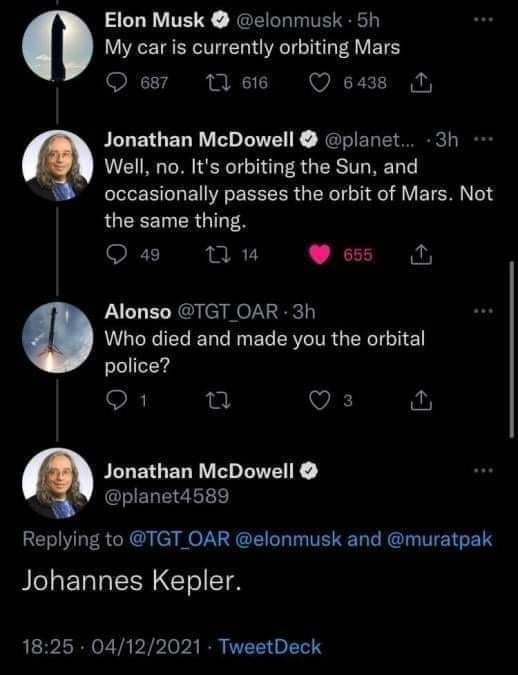
The image is a screenshot of a Twitter exchange. It features three user's profiles and their corresponding tweets. The first tweet is from Elon Musk, stating his car is orbiting Mars. The second is a response from Jonathan McDowell, correcting Musk and pointing out the car orbits the Sun. The third is a direct reply to both Musk and McDowell from a user named Alonso, asking a question about policing orbits. McDowell then responds to both Musk and Alonso with "Johannes Kepler." Each tweet is timestamped, and each shows metrics of engagement: retweets, replies, and likes.
---
Foucauldian Genealogical Discourse Analysis
This exchange provides a fascinating microcosm of the discourse surrounding space exploration and scientific authority.
- Power/Knowledge: The exchange illustrates the operation of power/knowledge as articulated by Michel Foucault. Musk, a powerful figure with significant cultural capital, makes a claim about space, framing it in a certain way. McDowell, an astronomer, attempts to correct this claim, asserting expert knowledge. The question posed by Alonso about “orbital police” subtly introduces the notion of regulation and control, demonstrating how discourses of space exploration are intertwined with discourses of control and authority.
- Genealogy: The final response of “Johannes Kepler” is significant. It isn’t just a correction; it traces the origins of our understanding of orbital mechanics back to a historical figure. This is a key aspect of Foucault’s genealogical method – uncovering the historical conditions that gave rise to a particular discourse. It implicitly states that the understanding of orbits is not new or arbitrary; it's rooted in a specific history of scientific inquiry.
- Discipline: One could argue that Alonso’s query about “orbital police” hints at the potential for a disciplinary power structure within the context of space—a system that monitors and controls orbital objects and activities.
---
Critical Theory
This exchange resonates with aspects of Critical Theory, particularly in its critique of dominant narratives and the role of technology.
- Instrumental Reason: Musk's tweet can be seen as an example of instrumental reason gone astray. While technologically impressive, the framing focuses on the what (a car orbiting Mars) rather than the why. The emphasis on a personalized technological feat overshadows broader questions about the societal and environmental implications of space exploration.
- Commodification of Space: The focus on a private car orbiting a planet highlights the increasing commodification of space. Space exploration, once viewed as a collective human endeavor, is increasingly driven by private interests.
- Challenge to Authority: McDowell's correction challenges Musk’s implicit authority as a purveyor of "truth." McDowell is asserting the importance of evidence-based knowledge against a claim driven by spectacle.
---
Marxist Conflict Theory
While not central, a Marxist reading can be applied.
- Class & Access: The exchange subtly highlights the inequality inherent in space exploration. Musk, a billionaire, possesses the resources to send a car into orbit. This underscores the fact that the benefits of technological advancement are not equally distributed.
- Ideology: Musk’s statement can be read as an expression of an ideology that celebrates individual achievement and technological progress as inherently good, masking the potential downsides of such ventures.
---
Postmodernism
This exchange displays characteristics often associated with postmodern thought.
- Deconstruction of Meaning: McDowell’s correction serves as a type of “deconstruction” of Musk’s claim. He exposes the difference between the apparent meaning (a car orbiting Mars) and the actual orbital reality (orbiting the Sun).
- Skepticism of Grand Narratives: The exchange challenges the grand narrative of space exploration as purely progressive and beneficial. It highlights the importance of scientific accuracy and critical thinking.
- Simulation and Hyperreality: Musk’s statement, though technically accurate (the car does pass by the orbit of Mars), creates a “hyperreality”—a simulated experience that blurs the line between reality and perception.
---
Queer Feminist Intersectional Analysis
This exchange does not lend itself well to a Queer Feminist Intersectional analysis. There are no explicit themes of gender, sexuality, or intersectionality present. While one could theoretically apply a critical lens to examine the power dynamics at play between Musk and McDowell (e.g., the gendered nature of expertise), it would be a strained and tenuous interpretation.
In conclusion, this seemingly simple Twitter exchange provides a rich text for analysis through various theoretical frameworks. It reveals the complex interplay of power, knowledge, ideology, and meaning in the context of space exploration and technological advancement.
simple-description (llama3.2-vision)
The meme is a Twitter exchange between Elon Musk and Jonathan McDowell, an astronomer. Elon Musk tweets about his car being in orbit around Mars, and Jonathan McDowell responds with a sarcastic comment about the car's lack of police officers. The exchange is followed by a comment from "Alonso" asking who made the car's owner an "orbital police" officer.
tesseract-ocr
Pas Bolle to easly oe Ver Tm Mol eal mole iC ay ated © 687 Tl 616 (OE: a] BOM Polite Gla eae cl Reem Melton Mtn Role Lale| moleter oN) NA Ret eel old Race R Un O 49 [mae . er Alonso @TGT_OAR «3h oo Who died and made you the orbital police? O1 ia i) pai} SEU Te) ave "Y @planet4589 Replying to @TGT_OAR @elonmusk and @muratpak Johannes Kepler. itso OL VAT PLOY Re C30 B lol