First Seen
2023-05-24T22:39:06+00:00
simple-description (llama3.2-vision_11b)
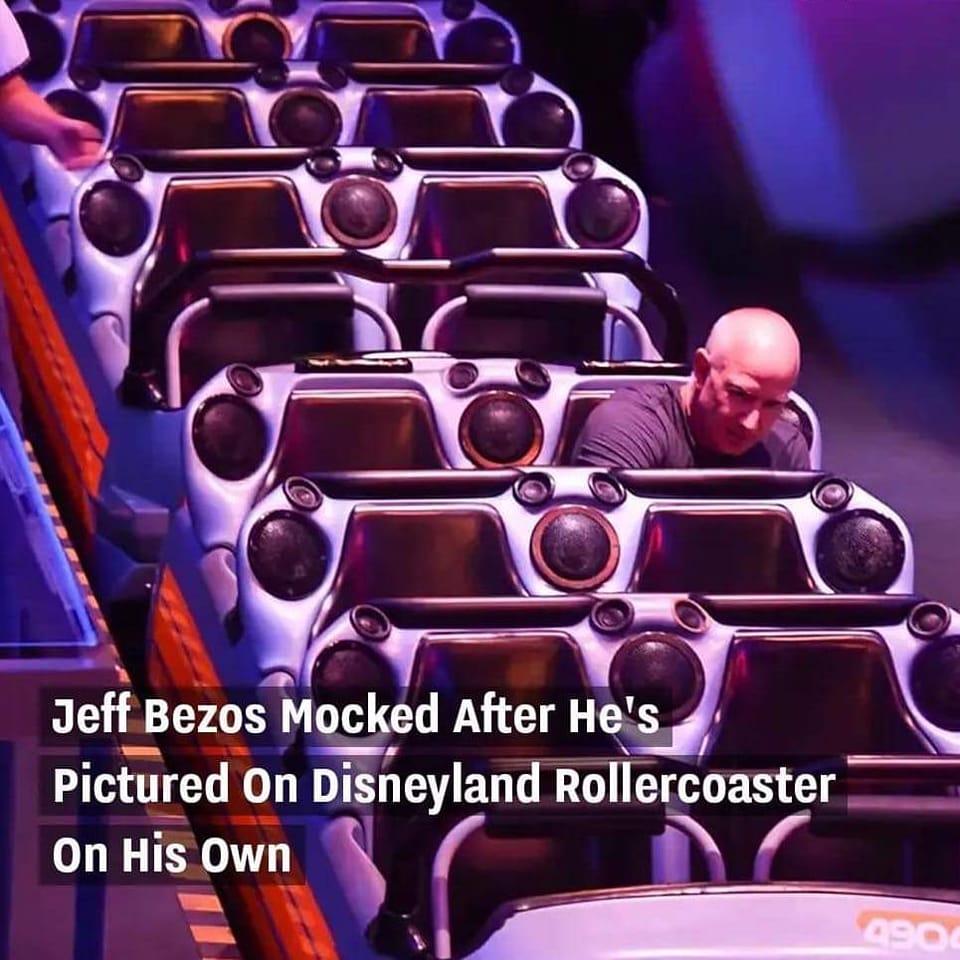
The meme is an image of Jeff Bezos, the CEO of Amazon, sitting in a rollercoaster car, looking terrified. The text "Jeff Bezos: I'd rather be in space" is overlaid on the image, implying that Bezos would rather be in space than on the rollercoaster. The meme is a humorous take on Bezos' wealth and his ability to travel to space, with the implication that even a rollercoaster ride is too scary for him.
detailed-analysis (gemma3-27b-vision)
Here's an analysis of the image, broken down into the requested sections, only including those that apply and are relevant. Given the subject matter (a wealthy man alone on a ride), the most pertinent analyses will lean toward Critical Theory, Marxist Conflict Theory, and potentially aspects of Postmodernism.
Visual Description
The image shows Jeff Bezos, the founder of Amazon, sitting alone in the front car of the "Mr. Toad's Wild Ride" attraction at Disneyland. The car is designed to resemble a vintage automobile, and is vibrant purple and blue. The car appears empty behind him – all the other seats are unoccupied. The lighting is fairly bright, typical of a theme park. The overall impression is one of isolation, and somewhat of awkwardness. A yellow safety bar/track is visible along the left side. Text overlays the image stating “Jeff Bezos Mocked After He’s Pictured On Disneyland Rollercoaster On His Own.”
Critical Theory
This image lends itself to a Critical Theory analysis by highlighting the ways in which power, wealth, and social perception intersect. The mockery directed toward Bezos isn't simply about him riding a ride alone; it’s a manifestation of broader societal anxieties surrounding wealth inequality and the perceived detachment of the ultra-rich from everyday experiences.
- The Spectacle: Bezos, as a globally recognized figure, exists within a “spectacle” (in the Debordian sense). The image is the spectacle; it’s a constructed moment made visible for consumption and commentary. The public’s reaction isn’t about the event itself but about what the event represents about Bezos and, by extension, the system he embodies.
- Dehumanization: The isolation on the ride can be interpreted as a metaphor for the perceived lack of empathy or connection to the common person. The mockery functions to “other” him, reinforcing a narrative of him being disconnected from the lives of average citizens. It strips away his humanity, reducing him to a symbol of excess.
Marxist Conflict Theory
The image is ripe for a Marxist analysis, focusing on class conflict and the symbolic representation of wealth.
- Symbol of Capital: Bezos is a central figure of capital, representing the accumulation of wealth through a system that often exploits labor. The fact that he can afford to rent out an entire theme park ride for himself emphasizes the extreme disparity between his economic power and that of the vast majority.
- Symbolic Violence: The mockery itself is a form of "symbolic violence," where cultural messages and reactions reinforce existing power structures. The public's amusement and criticism, while seemingly harmless, reinforce a negative perception of wealth and the individuals who accumulate it. It highlights the perceived injustice of a system where one person can have access to experiences unavailable to most.
- Commodification of Experience: The fact that this experience can be bought— that Bezos can essentially privatize a public attraction— demonstrates the complete commodification of leisure and experience within late-stage capitalism. Even fun and recreation are subject to the logic of the market.
Postmodernism
While not as central as the other analyses, Postmodern themes are subtly present.
- Simulation & Hyperreality: The image exists as a mediated representation – a photograph circulated online. It’s not the experience of riding the ride, but the image of the experience that generates the reaction. This contributes to a sense of hyperreality, where the signifiers (the image, the mockery) become more important than the reality itself.
- Loss of Grand Narratives: The mockery can be seen as a rejection of traditional narratives of success and wealth. It suggests a skepticism towards the idea that wealth automatically equates to happiness or fulfillment. The humor arises from a questioning of the value system that allows for such extravagance.
Important Note: Analyzing an image like this is open to interpretation. These are just a few possible readings based on the theoretical frameworks you requested. The context of the image (where it was shared, the specific reactions it received) would further inform these analyses.
simple-description (llama3.2-vision)
This meme is an image of a rollercoaster with a man screaming in the front car. The text overlayed on the image reads "Jeff Bezos mocked after he's pictured on Disneyland rollercoaster on his own". The meme is making a joke about the public's reaction to a photo of Jeff Bezos, the founder of Amazon, being spotted on a rollercoaster at Disneyland by himself, which was perceived as an awkward and humorous situation.
tesseract-ocr
a © am . o> oO fa > 4 » Z ae . \ pes mN ee . L . — €> a ee "o_o — a Kos ‘ = ry if CaN \ y _ XO . = a 4 at ——A~ be A f aS ONS Ung Le N iar CC Disneyland Rollercoaster = a 4 ( \ fe | —————- 606L0Ull