First Seen
2023-05-24T22:39:00+00:00
simple-description (llama3.2-vision_11b)
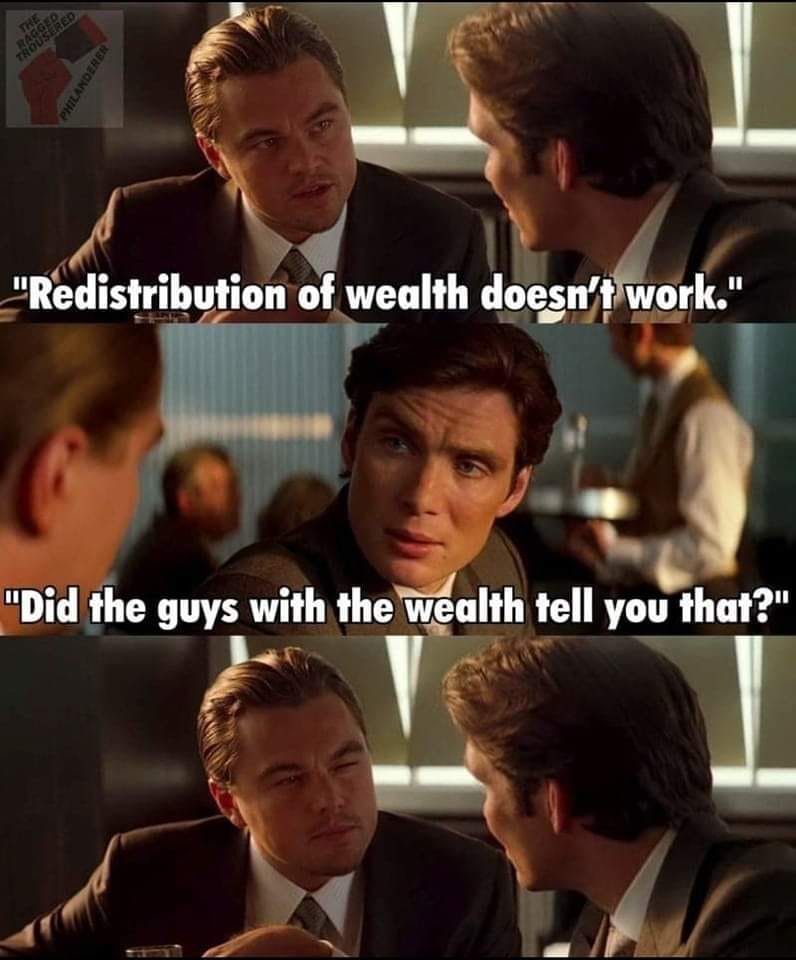
The meme is a screenshot from the movie "The Wolf of Wall Street" where Jordan Belfort, played by Leonardo DiCaprio, is explaining to his friend that the wealthy elite are responsible for the economic inequality in the US. The text overlay on the image reads: "The rich don't get richer by working harder, they get richer by exploiting the poor." This meme is used to illustrate the anti-oligarch sentiment, highlighting the unfairness of the wealth distribution in the US and the role of the wealthy elite in perpetuating this inequality.
detailed-analysis (gemma3-27b-vision)
Okay, let's break down this image and the overlaid text through several theoretical lenses. It's rich for analysis, especially given the direct quote about wealth redistribution.
Visual Description
The image is a still from the movie Margin Call (2011). It depicts a tense scene in a dimly lit, upscale office bar. Three men in dark suits (representing corporate finance professionals) are engaged in a close-up conversation. The camera angle is low, emphasizing their power dynamic and potentially conveying a sense of unease or confrontation. The lighting is stark and directional, casting shadows and highlighting the intensity of the moment. The color palette is cool, dominated by blues and grays. The setting evokes a world of privilege, exclusivity, and high-stakes decision-making. The emotional expressions range from dismissive (the man on the left) to intrigued/challenging (the central figure) to almost stoic (the man on the right). The focus is clearly on the dialogue and the emotional weight of the exchange.
Critical Theory
This image immediately lends itself to a Critical Theory analysis. The statement "Redistribution of wealth doesn't work" is a justification of the existing socio-economic order. It's presented as an objective truth, but it's implicitly defending a system that massively concentrates wealth in the hands of a few. The question, "Did the guys with the wealth tell you that?" deconstructs that justification by revealing its source—those who benefit from the current system.
Critical Theory argues that knowledge isn't neutral but is shaped by power relations. This image perfectly illustrates that concept. The very idea that "wealth redistribution doesn't work" is not based on impartial analysis, but on a self-serving narrative perpetuated by those who already hold the wealth. The image shows a closed, exclusive conversation between individuals who are likely deeply invested in maintaining the status quo. It represents the elite justifying their position, and subtly communicating amongst themselves.
Marxist Conflict Theory
From a Marxist perspective, this image embodies class conflict. The men in the image represent the ruling class—those who own the means of production and control capital. The statement about wealth redistribution is a direct defense of their position. Marxist theory suggests that history is driven by class struggle, and this image is a snapshot of that struggle playing out in a contemporary context.
The quote embodies the ideology used to justify exploitation. The argument that "redistribution doesn't work" serves to legitimize the existing inequality, masking the fact that wealth is accumulated through the labor of others. It’s a narrative that serves to preserve the power dynamics in favor of the ruling class. The response questions the source of that "truth," highlighting that it is a biased and self-serving claim made by those with a vested interest in maintaining the system. The underlying conflict isn’t simply about economics, but about power, control, and the reproduction of social inequality.
Foucauldian Genealogical Discourse Analysis
A Foucauldian reading would analyze the discourse surrounding wealth and redistribution. The statement isn't just a claim about economics; it's a statement that constructs a particular understanding of wealth, poverty, and the possibility of social change. The image isn't about whether redistribution actually works, but how the very idea of redistribution is framed and controlled.
The question "Did the guys with the wealth tell you that?" deconstructs this discourse by highlighting its genealogy – tracing how this particular “truth” came to be accepted and how it serves the interests of those in power. Foucault would be interested in who has the power to define what is considered "possible" or "impossible" in the economic sphere. The image suggests that power operates through discourse, shaping our understanding of the world and limiting our imaginations of alternative futures. The statement is not a truth, but a disciplinary mechanism used to maintain the existing power structure.
Postmodernism
A postmodern analysis would challenge the idea of a single, objective truth about wealth redistribution. It would point out that the statement is a construction – a narrative created and circulated by those in power to serve their interests. There’s no inherent "truth" to be discovered, only competing narratives.
Postmodernism would also emphasize the fragmentation of meaning and the role of language in shaping our understanding of reality. The image shows a conversation taking place within a specific context, and the meaning of the statement is dependent on that context. The power dynamic visible suggests that the meaning isn't neutral, but shaped by the unequal power relations between the individuals involved. The deconstruction of the narrative through the questioning of the origin of the statement further reveals the lack of a stable, objective truth.
Note: A Queer Feminist Intersectional Analysis doesn't fit particularly well with the image on its own, because the scene focuses on a male-dominated sphere of finance. While it's possible to argue that this represents a patriarchal structure that reinforces economic inequalities, it wouldn't be a primary or particularly strong reading given the content. The scene lacks overt gendered or queer dynamics for that analysis to take center stage. However, a connection could be made by exploring how the concentration of wealth in the hands of a small group of men exacerbates existing inequalities faced by marginalized communities.
Let me know if you’d like me to expand on any of these perspectives or delve deeper into a specific theoretical framework!
simple-description (llama3.2-vision)
This meme is a humorous exchange between two characters, likely from a movie or TV show, where one character is expressing his lack of understanding of a financial concept. The text "Redistribution of wealth doesn't work" is followed by a response "Did the guys with the wealth tell you that?" implying that the person was informed by those with a financial interest in keeping the status quo.
tesseract-ocr
i Ye = a ie A ay it “a " Cc : = CE RTL a a ae f b> : ae <n Ba