First Seen
2025-10-24T05:36:09+00:00
simple-description (qwen3.5_2b-q8_0)
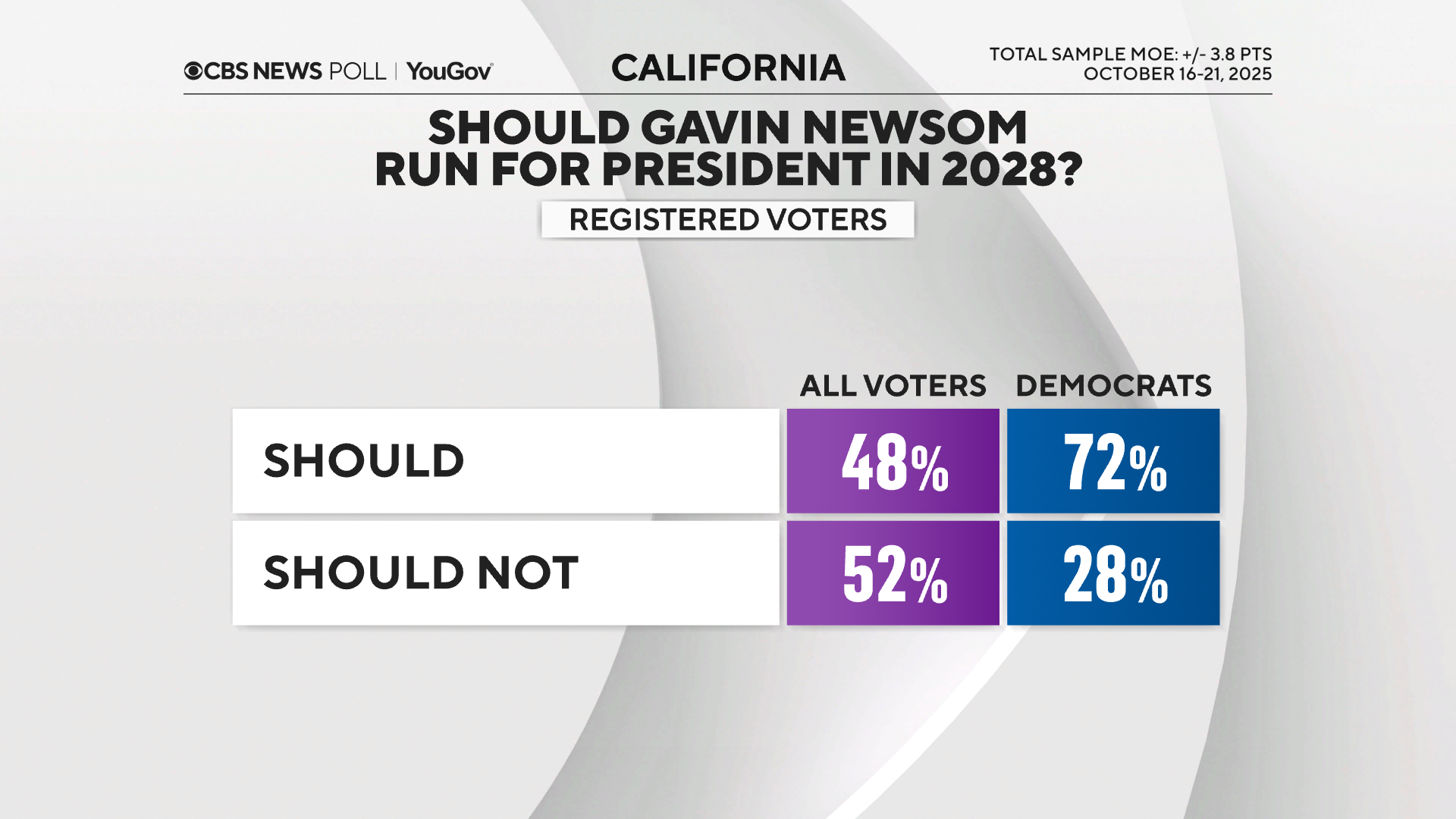
This meme, often referred to as "The California Dilemma," sets up a conflict between two political narratives: one that claims Gavin Newsom wants to run for president because he loves his home state (implying the Governor represents state interests), versus the counter-claim that Joe Biden runs to help Democrats who want to intervene in federal affairs.
From an Anti-Neoliberal perspective—which generally advocates for limited government and local sovereignty—this meme supports the idea that Newsom is a champion of conservative, state-aligned values against the liberal federal party represented by Biden. The visual data, showing that 72% of Democrats (who represent the Federal party) want him to run, reinforces the argument that despite being a Democratic governor, he aligns with conservative anti-interventionist principles and "small government" ideals more than the interventionist agenda favored by his party's federal platform.
detailed-analysis (gemma3_27b-it-q8_0)
Okay, let's break down this poll data regarding Gavin Newsom's potential presidential run, from the perspective of an "Anti-Neoliberal" framework. This is a complex framing, so I'll approach it systematically, applying the relevant theoretical lenses as applicable.
Understanding the Anti-Neoliberal Lens
Before diving in, let's define the core of "Anti-Neoliberalism" as we'll use it here. This isn’t just about being “against” liberals. It’s a critique of a specific political and economic ideology that emerged in the 1980s (Thatcher/Reagan) and profoundly shaped global politics. Key tenets include:
- Rejection of Free Markets as Neutral: Neoliberalism posits that free markets are the most efficient and natural way to allocate resources. Anti-Neoliberals see markets as constructed through power relations, inevitably leading to inequality, exploitation, and social degradation.
- Critique of Deregulation: Deregulation is a central neoliberal strategy. Anti-Neoliberals argue it undermines social protections, environmental safeguards, and worker rights.
- Opposition to Austerity: Neoliberal policy often involves austerity measures (cutting social programs) to reduce government debt. Anti-Neoliberals see this as a deliberate strategy to dismantle the welfare state and weaken collective bargaining power.
- Skepticism Towards Globalisation (as currently practiced): Not necessarily against all international cooperation, but critical of the ways globalisation has been used to benefit corporations and elites at the expense of local communities and national sovereignty.
- Rejection of Managerial Governance: Emphasis on technocratic solutions and "expert" decision-making.
Visual Description
The graphic is a straightforward bar chart presenting poll data from CBS News and YouGov. It asks “Should Gavin Newsom Run for President in 2024?”. There are two sets of data presented: “All Voters” and “Democrats.”
- "All Voters" show a very slight leaning towards "Should Not" (52%) versus "Should" (48%).
- "Democrats" reveal a strong inclination towards Newsom running (72% “Should”) and a comparatively small opposition (28% “Should Not”).
Foucauldian Genealogical Discourse Analysis
From a Foucauldian perspective, this poll data reveals the discursive formations that structure our understanding of leadership and political possibility. Newsom embodies a particular kind of Californian political figure—pro-business, socially liberal, but fundamentally within the established order. The fact that a majority of all voters are hesitant about his run isn’t necessarily about Newsom as an individual, but about a growing distrust in the dominant discourses of political “solutions.”
- Power/Knowledge: The poll itself is an exercise of power/knowledge. It establishes a framework for acceptable political discourse ("should he run?") and defines who gets to be considered a legitimate candidate. It's about shaping the landscape of what is thinkable.
- Genealogy of 'Leadership': Looking at the historical development of the concept of "leadership," a Foucauldian would trace how it's become intertwined with narratives of individual exceptionalism, managerial efficiency, and technological advancement. Newsom is a product of this genealogy.
- The “Crisis” of Legitimacy: The split between all voters and Democrats signals a potential crisis in the legitimacy of the Democratic Party’s current leadership model. The "all voters" data suggests that the narratives the Democratic Party depends on—hope, change, pragmatism—are losing their power to convince a wider audience.
Critical Theory
Critical Theory, particularly building on the Frankfurt School, would examine the poll data as a symptom of broader societal alienation and the failure of the existing political system to address fundamental problems.
- Commodification of Politics: The poll treats Newsom as a “brand” to be evaluated, like a product in the marketplace. This reflects the broader commodification of politics in a neoliberal context, where candidates are packaged and sold based on their image and appeal rather than their substantive policies.
- False Consciousness: The 72% support from Democrats might be interpreted as a form of "false consciousness," where voters are persuaded to support a candidate who ultimately serves the interests of the ruling class. Newsom's pro-business stance and relative moderation might be seen as benefiting capital accumulation, even while appealing to progressive values.
- The Culture Industry: Newsom's carefully cultivated image and media presence would be analyzed as part of the “culture industry,” which produces standardized, easily consumable political content that reinforces existing power structures.
Marxist Conflict Theory
This poll data, viewed through a Marxist lens, speaks directly to class conflict and the limitations of electoral politics within a capitalist system.
- Class Interests: Newsom, despite being a Democrat, represents the interests of the capitalist class—corporations, real estate developers, and the wealthy elite. His policies, while potentially including some progressive elements, will ultimately serve to maintain the existing economic order.
- False Promises of Electoral Reform: The belief that electing Newsom could lead to meaningful change is a "false promise" designed to pacify the working class and prevent them from engaging in more radical forms of political action.
- The Illusion of Choice: The poll data presents an illusion of choice, suggesting that voters have a meaningful say in who represents them. However, within a capitalist system, the range of acceptable candidates is limited by the needs of capital.
Postmodernism
A postmodern perspective would deconstruct the very idea of a “candidate” and the categories used in the poll.
- Deconstruction of Grand Narratives: Postmodernism rejects "grand narratives" like the idea of "progress" or "national unity." Newsom’s potential campaign would be seen as a continuation of these empty narratives, lacking any genuine substance.
- The Simulacrum: Newsom might be viewed as a "simulacrum" —a copy without an original. His image and persona are constructed through media representations, lacking any authentic connection to the real world.
- Relativism & Context: The data is entirely context-dependent. What "should" mean is a subject of endless debate and lacks any objective truth.
Queer Feminist Intersectional Analysis
While Newsom's identity as a cisgender heterosexual man doesn't directly implicate a queer feminist analysis, the broader context of his potential candidacy does.
- Representational Politics: The poll doesn't say who within the “All Voters” category is less enthusiastic. A QFI analysis would want to know if marginalized groups (women, people of color, queer/trans individuals) demonstrate significantly lower support for Newsom. These groups often face disproportionate impacts from the policies Newsom would likely support.
- Intersectionality of Oppression: A QFI framework would analyze how Newsom’s policies intersect with systems of oppression based on race, class, gender, sexuality, and disability. For example, his housing policies might exacerbate racial wealth gaps, or his economic policies might disproportionately harm low-wage workers who are predominantly women and people of color.
- Challenging the Status Quo: The reluctance of “All Voters” might signal a desire for candidates who are more actively committed to dismantling oppressive systems and building a more just and equitable society.
In conclusion, from an Anti-Neoliberal perspective, this poll data isn’t merely a measure of Newsom’s popularity. It's a reflection of a growing disillusionment with the established political order and a desire for more radical alternatives. The split in support indicates that the narratives of neoliberalism are losing their hold on the wider electorate, and that there is space for a new kind of politics that prioritizes social justice, economic equality, and democratic participation.
simple-description (llama3.2-vision_11b)
The meme is a screenshot of a news article from 2023, showing a poll asking if voters in California should support a 2024 presidential candidate who is a neoliberal. The meme is captioned "Neoliberal" and includes a quote from a 2023 article stating that a 2024 candidate "is a neoliberal."