First Seen
2025-09-23T19:54:27.740311+00:00
simple-description (qwen3.5_2b-q8_0)
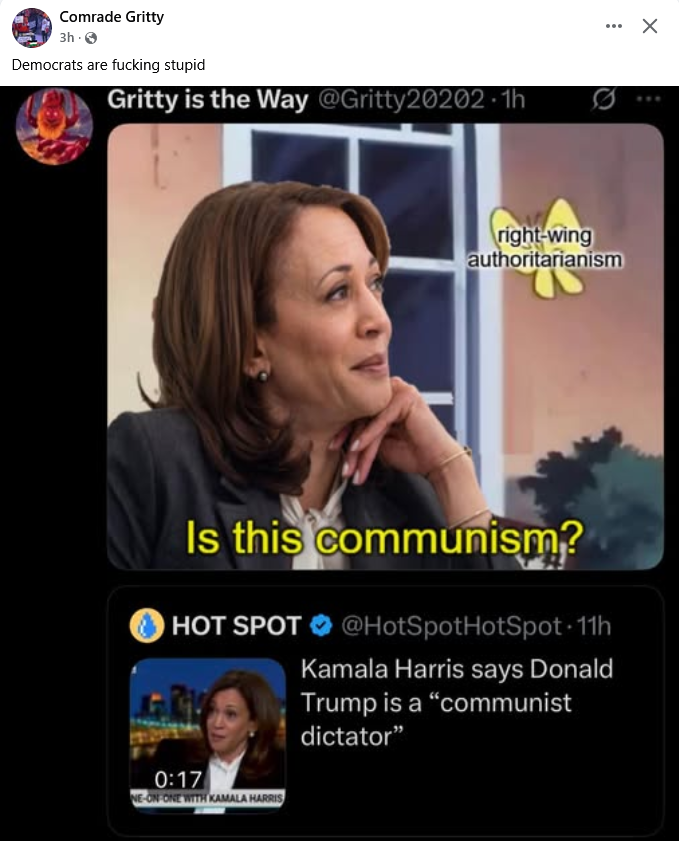
This meme satirizes the political rhetoric used to frame the US election cycle as a struggle against democracy itself, arguing that what opponents label as "communist dictatorships" are actually other forms of authoritarianism. In an anti-neoliberal context, it critiques the perception that free-market capitalism is fundamentally incompatible with liberal democratic values, suggesting that the current political battle is less about economic policy and more about a fear of what appears to be an embrace of these very same ideologies. The text specifically points out the absurdity of labeling any resistance to capitalist values as "dictatorship," highlighting how opponents have redefined freedom through a lens of security rather than liberty.
detailed-analysis (gemma3_27b-it-q8_0)
Okay, let's break down this meme from an anti-neoliberal perspective, utilizing the requested theoretical frameworks where relevant. This is a complex meme requiring a layered analysis.
Overall Context: The Anti-Neoliberal Lens
Before diving into the specific frameworks, it's crucial to establish the core tenets of an anti-neoliberal viewpoint. This ideology generally rejects the consensus that free-market capitalism, deregulation, globalization, austerity, and reduced government spending are beneficial. It sees these policies as leading to increased inequality, environmental destruction, erosion of democracy, and the rise of authoritarianism. Anti-neoliberals are often critical of both traditional left and right wing approaches that uphold the capitalist system. The meme, viewed through this lens, is a cynical commentary on the intellectual vacuity and manipulative rhetoric of the Democratic party.
Visual Description
The meme utilizes a screenshot of Kamala Harris looking bewildered, with the text "Is this communism?" overlaid. Above her head is a text bubble that reads "right-wing authoritarianism." The image is paired with a clip from HotSpot, showing Kamala Harris describing Donald Trump as a "communist dictator." The juxtaposition is the core of the meme's humor and message. It’s deliberately awkward and relies on the perceived contradiction in Harris’s statement.
Foucauldian Genealogical Discourse Analysis
This framework focuses on the power dynamics inherent in language and the construction of meaning. The meme demonstrates how the term "communism" (and the concept of a “dictator”) is not a fixed, objective category, but rather a product of discourse that has been historically shaped and deployed to exercise power.
- Genealogy of "Communism": Foucault would argue that the meaning of "communism" has been continually redefined. For decades it was used to delegitimize the Soviet Union and anti-capitalist movements. Here, the meme points to the absurd extension of this discourse—claiming Trump, a figure associated with capitalistic and right-wing power structures, is a “communist dictator.”
- Power/Knowledge: The meme reveals how power operates through knowledge. The Democrats attempt to demonize their political opposition (Trump) by associating them with a feared ideology (communism). By doing so, they try to control the narrative and justify their own actions.
- Discursive Formation: The meme exposes the breakdown of coherent discourse. The Democratic party, in this view, has lost touch with any consistent ideological grounding, resorting to labeling anything they dislike as “communism” – a rhetorical tactic devoid of meaningful substance.
Critical Theory
Critical Theory, rooted in the Frankfurt School, examines how culture and ideology maintain power structures. This meme taps into several of its concerns:
- Instrumental Reason: The Democrats’ use of “communism” as a pejorative label is an example of instrumental reason. They are not engaging in genuine political analysis but are instead using language strategically to achieve a desired outcome (demonizing Trump).
- The Culture Industry: The clip from HotSpot itself can be seen as part of the “culture industry” – mass media that shapes public opinion and reinforces dominant ideologies. The meme critiques this by exposing the absurdity of its messaging.
- False Consciousness: From an anti-neoliberal perspective, the meme suggests that many people are operating under “false consciousness.” They accept the simplistic narratives presented by the media and political elites without critical examination.
Marxist Conflict Theory
This framework highlights class struggle and the inherent contradictions within capitalism.
- Ideology & Class: The meme suggests that the Democratic party is a representative of the capitalist class, even if it sometimes engages in rhetoric about social justice. Labeling Trump a "communist dictator" is a way to deflect attention from the real problems of capitalism—inequality, exploitation, and environmental degradation.
- Contradictions of Capital: The meme points to the absurdity of attempting to categorize Trump within a communist framework, showcasing the contradictions inherent in a system that suppresses any genuine challenge to its dominance. The attempt to attach the label demonstrates how capitalism attempts to neutralize any threat by mislabeling and distorting it.
- Hegemony: The constant invocation of “communism” as a negative force is part of the ruling class’s effort to maintain hegemony – cultural and ideological dominance.
Postmodernism
While not a primary lens, some postmodern ideas are relevant:
- Deconstruction: The meme “deconstructs” the meaning of "communism" by showing how it can be applied in a completely nonsensical way. It challenges the notion that there is a fixed or stable meaning to any political term.
- Simulacra and Simulation: In a postmodern sense, the use of "communism" becomes a simulacrum – a copy without an original. The term loses its connection to any actual political reality and becomes simply a signifier used to evoke fear and distrust.
In conclusion:
From an anti-neoliberal perspective, the meme is a scathing critique of the Democratic party's ideological incoherence, its reliance on fearmongering, and its role in perpetuating a capitalist system that benefits the wealthy and powerful. It exposes the hypocrisy of the party and its inability to offer a genuine alternative to the status quo. It uses humor and irony to undermine the legitimacy of mainstream political discourse, suggesting that both Democrats and Republicans ultimately serve the interests of capital.
simple-description (llama3.2-vision_11b)
The meme features a photo of Kamala Harris with a caption "Is this communism?" and a quote "I like to think of myself as a democratic socialist" in response to a question about her political ideology. The meme is a satirical take on the left-wing/progressive ideology, specifically the Democratic Socialist movement, and the idea that the left-wing/progressive ideology is being labeled as "communism" by the right-wing/conservative ideology.