First Seen
2025-07-06T14:58:04+00:00
detailed-analysis (gemma3_27b-it-q8_0)
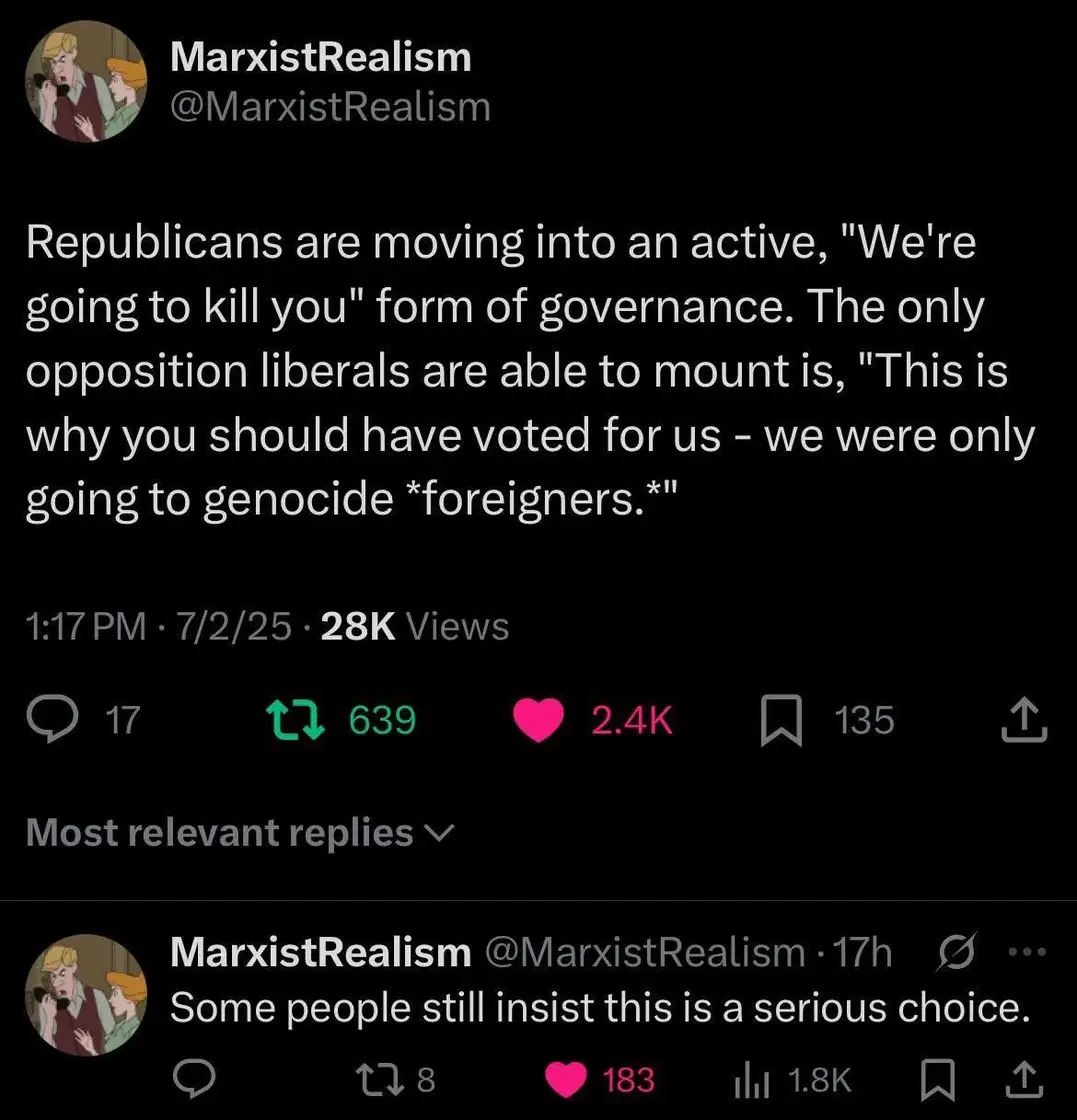
Okay, let's break down this tweet from the "MarxistRealism" account, contextualized through an Anti-Neoliberal lens, and leveraging relevant theoretical frameworks where applicable. It's a dense statement, so we’ll go section by section.
Understanding Anti-Neoliberalism
First, it's crucial to understand what "Anti-Neoliberalism" entails. It’s not simply "anti-liberal" in the traditional American sense. It's a critical stance against Neoliberalism as a specific historical and economic order. Neoliberalism, originating in the late 20th century, emphasizes:
- Deregulation: Reducing government intervention in the economy.
- Privatization: Transferring public assets to private ownership.
- Austerity: Reducing public spending.
- Globalization: Free trade and the movement of capital across borders.
- Individual Responsibility: Shifting focus away from collective welfare.
Anti-Neoliberals see this system as producing massive inequality, social disintegration, environmental destruction, and a weakening of democratic processes. They often advocate for a return to stronger state intervention, social welfare programs, and economic democracy. The framing of this tweet is deeply rooted in this critique.
Visual Description
The tweet features an avatar of a figure that appears to be a gender-bending aristocrat/courtier. This imagery is important, subtly invoking a sense of decadence, out-of-touch power, and possibly historical patterns of ruling class behavior. The account name, “MarxistRealism,” suggests a deliberate attempt to ground Marxist theory in tangible, observable political realities. This isn’t abstract theorizing; it’s about what’s happening now.
Marxist Conflict Theory
This is the primary lens through which to understand this tweet.
- Class Struggle: The core idea here is that the statement depicts a heightened stage of class conflict. “Republicans” are presented not as simply a political party but as a ruling class faction enacting a violently oppressive program. The “we're going to kill you” isn’t a literal threat in every instance, but a metaphor for the destructive effects of neoliberal policies (decarceration, wealth stripping, the denial of healthcare) on the working class, marginalized groups, and the poor.
- State as an Instrument of Class Rule: The statement implies the state apparatus (represented by "Republicans") is being used to actively suppress and eliminate perceived threats to the existing power structure.
- False Consciousness: The tweet’s sarcastic retort – “This is why you should have voted for us – we were only going to genocide foreigners” – attacks the idea that electoral politics within the current system can offer meaningful change. It suggests that even the “lesser evil” (the implied "us" – liberals) ultimately serves the interests of the ruling class, only masking their exploitative and genocidal tendencies. The use of "foreigners" is a subtle accusation of internal colonialism, suggesting the dispossession and elimination of marginalized people within the nation-state.
- Revolutionary Imperative: The underlying message is that appealing to the current political system is futile. The situation has reached a point where a fundamental transformation of the existing order is required.
Foucauldian Genealogical Discourse Analysis
While not the dominant lens, Foucault’s work is relevant.
- Power/Knowledge: The tweet highlights how power operates through discourse. The "we're going to kill you" statement isn't just a threat; it's a normalization of violence and domination. The discourse creates a reality where such brutality is considered acceptable or even inevitable.
- Biopower: The reference to "genocide" touches upon Foucault’s concept of biopower—the ways in which modern states regulate and control life. Neoliberal policies are framed as mechanisms of biopower that determine who lives and who dies, who thrives and who is left to perish.
- Genealogy: A Foucauldian approach would seek to trace the historical lineage of these power relations – how the current situation arose from specific historical forces and discourses. For an Anti-Neoliberal, this would mean examining the rise of neoliberalism and its effects on the state, the economy, and social life.
Critical Theory
Critical Theory (drawing from the Frankfurt School) provides another layer of understanding.
- Critique of Instrumental Reason: The tweet critiques the cold, calculated logic of power that prioritizes efficiency and control over human values. The "we're going to kill you" phrasing highlights the dehumanization inherent in this logic.
- Culture Industry: Critical theorists argue that the "culture industry" (mass media, entertainment, etc.) serves to pacify and control the population. The sarcastic tone of the tweet is a rejection of the complacency fostered by mainstream media and political narratives.
- Domination: The tweet expresses a concern with the systemic nature of domination – how power operates through all aspects of social life, shaping individuals’ beliefs, values, and behaviors.
Postmodernism
Postmodernism is less directly applicable, but relevant in how it challenges grand narratives.
- Rejection of Meta-Narratives: The tweet implicitly rejects the idea that there is a single, overarching narrative that explains the world. It suggests that the prevailing narratives of liberal democracy and progress are masking a much darker reality.
- Deconstruction: One could read the tweet as a deconstruction of the rhetoric of political legitimacy. It exposes the violence and contradiction inherent in the claims of power.
- Simulation/Hyperreality: The “serious choice” follow-up tweet might be interpreted as a comment on the simulated nature of political choices, implying that the options presented are ultimately superficial and disconnected from material realities.
Queer Feminist Intersectional Analysis
This could be relevant, though it requires interpretation.
- Intersectionality: The phrase “foreigners” is a broad category that can encompass various marginalized groups, including racialized minorities, immigrants, and LGBTQ+ individuals. An intersectional analysis would emphasize how these groups experience overlapping forms of oppression.
- State Violence: The threat of "genocide" is particularly salient for groups historically targeted by state violence. Queer and feminist scholars have long documented how the state uses its power to control and punish those who deviate from dominant norms.
- Deconstruction of Normativity: The tweet’s critique of the existing power structure can be seen as a challenge to the norms and values that uphold systemic inequality.
In Conclusion
The tweet from "MarxistRealism" is a stark and provocative statement. From an Anti-Neoliberal perspective, it’s a diagnosis of the current political moment as a dangerous escalation of class warfare, where the ruling class is openly deploying violence and domination to maintain its power. It's a rejection of the illusion of choice within the existing political system and an implied call for radical transformation. The layers of theoretical understanding help unpack its message.
simple-description (llama3.2-vision_11b)
The meme is a screenshot of a Twitter post from the account @MarxistRealism, which is a satirical account that critiques neoliberalism. The post reads: "Republicans are moving into an active, 'We're going to kill you' form of governance. The only opposition liberals are able to mount is, 'This is why you should have voted for us - we were only going to genocide foreigners.'" This post is a commentary on the current political climate and the rise of far-right ideologies.
detailed-analysis (gemma3-27b-vision)
Okay, let's break down this Twitter post through the lenses you've requested. It's a strongly worded statement, so there's a lot to unpack.
1. Visual Description
The image is a screenshot of a Twitter post from the account "@MarxistRealism." The account avatar features a stylized illustration of a man in clothing reminiscent of 19th/early 20th century revolutionary art (think Russian constructivism or early socialist realism). The colors are primarily red, black, and white. This immediately signals a commitment to leftist ideology. The post itself is text-based, presenting a claim about the behavior of Republicans and an implied justification for a prior political action by "liberals." Below the initial post is a reply from the same account, furthering the idea of a dire choice. There are numerical indicators showing engagement: views, replies, retweets, likes, and bookmarks.
2. Foucauldian Genealogical Discourse Analysis
Foucault’s work is about the relationship between power, knowledge, and discourse. This post is a prime example of how discourse constructs reality and exerts power.
- Power/Knowledge: The post asserts a claim about the intention of Republicans ("We're going to kill you") which is a powerful statement framing them as actively malevolent. It defines their actions as genocidal. This doesn't necessarily reflect objective reality, but instead constructs a narrative that justifies the actions of "liberals." The post leverages a specific discourse of threat and danger to establish a specific understanding of the political landscape.
- Genealogy: A genealogical analysis would ask: What historical conditions allow this type of claim to emerge? The claim evokes a deep-seated fear of political violence and genocide. Tracing the genealogy of this fear would reveal a history of state violence, colonialism, and oppression that informs the present-day political rhetoric. It's a narrative drawing on historical and symbolic power.
- Disciplinary Power: While not a direct example of disciplinary power (like prisons or schools), the post exerts power by attempting to normalize a specific interpretation of events. It aims to shape public opinion and create a sense of urgency. It suggests a binary "us vs. them", and sets the terms for what qualifies as legitimate political action.
3. Critical Theory
Critical Theory, stemming from the Frankfurt School, is concerned with uncovering power structures and challenging dominant ideologies. This post aligns with several aspects of Critical Theory:
- Critique of Ideology: The post is an explicit critique of the perceived ideology of Republicans. It presents a negative characterization of their actions as inherently violent and genocidal. It frames Republican ideology as being a threat to human life.
- Domination & Emancipation: The post implies that "liberals" represent a force for emancipation—defending against the oppressive "genocidal" tendencies of Republicans. This sets up a power dynamic, framing the political struggle as a battle between liberation and oppression.
- Reason & Enlightenment: While seemingly a radical statement, the post subtly appeals to Enlightenment ideals of reason and justice—arguing that the actions of Republicans are irrational and unjust. This is juxtaposed with the supposed moral high ground of the "liberals."
4. Marxist Conflict Theory
This post is very explicitly framed within a conflict theory lens:
- Class Struggle: While the post doesn't explicitly reference class, the underlying assumption is that there is a fundamental conflict between opposing political groups (in this case, Republicans and "liberals"). This conflict is presented as inherently antagonistic, with one side actively seeking to harm the other.
- Dominant & Subordinate Groups: The post implicitly positions Republicans as the dominant group (in terms of power and agency) seeking to oppress the "liberals," and frames this as a genocidal act. The "liberals" are presented as the oppressed group defending against this aggression.
- Revolution/Resistance: The post can be interpreted as a call for resistance against perceived oppression. By framing Republican actions as genocidal, it justifies the actions of "liberals" as a necessary defense against existential threat.
5. Postmodernism
Postmodernism challenges grand narratives and universal truths. The post, while appearing to make a definitive claim, can be analyzed through a postmodern lens:
- Deconstruction of Truth: The claim of "genocide" is an extreme one, and it's arguably a deconstruction of the conventional understanding of political discourse. It challenges the notion of a neutral or objective account of events.
- Relativism of Knowledge: The post implies that knowledge is always situated and partial. The claim isn't presented as a factual truth, but as an interpretation informed by a specific ideological perspective.
- Meta-narratives: The post actively invokes a "meta-narrative" of oppression and liberation, which is a hallmark of ideological discourse.
6. Queer Feminist Intersectional Analysis
This is perhaps the most challenging lens to apply directly to this post, as it doesn't explicitly address issues of gender, sexuality, or intersectionality. However, a queer feminist intersectional analysis can reveal some subtle dynamics:
- Vulnerability & Marginalization: The post frames "liberals" as vulnerable to the violence of Republicans. This can be linked to the broader feminist concern with the vulnerability of marginalized groups.
- Power Dynamics: The post highlights the power dynamics between opposing groups, which is a central theme in queer feminist theory.
- Critique of Oppression: The post implicitly critiques the systemic oppression of "liberals" by Republicans. This can be seen as aligning with the broader feminist goal of challenging all forms of oppression.
Important Considerations
It's crucial to note that this post is highly charged and potentially inflammatory. While it can be analyzed through various theoretical lenses, this analysis doesn't endorse its claims or diminish the potential harm it could cause. The post functions as a powerful statement, designed to elicit a strong emotional and political response. It's a prime example of how ideology shapes our understanding of the world, and how discourse can be used to exert power.
I hope this detailed breakdown is helpful! Let me know if you'd like me to elaborate on any particular aspect.
simple-description (llama3.2-vision)
The meme is a tweet from @MarxistRealism that ironically comments on the lack of action from Republicans. It says, "Republicans are moving into an active, 'We're going to kill you' form of governance. The only oppositional liberals are able to mount is, 'This is why you should have voted for us - we were only going to genocide foreigners.'" The tweet is meant to be satirical, making a commentary on how people can be so easily convinced to accept what is happening to them. The final line, "Some people still insist this is a serious choice," is meant to be a commentary on how people can be so easily swayed by others. The tone of the tweet is meant to be satirical, making a commentary on how people can be so easily convinced to accept what is happening to them.