First Seen
2025-07-03T18:22:32+00:00
detailed-analysis (gemma3_27b-it-q8_0)
Okay, let's break down this meme through an anti-neoliberal lens, using the headings you provided. This is a rich image for such an analysis!
Visual Description
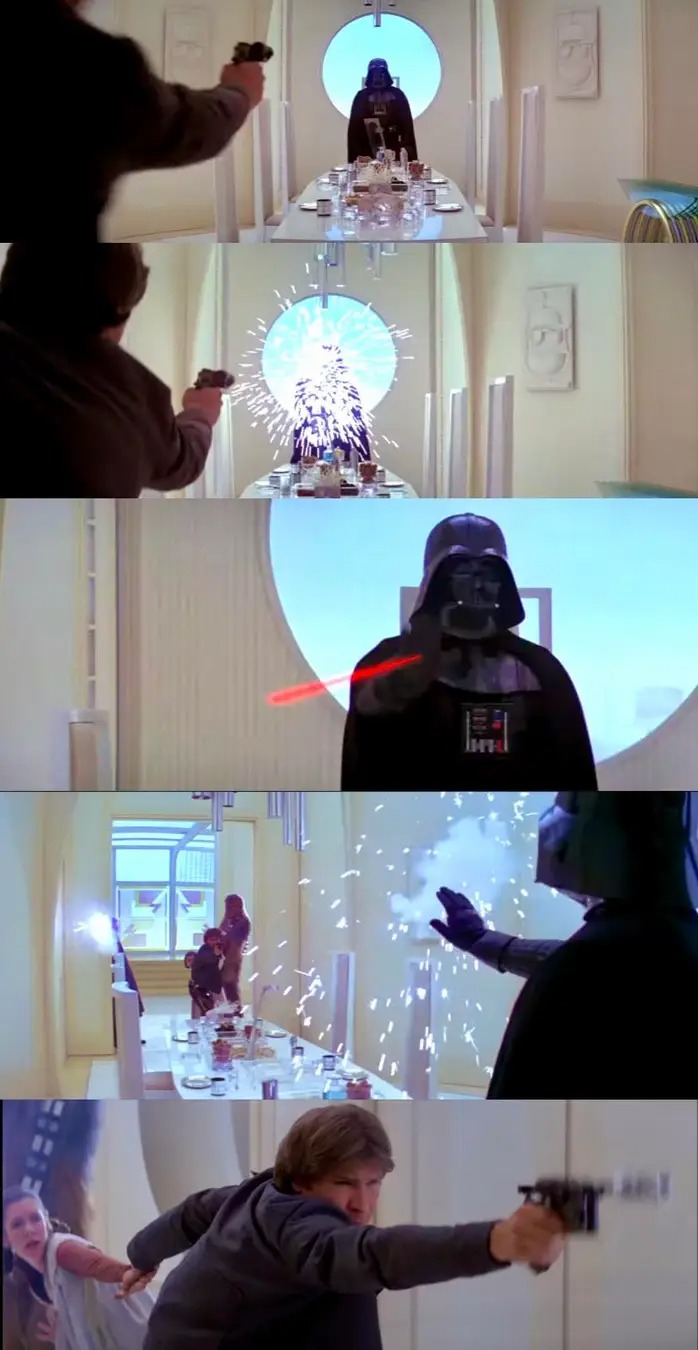
The meme uses a sequence of stills from Star Wars: A New Hope. It depicts Luke Skywalker, a young and somewhat naive protagonist, attempting to confront Darth Vader. The sequence shows:
- Luke, with a blaster, approaching Darth Vader from behind while Vader is seated at a sterile, luxurious dining table. The table is laden with food, representing excess.
- Luke raising his blaster.
- Darth Vader spinning around, igniting his lightsaber, and blocking the attack.
- A further shot showing the resulting clash, with furniture and objects from the table being destroyed.
- A final shot of Luke, with a look of determination, continuing his attack.
The sterile, bright setting and the opulence of the table contribute to a sense of artificiality and detachment. Vader's imposing figure and dark attire reinforce his association with power and control.
Foucauldian Genealogical Discourse Analysis
From a Foucauldian perspective, the meme speaks to the normalization of power structures. Darth Vader represents the established, disciplinary power of the Empire—a power that is not simply brute force, but a pervasive system that shapes behavior and dictates reality. The opulent dining table is symbolic of the Empire’s control of resources and the construction of a particular “truth” around prosperity and order.
Luke's initial act of shooting from behind can be read as a challenge to this power, but it's a clumsy, inarticulate one. It’s a gesture that attempts to disrupt the established discourse but hasn't yet formulated a coherent alternative. It's a "rebellion" that is still operating within the framework of the power it’s trying to overthrow.
The subsequent clash isn’t just a physical fight; it’s a clash of discourses. Vader, representing the established order, actively creates and defends his truth through the exercise of power (the lightsaber). The breaking of the table and scattering of items signify the disintegration of the Empire's fabricated order when challenged.
Critical Theory
This meme is potent when viewed through a Critical Theory lens, particularly concerning the concepts of “culture industry” and “false consciousness.” The Empire’s opulent dining scene is representative of the “culture industry” at work, a constructed spectacle designed to obscure the real relations of domination. It's a display of manufactured consent and a distraction from the actual exploitation occurring elsewhere in the galaxy.
Luke, initially, is a product of this system (raised on Tatooine, somewhat disconnected from the larger political reality). His action, while seemingly rebellious, stems from a feeling of injustice, not from a deeply developed understanding of the structural issues at play. He's a representative of potential liberation, but still bound by the limitations of his upbringing.
The meme critiques the idea of individual heroic action as the sole path to liberation. It suggests that dismantling the system requires more than just a direct, reactive assault. It demands a fundamental challenge to the underlying ideology that sustains it.
Marxist Conflict Theory
From a Marxist perspective, the meme powerfully visualizes class conflict. Darth Vader embodies the ruling class, comfortably enjoying the fruits of exploitation while Luke represents a nascent revolutionary class. The dining table symbolizes the material wealth accumulated through the labor of others.
Luke’s action is an attempt to disrupt the material conditions of the dominant class – to challenge their control over resources and to expose the inequalities inherent in the system. The destruction of the table isn’t merely a physical act; it represents the potential for a fundamental restructuring of society.
The lightsaber duel is, therefore, a metaphorical representation of the class struggle. It’s a direct confrontation between those who benefit from the existing order and those who seek to overturn it. The image’s resonance lies in its depiction of the inherent violence within a system built on exploitation.
Anti-Neoliberal Interpretation – Synthesizing the Above
Within the context of anti-neoliberalism, the meme is particularly insightful. Neoliberalism, as a modern form of capitalism, relies on constructing a particular narrative of prosperity, individual responsibility, and the free market. The Empire and its dining table are a perfect metaphor for this. It's a simulation of wealth and order that masks systemic oppression and exploitation.
Luke's clumsy, reactive attack represents the kinds of resistance that often emerge against neoliberal structures – protests, disruptions, individual acts of defiance. These are important, but often insufficient on their own. They need to be informed by a deeper understanding of the systemic issues at play.
The meme suggests that the goal isn’t simply to “take down” individuals like Darth Vader (the symbolic representation of CEOs, politicians, or other figures of power). It’s to dismantle the entire system that allows them to thrive—the neoliberal order itself. The destruction of the table, therefore, symbolizes the necessary destruction of the ideological and material foundations of that order. It’s a call for radical restructuring, not just superficial reform.
The meme’s popularity in anti-neoliberal spaces speaks to its ability to encapsulate this critique in a visually compelling and culturally resonant way. It illustrates the need to move beyond individual blame and focus on dismantling the structures of power that perpetuate inequality and exploitation.
Let me know if you'd like me to elaborate on any of these points or explore other interpretations!
simple-description (llama3.2-vision_11b)
The meme is a screenshot from the movie "Star Wars: A New Hope" where Darth Vader is about to shoot a group of rebels, but his blaster is jammed. The meme is captioned "When you're trying to make a point but your neoliberalism is just stuck in the way." The image is a humorous take on the idea that sometimes our words and actions can be stuck in a way that prevents us from making progress.
detailed-analysis (gemma3-27b-vision)
Okay, let's break down these Star Wars: The Empire Strikes Back stills, approaching them through various theoretical lenses as requested. Given the imagery, some of these analyses will be more fruitful than others.
Visual Description
These stills capture a pivotal moment in the climactic duel between Luke Skywalker and Darth Vader in The Empire Strikes Back. The setting is a spacious, sterile, white-walled chamber in Cloud City, part of the Bespin gas mining operation.
- Composition: The images are sequenced to reveal the dramatic turning point of the duel. We see Luke initially positioned in the background, taking aim. Then the focus shifts, revealing Darth Vader standing amidst a table filled with various technological devices. The table is disrupted by a blast, and finally, a close-up of Luke preparing to attack.
- Color & Light: The predominant color is white, highlighting the stark, clinical atmosphere of the scene. The contrast with Vader’s dark, imposing figure emphasizes his menacing presence. Red light saber clashes are dramatic focal points.
- Symbolism: The arrangement of technological devices on the table suggests a space of power, control, and possibly manipulation. The white setting contrasts with the darkness of Vader and hints at a sterile, dehumanizing force. The shattered devices emphasize the impact of the conflict and the disruption of order.
Foucauldian Genealogical Discourse Analysis
This scene is extremely ripe for a Foucauldian reading. Foucault's work on power, knowledge, and discourse is exceptionally relevant.
- Discipline & Panopticism: Cloud City itself can be viewed as a panoptic space. The vast, open chamber, seemingly observed from multiple points, enforces a form of disciplinary power. The white setting contributes to the feeling of being monitored, scrutinized, and controlled.
- Power/Knowledge: Vader embodies power/knowledge. He holds the "knowledge" of the Force, of combat, of Luke’s lineage. This knowledge is power, and it is enacted through his physical and technological dominance. The devices on the table are tools that solidify and project his power.
- Genealogy of "The Jedi": The revelation of Vader's identity as Luke's father disrupts the discourse around "The Jedi." Suddenly, the lineage and historical narrative are thrown into question. Vader doesn’t simply defeat Luke; he re-writes the narrative of the Jedi order, presenting a corrupted and fallen version. The conflict isn’t just about good vs. evil, but about competing narratives of truth and power.
- Biopower: Vader's attempt to bring Luke over to the dark side can be understood through the lens of biopower. He is trying to control Luke's life, to shape his will and identity, to integrate him into the system of the Empire. He doesn’t simply want to kill Luke; he wants to transform him into a tool of the Empire.
Critical Theory
This scene exemplifies key themes within Critical Theory, specifically around ideology, domination, and alienation.
- Ideology & False Consciousness: The Empire's power rests on an ideology of order, control, and dominance. Vader is the embodiment of this ideology. Luke, initially fighting for a "rebel alliance" rooted in freedom, is confronted with the uncomfortable truth that there’s more to the power structures than he realizes. Vader’s attempt to convert Luke represents the attempt to instill a different ideology and, thus, enforce compliance.
- Domination & The Other: Vader represents a dominant force, seeking to subjugate Luke. Luke, as the "other," is presented as a threat to the Empire’s established order. The duel is an enactment of the struggle between these forces. The revelation of their familial connection complicates this struggle, adding a layer of psychological and emotional complexity.
- Alienation: The sterile environment of Cloud City, the coldness of Vader, and the disruptive nature of the conflict all contribute to a sense of alienation. Luke is alienated from his past, his identity, and his ideals. The scene depicts the isolating and dehumanizing effects of power.
Marxist Conflict Theory
This scene can be interpreted as a microcosm of class struggle.
- Bourgeoisie vs. Proletariat: The Empire represents the ruling class (bourgeoisie) with vast wealth, technological superiority, and control over resources. The Rebel Alliance, while not a perfect analogy, can be seen as the proletariat, fighting for liberation and equality.
- Means of Production & Control: The technological devices on the table represent the “means of production.” The Empire controls these resources, enabling it to maintain its power and suppress dissent.
- False Consciousness (Again): Vader’s attempt to bring Luke over to the dark side is an attempt to indoctrinate him into the ruling class’s ideology, to make him complicit in the system of domination.
- Revolutionary Potential: Luke represents the potential for revolutionary change, but he is also vulnerable to the forces of oppression.
Postmodernism
While somewhat less central than the previous analyses, postmodern themes can be identified.
- Deconstruction of Narrative: The revelation of Vader’s identity radically deconstructs the traditional hero’s journey narrative. The clear-cut distinction between good and evil is blurred.
- Simulacra & Simulation: The pristine, artificial environment of Cloud City could be seen as a "simulacrum" - a copy without an original. It represents a world increasingly detached from reality.
- Questioning of Grand Narratives: The scene challenges the idea of a simple, linear historical narrative. It suggests that power and truth are always contested and contingent.
Queer Feminist Intersectional Analysis
This one is the most challenging to apply directly, but potential avenues for analysis exist.
- Patriarchal Power Structures: The Empire, as a hierarchical and militaristic organization, embodies patriarchal power structures. Vader's imposing and dominant presence reinforces this dynamic.
- Masculinity & Violence: The duel itself is a performance of hypermasculinity and violence. The expectation of a male warrior’s aggression permeates the scene.
- Lineage and Reproduction: The revelation of their father-son connection brings a focus on lineage and reproduction as tools for consolidating power. This has patriarchal implications, as power is passed down through male lines.
- The Disruption of Binary Oppositions: The revelation of the familial connection and Vader’s fall from grace complicate the binary opposition of "good" and "evil", undermining conventional definitions of hero and villain.
I hope this breakdown, organized by these various theoretical lenses, is helpful! Let me know if you'd like me to focus on any one of these analyses in greater detail.
simple-description (llama3.2-vision)
This meme is a still from the 1976 film "Star