First Seen
2025-12-29T02:51:35.014764+00:00
simple-description (qwen3.5_2b-q8_0)
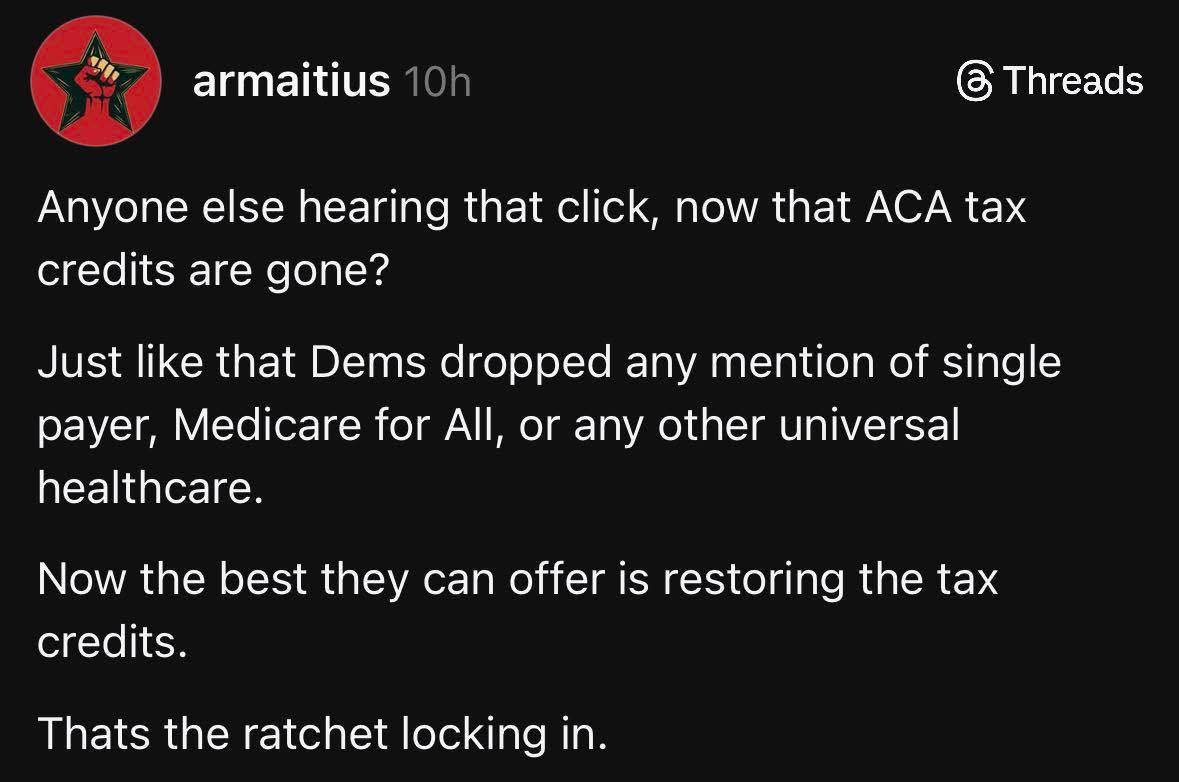
This meme frames the political shift as a calculated trap where Democrats removed the Affordable Care Act tax credit to secure future votes. It argues that they are trying to lock people into the current system by promising to restore these credits, effectively using "dependency" as a strategy while dismissing Universal Healthcare and Medicare for All as viable alternatives.
detailed-analysis (gemma3_27b-it-q8_0)
Okay, let's break down this meme from an Anti-Neoliberal perspective, using the requested theoretical frameworks where applicable.
Understanding the Anti-Neoliberal Lens
Before diving into the analysis, it's crucial to understand Anti-Neoliberalism. It's a broad political and economic worldview that critiques the dominant neoliberal order – characterized by deregulation, privatization, austerity, and the prioritization of market forces above all else. Anti-Neoliberals generally view these policies as leading to increased inequality, social fragmentation, and a decline in democratic accountability. They advocate for greater state intervention, social justice, and democratic control over the economy. They're deeply skeptical of mainstream political establishments (both liberal and conservative) and often favor radical systemic change.
Visual Description
The image is a screenshot from Threads, a text-based social media platform. It shows a post by a user named "armaitius" with a profile picture featuring a red star, often associated with socialist or communist ideologies. The background is dark, emphasizing the text. The style is simple, focusing solely on the written message and user identification, suggesting a direct, unfiltered communication characteristic of anti-establishment online discourse.
Marxist Conflict Theory
This meme is strongly rooted in Marxist Conflict Theory. Here's how:
- Class Struggle: The meme highlights a perceived betrayal by the Democratic Party, a group traditionally seen as representing (though imperfectly) the interests of working-class people. The "Democrats" are seen as aligning themselves with the interests of capital (i.e., insurance companies, healthcare industry profits) rather than addressing the fundamental material needs of the populace (access to healthcare).
- Ideology & False Consciousness: The "ACA tax credits" are presented not as a genuine solution but as a palliative – a band-aid fix that doesn’t address the root of the problem (a profit-driven healthcare system). This is an example of how ideology (the belief in market-based solutions) can create "false consciousness" – preventing people from recognizing their true class interests and fighting for systemic change.
- The Ratchet Effect (Key to the Meme): The phrase "the ratchet locking in" is the crux of the Marxist interpretation. A "ratchet" in this context refers to the idea that concessions made during struggle can be consolidated and become permanent, effectively reducing the possibility of further progress. The Democrats, by settling for restoring tax credits after once hinting at universal healthcare, are seen as locking in a system that's inferior to what could have been achieved. It’s a loss of leverage and a shift toward the right, even when framed as a “win.” The ratchet metaphor implies that the struggle for genuine healthcare is moving backward.
- Commodity Fetishism: The meme subtly speaks to a critique of commodity fetishism. Healthcare shouldn’t be a commodity to be accessed via tax credits or dependent on the market, but a right. The focus on individual subsidies reinforces the idea that healthcare is something that must be "purchased" rather than a universally available service.
Foucauldian Genealogical Discourse Analysis
While less directly than Marxist theory, a Foucauldian analysis can illuminate the meme:
- Power/Knowledge: The meme reveals a struggle over how we define healthcare. The dominant discourse – represented by the Democratic Party’s approach – constructs healthcare as something that can be mediated through markets, insurance, and tax incentives. This is a form of power/knowledge: the way healthcare is understood shapes the possible solutions and reinforces existing power relations.
- Genealogy of the "Healthcare Debate": A genealogical approach would trace the historical development of healthcare policy. It would reveal how the current system, with its emphasis on private insurance and market mechanisms, didn’t emerge naturally but was constructed through specific historical forces and power struggles. The meme implies a rejection of this constructed reality.
- Discipline and Normalization: Tax credits, while seemingly helpful, can be seen as a form of disciplinary power. They incentivize participation in the existing system, normalizing it and discouraging more radical alternatives.
Critical Theory
This meme resonates with Critical Theory’s focus on uncovering hidden power structures and challenging the status quo:
- Critique of Instrumental Reason: The focus on "restoring tax credits" embodies a type of "instrumental reason" – a pragmatic, problem-solving approach that fails to question the underlying assumptions of the system. Critical theorists would argue that this approach perpetuates the problems it seeks to solve.
- The Dialectic of Enlightenment: The meme implicitly critiques the idea that simply tweaking the system (e.g., restoring tax credits) will lead to progress. It suggests that the Enlightenment's faith in reason and progress has been corrupted by the forces of power and capital.
- Hegemony: The meme suggests that the Democrats have accepted a hegemonic worldview that prioritizes incrementalism and compromise over radical change. They have internalized the constraints of the existing system and are unable to envision a truly transformative alternative.
Postmodernism
Postmodern elements are weaker here, but present:
- Deconstruction: The meme subtly deconstructs the notion of "progress" within the Democratic Party. It exposes the gap between their rhetoric (single-payer, Medicare for All) and their actual policy choices.
- Rejection of Grand Narratives: The meme implicitly rejects the “grand narrative” of liberal reformism. It suggests that the idea of achieving social justice through incremental policy changes is a failed project.
Queer Feminist Intersectional Analysis
While not the primary focus, an intersectional lens adds depth:
- Access to Healthcare as a Matter of Justice: Healthcare is not merely a practical issue but a matter of social justice, especially for marginalized groups (people of color, LGBTQ+ individuals, disabled people) who face systemic barriers to care. The failure to pursue universal healthcare exacerbates these inequalities.
- Neoliberalism and Bodily Autonomy: The commodification of healthcare under neoliberalism can undermine bodily autonomy, as access to care becomes dependent on economic status. This disproportionately affects marginalized communities.
In Conclusion
This meme is a potent expression of Anti-Neoliberal frustration with the Democratic Party. It utilizes Marxist concepts (class struggle, the ratchet effect) to critique the party's perceived compromises and failures. It subtly incorporates Foucauldian and Critical Theory insights to challenge the dominant discourse on healthcare and expose the hidden power structures that perpetuate inequality. It is a call for radical systemic change, rejecting the incrementalism and pragmatism of mainstream politics. The meme’s resonance within the Anti-Neoliberal online community highlights a growing dissatisfaction with the current political landscape and a desire for more transformative solutions.
simple-description (llama3.2-vision_11b)
This meme is from the perspective of the Anti-Neoliberal category, which is critical of neoliberalism and its effects on society. The meme is likely responding to a recent event or news story about the US government's decision to drop the "Dems" (Democratic Party) mention of single payer, Medicare for All, or other universal healthcare. The meme is saying that the "Dems" are not providing any mention of single payer, Medicare for All, or other universal healthcare, and that they are instead providing something else.