First Seen
2026-03-03T19:06:20.331916+00:00
simple-description (qwen3.5_2b-q8_0)
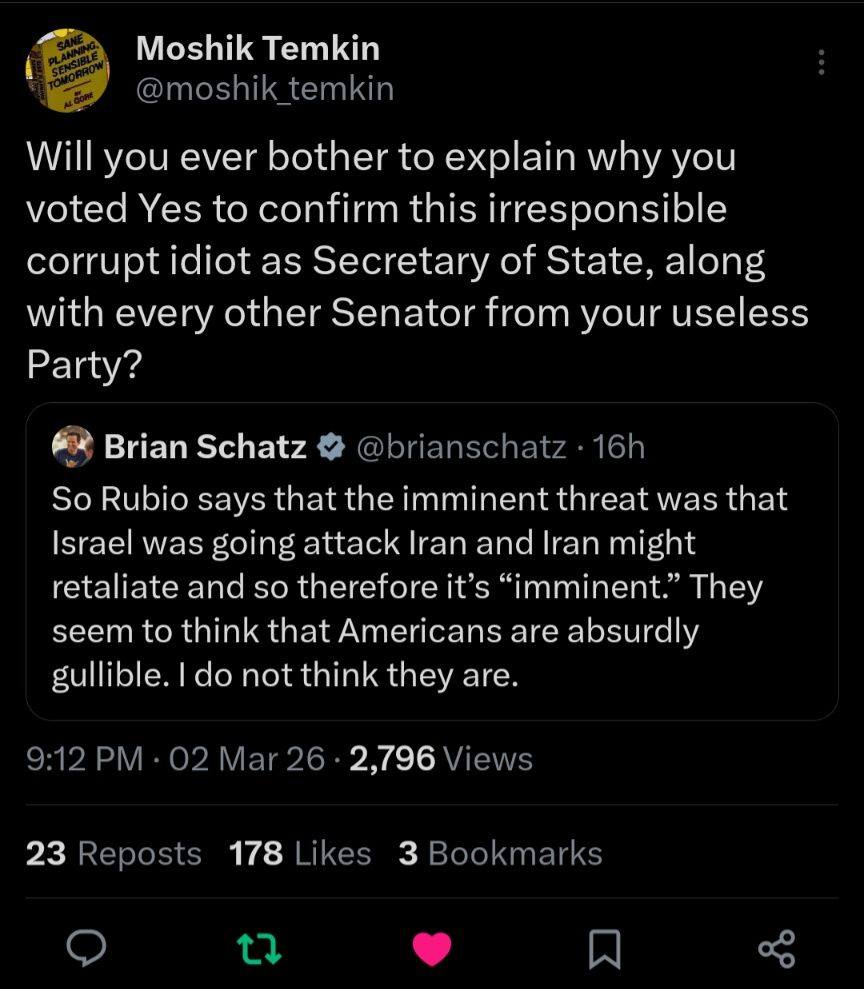
This meme critiques a political argument suggesting that US Foreign Policy is driven by economic coercion and domestic politics rather than strategic necessity. It highlights the claim that American "gullibility" toward authoritarian rivals like Iran is a calculated risk, arguing instead that ignoring these threats leads to catastrophic consequences for America.
detailed-analysis (gemma3_27b-it-q8_0)
Okay, let's break down this Twitter exchange from an Anti-Neoliberal perspective, drawing on relevant theoretical frameworks where applicable.
Overall Framing: An Anti-Neoliberal lens views this exchange as a critique of the established political order, specifically the prioritization of foreign policy interests (often linked to military interventionism and alliance politics like with Israel) over the needs of the domestic population. The anger and rhetorical force are aimed at challenging the legitimacy of the political class and their justifications for decisions made. It taps into distrust of "experts" and the narrative of constant manufactured crises.
1. Visual Description
The tweet consists of two text posts from different Twitter accounts, juxtaposed.
- Moshik Temkin's Post: Features a profile picture with a graphic stating “Cane, Planning Tomorrow.” The text is a direct, highly rhetorical question targeting unspecified “you,” likely referring to Senators, asking for justification for supporting a “corrupt idiot” as Secretary of State, and generally condemning their political party as "useless."
- Brian Schatz's Post: Displays a profile picture of a man, and text that expresses dismissive incredulity at the stated rationale—presented by Marco Rubio—for escalating tensions with Iran. It frames the public as “absurdly gullible.”
The visual element is minimal, relying primarily on the stark presentation of text and the implied authority conveyed by the profile pictures.
2. Foucauldian Genealogical Discourse Analysis
This exchange is a perfect example of a struggle over discourse. Foucault argued that power operates through discourse – systems of knowledge and language that shape how we understand the world.
- The Discourse of Exceptionalism & National Security: The exchange challenges the dominant discourse around national security. Marco Rubio's justification for potential escalation relies on a claim of "imminent threat," invoking a long-held discourse of exceptionalism—the idea that the US has a unique responsibility to intervene globally to maintain order. This discourse justifies interventions, large military budgets, and the curtailment of civil liberties.
- Moshik’s Counter-Discourse: Moshik Temkin’s response is a direct assault on the legitimacy of this discourse. Calling the Secretary of State an "idiot" and the party "useless" attempts to deconstruct the authority of political figures. The pointed language seeks to erode trust in the institutions that produce and disseminate the discourse of national security.
- Schatz's Discourse of Disbelief: Schatz further dismantles the threat narrative by highlighting its manipulative nature. Calling Americans “absurdly gullible” reframes the situation as one of deliberate deception rather than objective threat assessment.
- Genealogy of Crisis: A genealogical approach would examine how the concept of an “imminent threat” has historically been deployed to justify power grabs and policy changes. Anti-Neoliberals would trace this back to the Cold War and the permanent state of exception it created, seeing this pattern continuing today.
3. Critical Theory
This exchange reflects key themes within Critical Theory, particularly those related to ideology and the "culture industry."
- Ideology Critique: Critical theorists like Adorno and Horkheimer would argue that the "imminent threat" narrative is a form of ideology—a system of beliefs that masks the underlying power structures and serves to legitimize the status quo. This threat is presented as a natural and objective reality, but it's actually constructed to justify actions that benefit powerful interests (e.g., the military-industrial complex, arms manufacturers).
- Manufactured Consent: The exchange also taps into the idea of "manufactured consent" (Noam Chomsky & Edward Herman). The constant repetition of "imminent threats" through media and political rhetoric creates a climate of fear that encourages public support for policies that are not necessarily in their best interests.
- Critique of Rationalization: The way Rubio rationalizes escalating tensions – "Israel says so, Iran might retaliate, therefore it’s imminent"—is itself a target of critique. Critical Theory argues that the pursuit of “rational” justifications can often obscure ethical considerations and perpetuate oppressive systems.
4. Marxist Conflict Theory
From a Marxist perspective, this exchange exposes the inherent contradictions and conflicts within capitalism and its associated political system.
- Class Interests: Anti-Neoliberals often emphasize the ways in which foreign policy serves the interests of the ruling class—the capitalist elite who benefit from war, resource extraction, and political dominance. The exchange implies that escalating tensions with Iran are driven by these interests, not by genuine concern for national security or the well-being of the American people.
- Imperialism: The connection to Israel and Iran hints at a broader critique of U.S. imperialism and its role in maintaining global power structures. Anti-Neoliberals often see the U.S. as a declining hegemonic power desperately clinging to its influence through military intervention and geopolitical maneuvering.
- Alienation: The contempt expressed in the tweets reflects a sense of alienation from the political system. The feeling that politicians are out of touch, corrupt, and serving their own interests creates a sense of powerlessness and disengagement.
5. Postmodernism (Limited Application)
While Anti-Neoliberalism is distinct from Postmodernism, there’s some overlap in skepticism towards grand narratives.
- Deconstruction of Truth: Postmodern thought questions the possibility of objective truth. Schatz’s tweet implicitly suggests that the “truth” about the Iranian threat is not self-evident but is actively constructed through political manipulation.
- Rejection of Meta-Narratives: The critique of the national security discourse can be seen as a rejection of a meta-narrative – the overarching story that justifies U.S. foreign policy. Anti-Neoliberals reject the idea that the U.S. has a special responsibility to police the world.
In Conclusion:
From an Anti-Neoliberal viewpoint, this Twitter exchange is a potent critique of the establishment’s foreign policy, its reliance on manufactured crises, and its subservience to powerful interests. It’s a rejection of the dominant narratives, a demand for accountability, and a signal of growing distrust in the political class. It's a microcosm of a broader struggle against the perceived failures of neoliberal globalization and the associated political order.
simple-description (llama3.2-vision_11b)
The meme is a response to a tweet that asks if someone would ever explain why they voted for a certain person. The response is a sarcastic and humorous comment that implies the person is so
[...]
The text reads: "Will you ever bother to explain why you voted for this irresponsible corrupt idiot as Secretary of State, along with every other Senator from your useless party?"