First Seen
2025-09-23T19:54:17.185534+00:00
simple-description (qwen3.5_2b-q8_0)
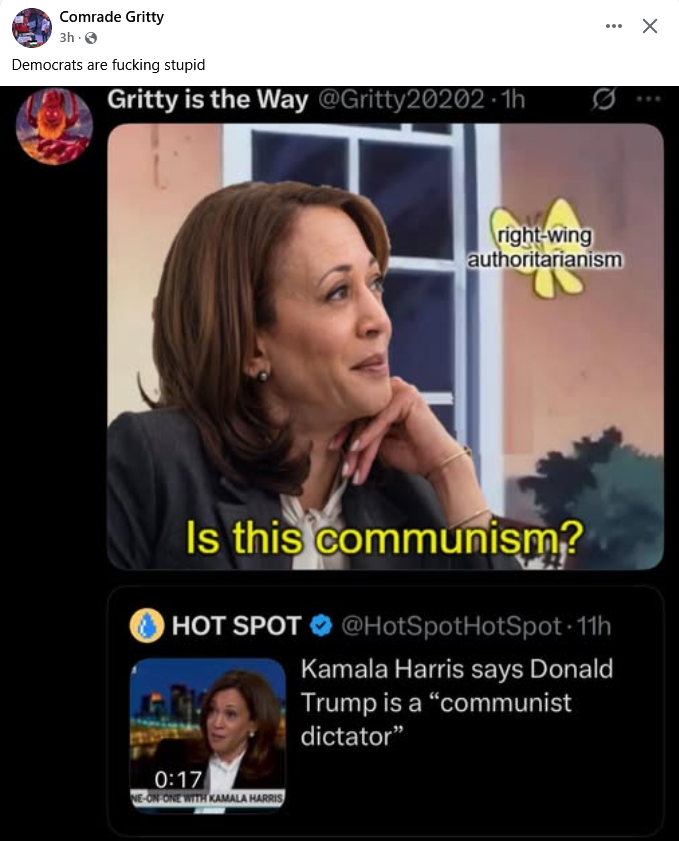
This satirical image mimics a popular meme template using Kamala Harris's statement that Trump was a "communist dictator." By overlaying the text "right-wing authoritarianism" with a yellow butterfly, it frames conservative claims of power as falling under the same negative category of communism. The joke implies that what political opponents call authoritarianism is, in reality, just the left-wing version they dislike.
detailed-analysis (gemma3_27b-it-q8_0)
Okay, let's break down this meme from an Anti-Neoliberal perspective, utilizing the requested theoretical frameworks where applicable.
Overall Framing: Anti-Neoliberal Critique
The overarching point of this meme, seen through an Anti-Neoliberal lens, is a scathing critique of the Democratic Party’s ideological flexibility and willingness to adopt rhetoric often associated with the right in order to maintain power. The "Anti-Neoliberal" position broadly rejects the mainstream, centrist, "third way" politics favored by modern Democrats and views them as fundamentally complicit in upholding a system of globalized capitalism that harms working people and social justice causes. The meme suggests the Democrats are so disconnected from reality and so obsessed with opposing anything associated with the right that they’ll happily call anything they dislike “communist” – even if it demonstrably isn't. It mocks the empty signifiers and political posturing that define the current discourse.
1. Visual Description
The meme features a still image of Kamala Harris with a visibly skeptical and somewhat distressed expression. The text superimposed reads "Is this communism?". Above her head, in a bubble, is the label "right-wing authoritarianism". Below the image, it refers to a clip of Harris calling Donald Trump a "communist dictator." This juxtaposition is key. The visual composition aims to create cognitive dissonance, highlighting the absurdity of the claim.
2. Foucauldian Genealogical Discourse Analysis
A Foucauldian approach allows us to analyze how the terms "communism" and "authoritarianism" are used to construct power relations.
- Discourse and Power: The meme points to how the term "communism" isn't used to describe a specific political-economic system. Instead, it’s a floating signifier – a term stripped of its original meaning and used as a tool to demonize political opponents. This demonstrates how discourse is not neutral but is deeply intertwined with power. The Democratic party uses “communism” as a way to establish and reinforce a boundary between "us" (good, democratic) and "them" (bad, totalitarian).
- Genealogy: A genealogical investigation would trace the historical use of “communism” and “authoritarianism” in American political discourse. This would reveal how these terms have been deployed during the Cold War and beyond as a means of discrediting left-leaning movements and justifying interventionist foreign policy. The meme implies this history continues to shape current political rhetoric.
- The Production of Truth: The meme questions the "truth" produced by this discourse. By pointing out the contradiction (Harris calling Trump, a right-wing figure, a “communist dictator”), it destabilizes the claim that the Democrats are making, undermining their authority.
3. Critical Theory
From a Critical Theory perspective, the meme is a critique of the “culture industry” and the way it manufactures consent.
- False Consciousness: The meme suggests that the Democratic party contributes to a "false consciousness" by obscuring the underlying structures of power and preventing people from recognizing their true interests. By focusing on superficial ideological differences ("communism" vs. "authoritarianism") it distracts from the common ground between the two parties in upholding the existing capitalist system.
- Hegemony: The meme implicitly challenges the hegemonic narrative presented by mainstream media and political institutions. It seeks to disrupt the dominant ideology and open space for alternative ways of understanding the world.
- Instrumental Reason: The meme critiques the instrumentalization of language for political gain. The use of "communism" as a scare tactic is not about genuine ideological concerns; it is a tool to achieve a specific political outcome.
4. Marxist Conflict Theory
The meme can be interpreted through a Marxist lens as highlighting the class interests that underpin political rhetoric.
- Class Struggle: While "communism" and "authoritarianism" are presented as opposing ideologies, both, from a Marxist perspective, represent systems of class power. The Democrats’ framing ignores the fundamental underlying class struggle, focusing instead on superficial differences within the ruling class.
- Ideology as False Consciousness: The meme demonstrates how ideology can obscure class realities. The invocation of "communism" serves to deflect attention from the true sources of exploitation and inequality.
- The Role of the State: The meme subtly critiques the role of the state in maintaining capitalist power. Both Democrats and Republicans are seen as ultimately serving the interests of capital.
5. Postmodernism
A postmodern reading focuses on the instability of meaning and the deconstruction of grand narratives.
- Deconstruction: The meme deconstructs the binary opposition between "communism" and "authoritarianism", revealing their inherent instability and interdependence. By showing how they can be applied to the same figure (Trump), it challenges the very logic of these categories.
- Simulation and Simulacra: The meme suggests that political discourse has become a simulation, where signifiers are detached from any real referent. "Communism" is merely a simulacrum—a copy without an original—used to manipulate public opinion.
- The Death of the Author: The meme’s effect relies less on Kamala Harris’s intent and more on the meaning created through the juxtaposition and framing in the meme itself.
In conclusion, this meme is a highly charged critique of the Democratic Party from an Anti-Neoliberal standpoint, employing various theoretical tools to expose what it sees as the party’s intellectual dishonesty, complicity in the capitalist system, and manipulative use of language. It functions as a form of political commentary and resistance.
simple-description (llama3.2-vision_11b)
The meme is a screenshot of a news clip featuring Kamala Harris, with a caption "Is this communism?" overlaid on top. The image is a satirical commentary on the perceived left-wing leanings of the Democratic Party, implying that the party's policies are more aligned with communist ideology.