First Seen
2025-07-07T03:30:41.345641+00:00
detailed-analysis (gemma3_27b-it-q8_0)
Okay, let's break down this meme through the lens of an "Anti-Neoliberal" framework. This is a complex political position, so I will try to be as thorough as possible.
Understanding the Anti-Neoliberal Perspective
Before diving into the analysis, it’s crucial to understand what "Anti-Neoliberalism" broadly entails. It's a critique of the neoliberal political-economic system that has dominated much of the late 20th and early 21st centuries. Key tenets of this critique include:
- Opposition to Deregulation: Neoliberalism promotes minimal state intervention in the economy. Anti-Neoliberals argue this leads to instability, exploitation, and increased inequality.
- Critique of Austerity: Cutting social programs to reduce government debt is a hallmark of neoliberal policy. Anti-Neoliberals see this as harming the most vulnerable in society.
- Rejection of Free Market Fundamentalism: The belief that the free market is the best solution to all problems is questioned. Anti-Neoliberals point to market failures, monopolies, and the prioritization of profit over people.
- Emphasis on Social Justice & Equity: Anti-Neoliberals often advocate for policies that redistribute wealth and power, and that prioritize social needs over economic growth.
- Skepticism towards Globalisation: Criticism towards the free flow of capital, labour and trade.
With this in mind, let’s analyze the meme.
Visual Description
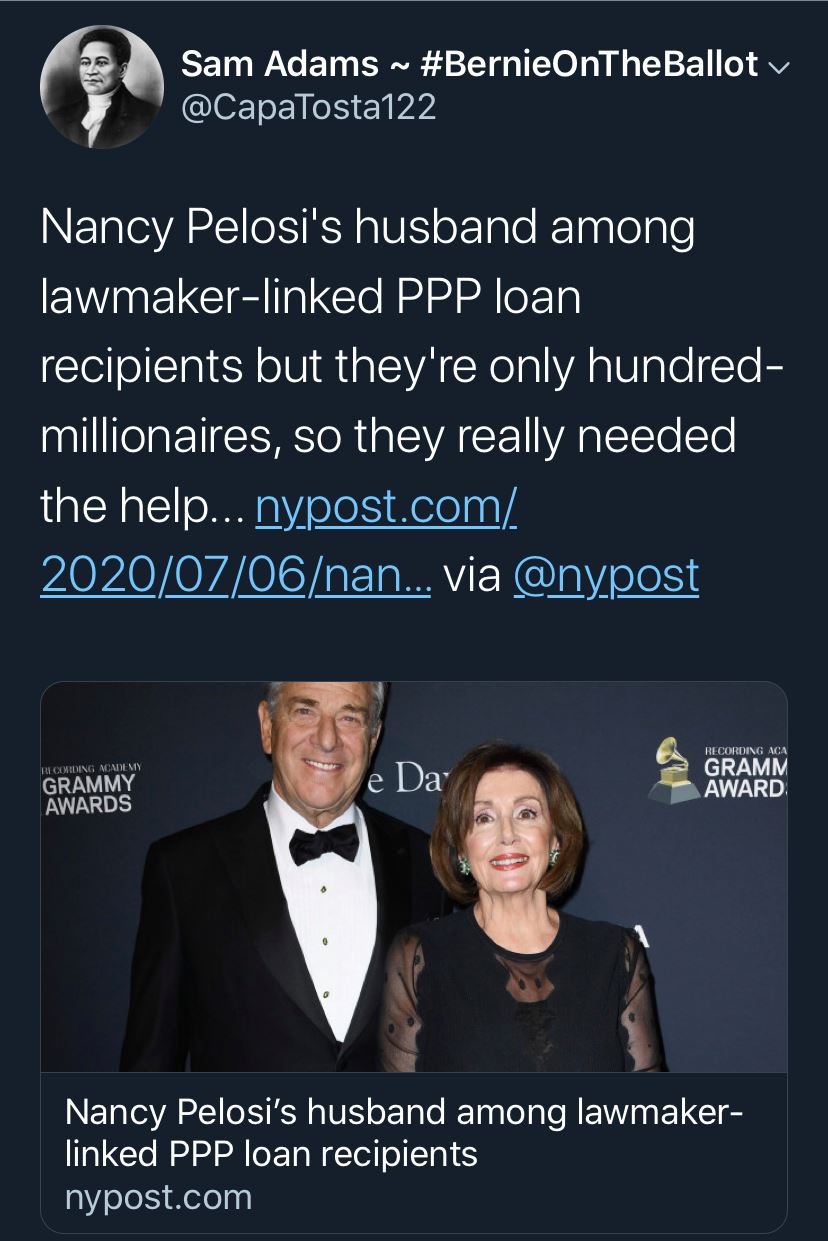
The image depicts Nancy Pelosi, Speaker of the House, and her husband, Paul Pelosi, in formal attire at a gala event (the Grammy Awards). They are both smiling and presented in a way that exudes wealth and status. The background is filled with branding related to the awards, further signifying a world of privilege and celebrity. The text accompanying the image highlights that Mr. Pelosi was among the recipients of Paycheck Protection Program (PPP) loans, despite being a multi-millionaire.
Marxist Conflict Theory
This is highly relevant to an Anti-Neoliberal analysis. The meme exposes the inherent contradictions within a capitalist system, and the way power operates within it.
- Class Warfare: The core of Marxist theory revolves around the struggle between classes – the bourgeoisie (the wealthy owners of capital) and the proletariat (the working class). The meme illustrates the bourgeoisie (in this case, the Pelosis) benefitting from policies supposedly designed to help the proletariat. The PPP loans were created to aid small businesses and keep people employed during the COVID-19 pandemic. By having millionaires access these funds, it's framed as capital being siphoned off from where it was desperately needed, and instead enriching those who already possess it.
- Exploitation & Accumulation: The meme implicitly critiques the system that allows for such accumulation of wealth in the hands of a few, while simultaneously failing to adequately support those in need. It suggests the system is rigged to benefit the ruling class.
- False Consciousness: This meme aims to break through what Marx termed "false consciousness" – the ideological framework that leads people to accept their exploitation. By highlighting the absurdity of a millionaire receiving pandemic relief, it attempts to awaken people to the systemic injustices at play.
Foucauldian Genealogical Discourse Analysis
This framework can help understand how power operates in shaping the narrative around this event.
- Discourse & Power: Foucault argues that power isn't simply repressive, but also productive. It operates through discourses – systems of thought, language, and practice – that shape our understanding of the world. The narrative surrounding the PPP loans could have been one of widespread, equitable relief. However, the meme reveals a discourse of privilege and cronyism.
- Genealogy: A genealogical analysis would trace the historical development of the concepts related to this issue: "small business," "economic relief," "fairness." It would expose how these terms have been redefined and used to justify specific power relations. The idea of a "small business" being eligible for PPP loans becomes distorted when a multi-millionaire is revealed to be benefiting.
- Governmentality: This refers to the way modern states govern through techniques that aim to shape the conduct of individuals and populations. The PPP loan program is a clear example of governmentality, attempting to influence economic behaviour. However, the meme argues that this power is being misused and instead serves the interests of the elite.
Critical Theory
Critical Theory, stemming from the Frankfurt School, seeks to critique and transform society as a whole.
- Critique of Instrumental Reason: Critical Theorists argue that modern society is dominated by "instrumental reason" – a focus on efficiency and rationality without consideration for ethical or humanistic values. The meme critiques the rationality of the system. It isn't logically sound to give financial aid to those who do not need it, but the system prioritises a certain kind of ‘efficiency’ (easy distribution of funds, perhaps) over justice.
- The Culture Industry: The inclusion of the image from a celebrity event (the Grammys) is significant. Critical Theory often discusses the "culture industry" – the ways in which culture is commodified and used to distract and control the masses. The Pelosis' presence at a glamorous event juxtaposed with the PPP loan issue exposes the disconnect between the elite and the everyday struggles of ordinary people.
- Dominant Ideology: The meme contests the dominant ideology that frames politicians as public servants. Instead, it paints a picture of an entrenched elite class exploiting systems for personal gain.
Postmodernism
While Anti-Neoliberalism isn’t inherently postmodern, there are points of intersection.
- Deconstruction: Postmodernism emphasizes deconstructing established narratives. The meme deconstructs the idea that the PPP loans were a genuine effort to help struggling businesses.
- Skepticism towards Meta-Narratives: Postmodernism questions grand, overarching narratives (like the “American Dream” or the “free market”). The meme implicitly challenges the narrative that the system is fair or meritocratic.
In Summary
From an Anti-Neoliberal perspective, this meme isn't just a statement about Nancy Pelosi's husband. It's a symbol of systemic corruption, the failure of neoliberal policies, and the perpetuation of inequality. It's a call to question the power structures that allow the wealthy to profit off of crises while the most vulnerable are left behind. It leverages Marxist concepts of class struggle and exploitation, alongside Foucauldian analysis of power dynamics, and is supplemented by Critical Theory’s questioning of reason and dominant ideology, and postmodern deconstruction of narrative. The meme aims to raise awareness and potentially inspire collective action against a system perceived as rigged in favour of the elite.
Let me know if you’d like me to elaborate on any aspect of this analysis!
simple-description (llama3.2-vision_11b)
The meme is a satirical image of Nancy Pelosi and her husband, with a headline that reads "Nancy Pelosi's husband is a millionaire, but he's not one of the 500 billionaires who are getting a $1.5 trillion bailout." The image is a play on the stereotype that Nancy Pelosi's husband is a wealthy millionaire, but the meme is actually about the fact that he is not one of the 500 billionaires who are getting a $1.5 trillion bailout.
detailed-analysis (gemma3-27b-vision)
Okay, let's break down this Twitter post through several theoretical lenses.
Visual Description
The image is a composite of two photographs, both depicting public figures attending an event (likely a formal one given the attire). On the left is a portrait of Paul Pelosi, husband of Nancy Pelosi. He is shown in a suit and tie, smiling at the camera. On the right is a photograph of a man in a tuxedo, being presented with a Recording Academy Grammy Award. The background suggests a formal awards ceremony. There are two logos indicating sponsorship from the Recording Academy. The text overlay reads “Nancy Pelosi’s husband among lawmakers-linked PPP loan recipients” accompanied by a link to an article on nypost.com. The overall effect is a juxtaposition meant to draw a specific, potentially critical, connection between Pelosi's husband and the perceived inequity of COVID-19 relief funding.
Foucauldian Genealogical Discourse Analysis
This tweet engages with the discourse of COVID-19 relief funding (specifically, the Paycheck Protection Program or PPP) and its perceived fairness. A Foucauldian approach would examine how the knowledge around PPP loans has been constructed and normalized. The tweet implicitly questions the construction of "need" and who is deemed deserving of government aid.
- Power/Knowledge: The tweet hints at a power imbalance, suggesting that those in positions of power (like Nancy Pelosi's husband) were able to access funds that were ostensibly meant for those most impacted by the pandemic. The very framing implies that wealth and political influence determined access to resources.
- Genealogy: Tracing the genealogy of this discourse would involve looking at how the concept of "small business relief" was articulated, who defined "need," and how these definitions were used to justify the allocation of funds. The tweet suggests that the narrative of assisting struggling businesses may have masked a different reality—one where the already wealthy benefited.
- Disciplinary power: The implication is that if millionaires were receiving funds meant for those suffering the most during the COVID-19 pandemic, there is a disconnect between the stated goals of the PPP and its actual implementation. The tweet implicitly questions how the program itself (a form of disciplinary power) failed in its aims.
Marxist Conflict Theory
This tweet is a clear illustration of class conflict. The core message centers on the perceived injustice of wealth flowing upward during a time of crisis.
- Bourgeoisie vs. Proletariat: While not explicitly naming these classes, the tweet implicitly pits the wealthy (represented by Nancy Pelosi’s husband) against the working class or small businesses genuinely in need of aid.
- Means of Production/Capital: The PPP loan represents a form of capital being distributed, but, according to the tweet, it’s being misallocated to those who already have capital, furthering inequality.
- False Consciousness: The tweet may be suggesting a disconnect between the ideology promoted around the PPP (helping struggling businesses) and the material reality (wealthy individuals benefiting). This misalignment could be interpreted as a form of “false consciousness” where the public is misled about the true beneficiaries of the program.
- Exploitation: If resources that could have benefitted small, struggling businesses instead flow to those who don’t require them, it’s arguably a form of exploitation because it deprives those in need and reinforces existing economic disparities.
Postmodernism
A postmodern interpretation focuses on the breakdown of grand narratives and the instability of meaning.
- Deconstruction: The tweet can be seen as a deconstruction of the narrative surrounding PPP loans. It challenges the simplistic story of “saving small businesses” by exposing a potentially contradictory reality.
- Hyperreality: The image is a juxtaposition of two separate events, creating a hyperreality. The connection between the image of the Grammy award and Pelosi’s husband accessing funds is not intrinsic but constructed through the tweet. This creates a sense of unreality or manipulated meaning.
- Skepticism towards Truth: Postmodernism would challenge the idea of a singular, objective "truth" regarding the PPP. It suggests that the reality of the situation is constructed through discourse and power dynamics. The tweet itself is part of that construction.
- Irony/Parody: The tweet utilizes a degree of irony – the juxtaposition of wealth and awards with a program intended for those in need.
Critical Theory
Critical Theory, often associated with the Frankfurt School, examines how power structures maintain and perpetuate domination. This tweet aligns with that by focusing on the ways power operates through social and economic institutions.
- Ideology: The tweet suggests that the stated goals of the PPP program (helping small businesses) may be an ideological masking of the true beneficiaries (those with power and wealth).
- Domination: The tweet implies that the existing power structures (e.g., political connections, wealth) allowed certain individuals to dominate the distribution of resources, perpetuating inequality.
- Emancipation: Implicitly, the tweet aims to expose this inequity, potentially leading to a call for greater transparency and accountability in government funding programs, ultimately striving for a more just and equitable distribution of resources.
- Instrumental Reason: The focus on quantifiable metrics (loans distributed, businesses “saved”) can be seen as an example of instrumental reason—a focus on efficiency and technical aspects without considering broader social implications or ethical concerns.
Queer Feminist Intersectional Analysis
While not immediately obvious, an intersectional lens can still be applied to this post by noting that the distribution of resources is never neutral, and certain groups are systematically disadvantaged.
- Intersectionality: The tweet focuses on class inequality, but it’s important to remember that economic disparities are often compounded by other forms of oppression (race, gender, sexuality, etc.). The individuals/businesses most harmed by the misallocation of PPP funds were likely those who already faced systemic disadvantages.
- Power Dynamics: The tweet highlights the ways in which power operates through economic systems. It is implicit that individuals with pre-existing advantages (wealth, political connections) can exert greater influence over resource allocation, reinforcing existing inequalities.
- Critique of Capitalism: Queer and feminist theorists often critique capitalism as a system that relies on and perpetuates oppression. The tweet’s critique of the PPP program can be seen as an extension of that broader critique.
Important Note: These are just interpretations, and the meaning of the tweet is open to debate. The theoretical lenses provide frameworks for analyzing the message and understanding its potential implications. Each theory emphasizes different aspects of the post, and a comprehensive understanding requires considering multiple perspectives.
simple-description (llama3.2-vision)
The meme is a tweet from Sam Adams that links to a NY Post article about how Nancy Pelosi's husband, a $ and $