First Seen
2026-03-20T06:01:55.853115+00:00
simple-description (qwen3.5_2b-q8_0)
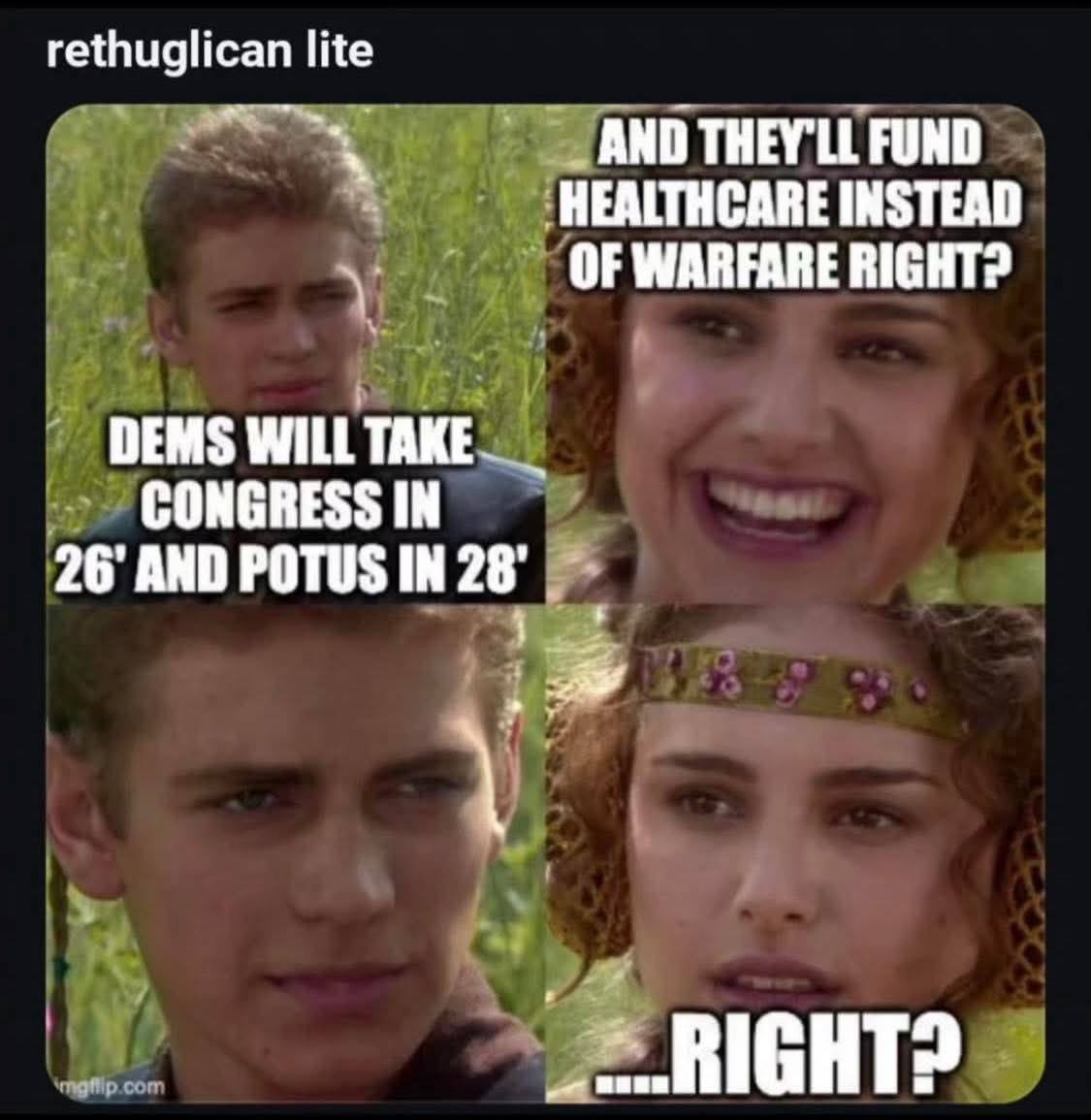
This image uses a political metaphor from The Princess Bride to satirize the expected consolidation of government power over market forces and policy priorities. From an Anti-Neoliberal perspective, it illustrates the argument that when the Democratic Party gains control of Congress and the Presidency, they will enforce strong government regulations on health and safety rather than relying on free-market alternatives. It implies a tension between those seeking state intervention to protect rights (represented by Inigo Montoya) and interests attempting to "fix" this arrangement with flawed economic solutions (represented by Breeanna), ultimately questioning whether such fixes actually solve the problem of governance.
detailed-analysis (gemma3_27b-it-q8_0)
Okay, let's break down this meme through the lens of an Anti-Neoliberal perspective. Given the meme's explicit "rethuglican lite" tag, we can expect a nuanced critique that doesn't necessarily fit neatly into traditional left/right paradigms. This is a meme aiming to mock the perceived "establishment" from both sides, specifically as it relates to prioritization of war over social welfare.
Here's an analysis, touching on the relevant theoretical frameworks:
Visual Description
The meme uses a two-panel format, employing the "Drakeposting" meme template. In this template, Drake (the rapper) expresses disapproval in the first panel and approval in the second.
- Panel 1: Drake is shown looking dismissive, turning away from the text "Dems will take Congress in '26 and POTUS in '28". This represents a rejection of the Democratic Party's ascendancy as a positive outcome.
- Panel 2: Drake looks approvingly at the text "And they'll fund healthcare instead of warfare RIGHT?". The use of capitalization and the question mark suggest a sarcastic, disbelief-tinged approval. The image of a woman in a crown (implied to be Daenerys Targaryen from Game of Thrones), adds a layer of irony – she is a figure associated with conquest and power, ironically approving a shift towards social welfare.
- The positioning of Drake's eyes and facial expression in each panel emphasizes the contrast between rejection and (questionable) acceptance.
Critical Theory
From a Critical Theory perspective, this meme is deeply critical of the prevailing power structures that consistently prioritize military spending and geopolitics over the basic needs of the population. Critical Theory, especially in the Frankfurt School tradition, argues that seemingly rational decisions (like allocating resources to defense) are often driven by ideological motivations—to maintain control, perpetuate existing hierarchies, and suppress dissent.
- Instrumental Reason: The meme attacks the "instrumental reason" at the heart of neoliberalism and its continuation in mainstream politics. Instrumental reason reduces all values to questions of efficiency and profitability. The implication is that even if Democrats gain power, they will still ultimately operate within this framework, prioritizing strategies that maintain the status quo (i.e., maintaining a large military-industrial complex).
- Culture Industry: The meme acknowledges that narratives of political “progress” (Democrats winning elections) are heavily mediated and often distract from substantive change. The Game of Thrones imagery is a nod to the “culture industry,” in that it’s an easy-to-understand reference that engages a broad audience while simultaneously subverting expectations.
- Domination: The meme suggests that the system is structured to ensure the continued domination of war and capital. It implies that electing Democrats won’t necessarily dismantle these systems of domination.
Marxist Conflict Theory
A Marxist reading sees this meme as a commentary on the material basis of power.
- Class Struggle: The meme points to a conflict of interests between the ruling class (which benefits from war and military spending) and the working class (which would benefit from increased healthcare funding). The critique suggests that the Democratic Party, despite claiming to represent the working class, is ultimately beholden to the interests of capital.
- Imperialism/Militarism as Capitalism's Extension: Marxists often understand imperialism and militarism as inherent aspects of late-stage capitalism – they provide markets for surplus capital, maintain access to resources, and suppress labor movements. The meme's juxtaposition of healthcare and warfare explicitly highlights this dynamic.
- False Consciousness: The meme implies that many people are operating under a "false consciousness," believing that electoral politics are the primary means of achieving social change. The sarcastic tone suggests the meme creator believes this is a naive and ultimately ineffective approach.
Foucauldian Genealogical Discourse Analysis
A Foucauldian approach examines how "truth" about politics and resource allocation are produced through discourse.
- Discursive Formation: The meme challenges the dominant discourse that frames military spending as necessary and inevitable. It deconstructs the idea that warfare is a natural or unavoidable aspect of international relations.
- Power/Knowledge: The meme reveals how power operates through the production of knowledge. The normalization of high military budgets and the marginalization of social welfare programs are not simply the result of objective economic realities but are actively constructed through discourse.
- Genealogy: A genealogical analysis would trace the historical development of this discourse, examining how it has evolved over time to justify ever-increasing military spending and the neglect of social welfare. It would analyze the changing meanings attached to “security,” “national interest,” and “defense.”
Anti-Neoliberal Interpretation (The Core)
This meme is a quintessential expression of Anti-Neoliberal sentiment.
- Rejection of the Consensus: Anti-Neoliberals reject the bipartisan consensus that prioritizes free markets, austerity, and military intervention. They see these policies as eroding social solidarity, exacerbating inequality, and undermining democratic institutions.
- Critique of Electoralism: The meme expresses a deep skepticism toward electoral politics as a means of achieving radical social change. It suggests that both Democrats and Republicans are ultimately complicit in maintaining the neoliberal order.
- Demand for a Paradigm Shift: The core message is a demand for a fundamental shift in priorities – a move away from endless war and towards investment in social programs like healthcare. The sarcasm suggests this isn’t a matter of expecting a logical adjustment, but a radical alteration of the entire system.
- Critique of "Liberal" Identity: The "rethuglican lite" tag is key. It suggests disillusionment with both traditional conservative and liberal ideologies, indicating a search for a political position outside of the existing two-party system.
In essence, the meme encapsulates the frustration of the Anti-Neoliberal perspective, highlighting a perceived betrayal by mainstream political actors and a yearning for a more just and equitable society. It's not about simply wanting Democrats to win; it's about questioning the entire game and the values it prioritizes.
simple-description (llama3.2-vision_11b)
The meme is a satirical commentary on the political views of the Democratic Party in the United States. It features a series of images with text, including the phrase "rethuglican lite," which is a pejorative term used to describe moderate or centrist Democrats who are perceived as being too similar to Republicans. The meme is criticizing the idea that some Democrats are not far enough to the left and are instead more moderate or even conservative in their views. The use of the term "rethuglican" is meant to be ironic and humorous, as it is a play on the term "Democrat" but with a negative connotation. Overall, the meme is poking fun at the idea that some Democrats are not progressive enough and are instead more moderate or even conservative in their views.