First Seen
2026-03-12T21:55:17+00:00
simple-description (qwen3.5_2b-q8_0)
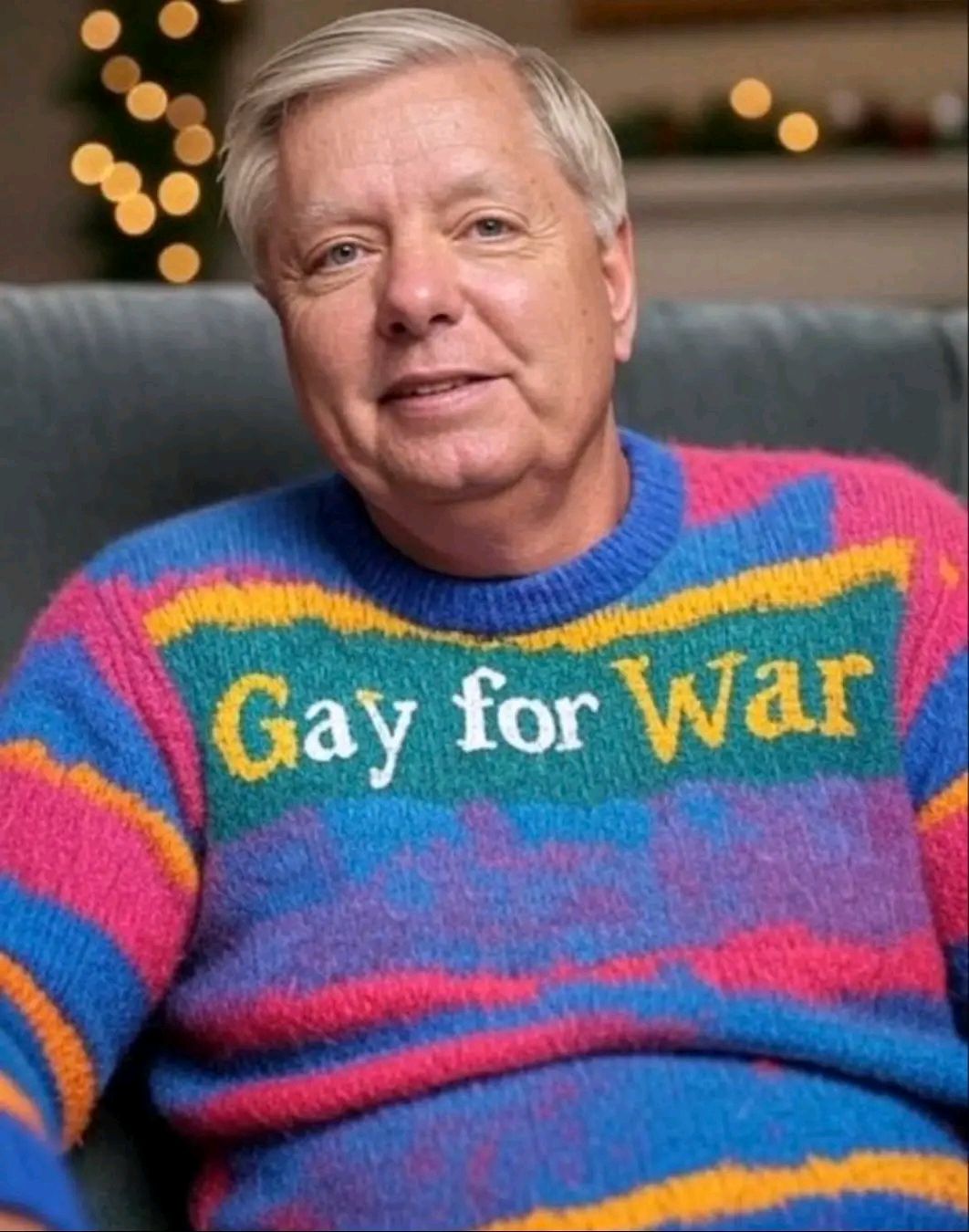
Anti-neoliberal ideology typically argues that free-market capitalism inevitably leads to economic chaos and inequality, meaning that true advocates believe the government must intervene to control prices and wages. The meme uses a colorful sweater with the text "Gay for War" to humorously suggest that wearing such an extreme statement is the ultimate act of political dedication to opposing neoliberal economics; it implies that while regular people wear sweaters for warmth, only those who hold radical views against capitalism will wear slogans like this.
detailed-analysis (gemma3_27b-it-q8_0)
Okay, let's break down this meme – featuring a man in a rainbow sweater emblazoned with "Gay for War" – through an anti-neoliberal lens, utilizing relevant theoretical frameworks as applicable. This is a nuanced image that challenges several core tenets of neoliberal ideology.
Visual Description
The image depicts an older, white man in a brightly colored, somewhat kitsch rainbow sweater. The most striking feature is the text “Gay for War” across the front. The background is domestic, suggesting a comfortable home setting. The overall aesthetic is deliberately jarring – the juxtaposition of a symbol of LGBTQ+ identity (the rainbow) with a direct advocacy of war creates immediate cognitive dissonance. The man's expression is placid and unconcerned, adding to the unsettling effect. This suggests a deliberate subversion of expectations.
Foucauldian Genealogical Discourse Analysis
From a Foucauldian perspective, this meme represents a disruption of normalized discourses surrounding both sexuality and warfare. Neoliberalism relies on specific constructions of identity—individualism, consumerism, a sanitized "freedom"—and a particular framing of geopolitical conflict as necessary for maintaining these conditions.
- Discipline & Punishment: The normalization of endless war is, in Foucault's terms, a form of discipline; a constant state of crisis justifies heightened security measures, surveillance, and the erosion of civil liberties, all of which benefit the state and its neoliberal allies.
- Power/Knowledge: The meme deconstructs the "power/knowledge" nexus. Traditionally, “gayness” (as a social construct) has been positioned in opposition to "masculinity" and, by extension, the supposed natural inclination towards aggression and war. By stating "Gay for War," the meme destabilizes this binary. It’s not a claim about inherent homosexual attraction to violence, but a cynical commentary on how identity can be co-opted to support power structures.
- Genealogy: By pointing out the incongruity, the meme questions how the discourses around both sexuality and war have come to be. It implicitly asks where the boundaries of acceptable expression are and what interests they serve. It suggests that the link between national security, “freedom,” and societal norms is built on precarious, constructed foundations.
Critical Theory (Frankfurt School)
The meme powerfully engages with the concerns of the Frankfurt School. Specifically, it touches on:
- The Culture Industry: The meme can be seen as a critique of how the culture industry (media, entertainment) actively manufactures consent for war. The rainbow, often leveraged in neoliberal marketing for "inclusive" branding, is here turned into a symbol of complicity with militarism. It exposes the superficiality of “diversity” that doesn't challenge systemic power.
- Instrumental Reason: The meme highlights the dangers of instrumental reason – a logic where everything is evaluated by its usefulness to achieving a specific end (in this case, the continuation of military intervention). The individual's sexuality becomes a mere instrument in justifying war, divorced from any genuine human concern.
- False Consciousness: The placid expression of the man in the image suggests a detachment from the real human consequences of war. It hints at a false consciousness, where people are led to believe that supporting war is somehow in their self-interest or a matter of national pride, obscuring the exploitative dynamics at play.
Marxist Conflict Theory
From a Marxist perspective, the meme underscores the role of war as a tool for capital accumulation.
- Imperialism and Neocolonialism: Neoliberalism is fundamentally tied to global capitalism. War is not simply a matter of ideology; it’s an economic engine. The meme points to the way even marginalized identities can be drawn into supporting the imperialistic projects that benefit the capitalist class.
- Class Struggle: Although not explicitly about class, the meme can be interpreted as a critique of how nationalistic fervor (often stoked by war) can obscure class conflict. It suggests that even within progressive identity groups, there’s a danger of prioritizing national interests over the interests of the working class globally.
- Ideology and Hegemony: The "Gay for War" slogan is a perversion of progressive ideals, demonstrating how dominant ideology can co-opt and neutralize potential challenges to the status quo. The meme reveals the subtle ways in which power maintains its hegemony.
Postmodernism
Postmodern thought is relevant in understanding the meme's disruption of meaning.
- Deconstruction: The meme performs a deconstruction of binary oppositions – sexuality/war, peace/violence, inclusivity/imperialism. It shows how these categories are not fixed but are fluid and can be subverted.
- Simulacra & Simulation: The rainbow, as a symbol, is often already a "simulacrum" – a copy without an original – in the context of commodified queer representation. The meme amplifies this sense of artificiality, suggesting that even progressive symbols can be hollowed out and used to mask more sinister realities.
- Meta-Narratives: The meme challenges grand narratives of progress, freedom, and national security. It suggests that these narratives are suspect and serve to justify oppressive power dynamics.
Queer Feminist Intersectional Analysis
This meme is complex for queer and feminist analysis.
- Commodification of Identity: The rainbow has been extensively used by corporations for "pinkwashing" – leveraging LGBTQ+ inclusivity for profit without genuine commitment to social justice. The meme points to the dangers of this commodification and how it can be used to legitimize harmful policies.
- Intersectionality: The meme highlights how different forms of oppression (homophobia, militarism, imperialism) are interconnected. It raises the question of how LGBTQ+ individuals can resist being co-opted into supporting systems of violence that disproportionately impact marginalized communities globally.
- Critique of Liberal Identity Politics: This meme is a sharp critique of a liberal identity politics that focuses on representation without addressing systemic inequalities. It suggests that simply achieving visibility or inclusion within the existing system is insufficient; fundamental structural changes are needed.
In conclusion, this meme is a potent piece of anti-neoliberal critique. It’s a jarring, cynical, and thought-provoking image that uses humor to expose the underlying contradictions and exploitative dynamics of contemporary power structures. It suggests that complicity can manifest in unexpected places and that a true challenge to the status quo requires a critical examination of all dominant discourses, including those that appear progressive.
simple-description (llama3.2-vision_11b)
The meme features a photo of a man with a humorous, ironic, and satirical message on his sweater, which reads "Gay for War" - a phrase that seems to be a playful, tongue-in-cheek commentary on the idea of being "gay for" something, but in this case, it's actually a commentary on the idea of being pro-war or militaristic. The phrase is likely meant to be humorous and ironic, as it's a phrase that is usually used to describe someone who is gay for something that is not typically associated with gay men, but in this case, it's being used to make a point about the absurdity of war and the military.