First Seen
2026-02-13T07:31:53.234317+00:00
simple-description (qwen3.5_2b-q8_0)
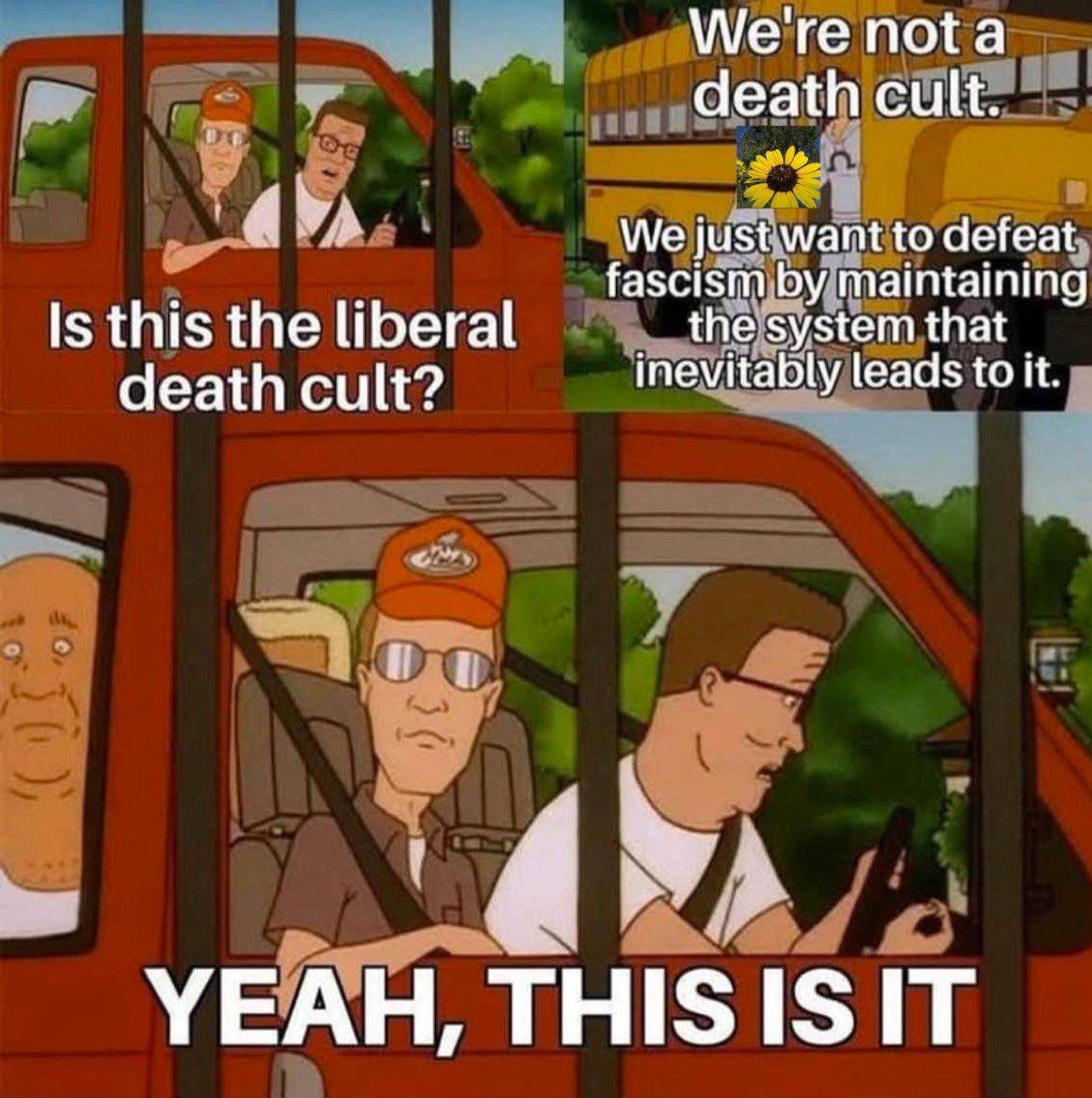
This image functions as an anti-neoliberal joke by framing conservative self-identities as a desperate attempt to maintain the very economic order they claim opposes. It argues that conservatives are fighting "fascism" not out of hatred for socialism, but because they believe capitalism is inherently unstable and leads eventually to its own destruction (like Donald Trump). Therefore, it portrays their struggle as a necessary act of preserving a neoliberal system against a hostile political takeover.
detailed-analysis (gemma3_27b-it-q8_0)
Okay, let's break down this meme from an Anti-Neoliberal perspective, using the requested theoretical frameworks where applicable. It's a layered meme, and the strength comes from its cynical accuracy in how many perceive the contemporary "liberal" political response to rising fascism.
Visual Description
The meme utilizes stills from King of the Hill. The panels are framed as a conversation viewed through the windows of a red pickup truck. In the upper panel, a man wearing a MAGA hat is shown speaking to another man in the passenger seat, with text that says “We’re not a death cult. We just want to defeat fascism by maintaining the system that inevitably leads to it.” In the lower panel, the passenger, Hank Hill, looks back with a skeptical, almost resigned expression, and the text reads, “Yeah, this is it.”
The visual choice of King of the Hill is significant. The show represents a certain American everyman, a grounded, pragmatic, and traditionally conservative viewpoint. Using Hank Hill, a character often portrayed as upholding traditional values, to affirm the description of liberals as part of a self-destructive system adds to the cynical impact. The red truck itself is also symbolically American, hinting at a critique of the foundations of American political and economic systems.
Foucauldian Genealogical Discourse Analysis
This meme functions as a powerful commentary on discourse and power. The discourse of mainstream liberalism, particularly in response to the rise of right-wing extremism, is presented as fundamentally contradictory. The statement "We just want to defeat fascism by maintaining the system that inevitably leads to it" is a prime example of this.
From a Foucauldian perspective, this reveals how power operates not simply through repression, but through productivity. The liberal discourse produces the very conditions it claims to oppose. Neoliberal policies (deregulation, privatization, austerity) have created widespread economic insecurity, social fragmentation, and a sense of alienation – the very breeding ground for fascism.
The meme's genius lies in highlighting how liberal discourse obscures this causal relationship. It reifies the system as neutral and inevitable, rather than acknowledging its role in generating the crisis. The genealogy traces the historical development of this discourse, revealing how it emerged alongside the rise of neoliberalism and served to legitimize its continuation, even as its consequences became apparent. Hank's "Yeah, this is it" is a resigned acknowledgment of the discourse’s internal logic and its inevitable outcome.
Critical Theory
This meme directly engages with a central tenet of Critical Theory: the critique of instrumental reason. The 'liberal' position described in the meme embodies a commitment to a system (capitalism, liberalism) as an end in itself, regardless of its destructive consequences. The logic is purely instrumental: the system must be preserved, even if it means allowing the conditions for its own potential overthrow by a more extreme force.
The meme implicates the 'liberal' in the reproduction of domination. By refusing to challenge the fundamental structures of power, they become complicit in the suffering they claim to oppose. This resonates with Adorno and Horkheimer's analysis of the "dialectic of enlightenment," where rationality itself can turn into a tool of domination.
The meme also touches on the idea of false consciousness. The liberals, according to this perspective, are blinded by their ideological commitments to the extent that they cannot perceive the real source of the problem – the system they defend.
Marxist Conflict Theory
From a Marxist perspective, the meme unveils the inherent contradictions of capitalism. The system’s drive for profit accumulation inevitably leads to inequality, exploitation, and ultimately, social unrest. Fascism, in this reading, is not an aberration but a potential outcome of capitalism’s inherent crisis.
The liberal response, as described in the meme, is seen as a futile attempt to manage the symptoms (fascism) without addressing the underlying cause (capitalism). Maintaining the system perpetuates the conditions that create the possibility of fascism.
The conflict isn’t simply between “fascism” and “anti-fascism,” but a class struggle playing out in a new form. The meme highlights how liberal ideology serves to obscure this fundamental conflict and protect the interests of the ruling class. Hank Hill's resignation can be seen as a working-class disillusionment with a political system that consistently fails to address their material concerns.
Postmodernism
While less directly applicable than other frameworks, a postmodern reading could focus on the deconstruction of grand narratives. The meme challenges the simplistic binary of "fascism vs. anti-fascism." It suggests that the very categories are unstable and that the "anti-fascist" position can become self-defeating when it operates within the logic of the system that generates fascism.
The meme undermines the notion of a coherent, unified "liberal" identity. It reveals the internal contradictions and the absurdity of a position that simultaneously opposes fascism while upholding the conditions for its emergence.
In Conclusion
This meme is a potent critique of mainstream liberalism from an anti-neoliberal perspective. It uses sarcasm and a well-chosen visual to expose the perceived hypocrisy and self-defeating logic of a political stance that seeks to combat fascism without challenging the underlying systemic forces that enable it. It’s a cynical, but often-felt, expression of disillusionment with the limitations of liberal politics in addressing the fundamental problems of the 21st century.
simple-description (llama3.2-vision_11b)
This meme is a commentary on the perceived divide between liberal and conservative ideologies. It features a scene from the animated TV show "King of the Hill," where two characters, one liberal and one conservative, engage in a conversation. The liberal character, who is a liberal, is asked if he is a "liberal death cult" and responds with a statement about wanting to "defeat fascism" by maintaining the system that leads to it. This statement is meant to be ironic and satirical, as it is a way to make a statement that is the opposite of what is expected.