First Seen
2026-02-09T06:39:48.701046+00:00
simple-description (qwen3.5_2b-q8_0)
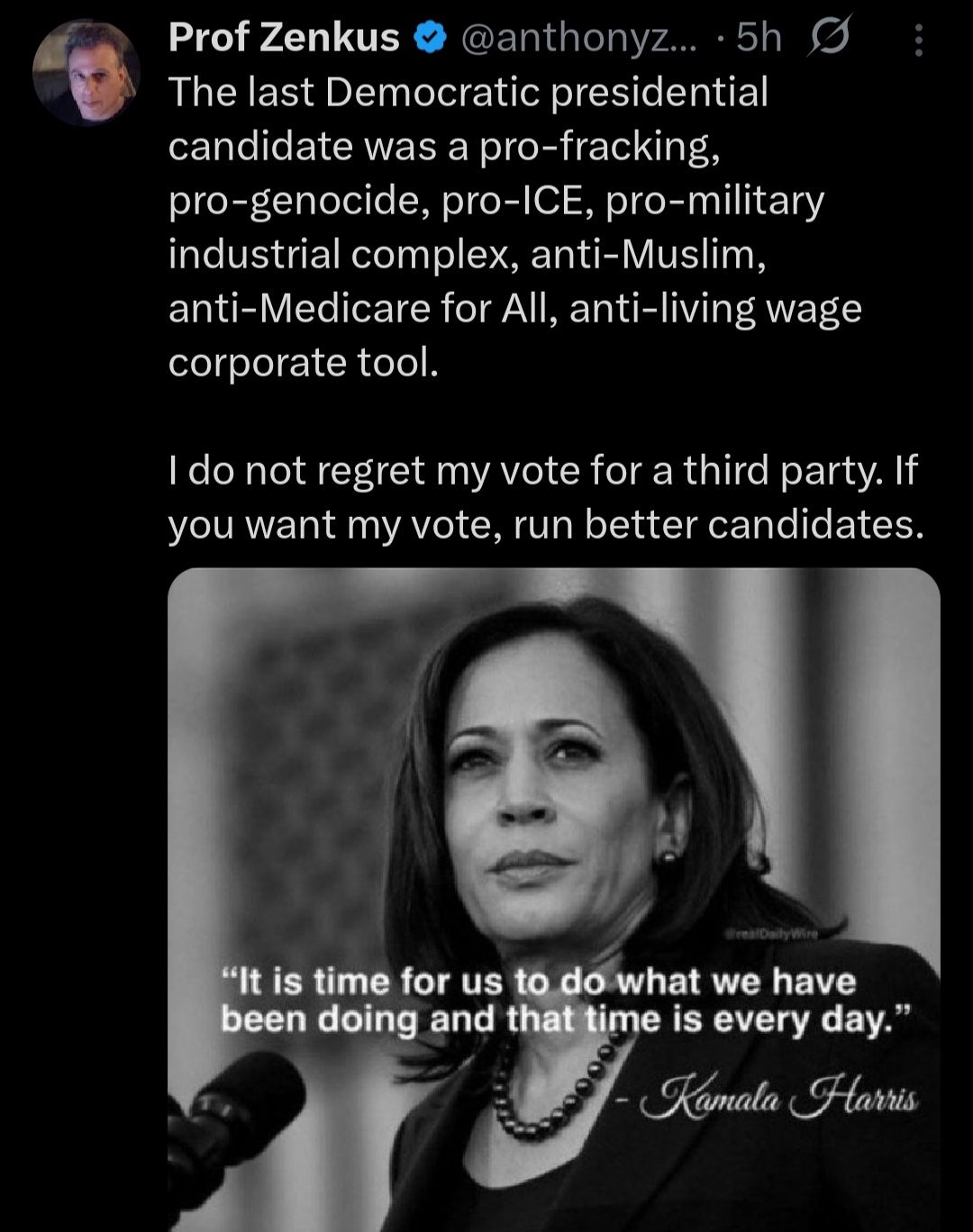
The image features a satirical tweet by Prof Zenkus that characterizes Kamala Harris as a "pro-fracking," "anti-living wage corporate tool," and an adversary of medical marijuana, reflecting a hostile political narrative. From an anti-neoliberal perspective, this aligns with their skepticism of the system they view as dominated by private capital and profit-driven policies, suggesting that Harris's support for government healthcare and living wages represents a necessary step toward protecting workers from corporate domination. The caption "If you want my vote, run better candidates" indicates the poster intends to replace current governance with one that prioritizes economic justice and public welfare over industrial interests.
detailed-analysis (gemma3_27b-it-q8_0)
Okay, let's break down this meme through an Anti-Neoliberal lens, using the frameworks you've provided where applicable. This is a complex image loaded with political meaning, and the framing of "Anti-Neoliberalism" is crucial to its interpretation.
Understanding the Anti-Neoliberal Lens
Before diving in, let's quickly define our guiding principle. Anti-Neoliberalism (in its most common contemporary usage) critiques the political-economic policies and ideologies that emerged in the late 20th century, often associated with figures like Margaret Thatcher and Ronald Reagan. It opposes deregulation, privatization, austerity, free trade, and the erosion of the social safety net. It views these policies as serving the interests of capital and exacerbating inequality. Anti-Neoliberal thinkers often point to the ways in which these policies dismantle democratic institutions and promote a form of authoritarianism focused on maintaining market order.
1. Visual Description
The image features a close-up portrait of Kamala Harris speaking at a podium, with a microphone visible. She's in a formal setting, looking directly at the camera with a determined expression. Below the image is a quote attributed to her: "It is time for us to do what we have been doing and that time is every day." The username of the poster is "Prof Zenkus" and the accompanying text reads: "The last presidential candidate was a pro-fracking, pro-genocide, pro-ICE, pro-military industrial complex, anti-Muslim, anti-Medicare for All, anti-living wage corporate tool. I do not regret my vote for a third party. If you want my vote, run better candidates." The image is watermarked with "@realDailywire", suggesting it originated from or was re-posted by that conservative news outlet.
2. Foucauldian Genealogical Discourse Analysis
This meme is highly relevant to Foucault's ideas. The poster is dissecting a "discourse"—the language and concepts surrounding the political sphere—and attempting to reveal its power dynamics.
- Power/Knowledge: The labels applied to Harris – "pro-fracking," "pro-genocide," etc. – aren’t necessarily statements of fact, but rather interpretations that construct her as a figure within a specific power structure. These labels produce her as a representative of the harmful forces the poster opposes. The labeling is itself an act of power, attempting to define and delegitimize her authority.
- Genealogy: The critique implies a historical tracing of how these policies (fracking, the military-industrial complex, ICE, etc.) have developed. The poster implies these policies have a lineage rooted in exploitative systems and a prioritization of capital over people.
- Discursive Formation: The quote, “It is time for us to do what we have been doing and that time is every day,” becomes key. From the anti-neoliberal perspective, it is a statement of commitment to the status quo – a status quo that is itself deemed oppressive. It's a refusal to envision a radically different future. This statement serves to reinforce the existing structures of power, as it suggests that the current course of action is not only acceptable but should continue indefinitely.
3. Critical Theory
Critical Theory, particularly in the Frankfurt School tradition, deals with analyzing how ideology is used to maintain systems of domination.
- Ideology Critique: The meme performs an explicit ideology critique. It deconstructs the image of Harris as a progressive leader and reveals, according to the poster, the underlying neoliberal agenda she represents. The labels aren't simply policy positions; they're accusations of complicity in structures of oppression.
- The Culture Industry: While less direct, the fact the image comes from Dailywire can be seen as indicative of the "culture industry" at work. The framing and amplification of specific narratives (in this case, by presenting Harris as a representative of negative forces) are functions of media apparatuses that reinforce existing power structures.
- False Consciousness: The meme suggests that supporters of Harris are potentially operating under "false consciousness," unaware of the true implications of her policies and her alignment with structures of domination.
4. Marxist Conflict Theory
This is a central framework for understanding the meme.
- Class Struggle: The criticisms leveled at Harris – opposing a living wage, Medicare for All – directly relate to issues of class struggle. These policies would benefit the working class, while her opposition suggests alignment with the interests of capital.
- Capitalist Exploitation: The accusations of "pro-fracking," and "anti-living wage" directly address the exploitation of labor and the environment for the accumulation of capital.
- The State as an Instrument of Class Rule: The poster sees Harris (and by extension, the Democratic Party) as functioning as an instrument of the capitalist class, perpetuating a system that benefits the few at the expense of the many.
5. Postmodernism
This is the least directly applicable framework, but some elements are present:
- Deconstruction of Grand Narratives: The meme challenges the "grand narrative" of the Democratic Party as a force for progress. It rejects the notion that voting for the "lesser evil" will ultimately lead to positive change.
- Relativism (with caveats): While the poster presents a strong critique, the very act of labeling and interpretation acknowledges the subjective nature of meaning. The "pro-genocide" label, while strong, is an interpretation of policy impacts. (It's important to note that the poster is not necessarily advocating for total relativism, but the deconstructive impulse is present.)
6. Queer Feminist Intersectional Analysis
This framework adds nuance. While not the primary focus, it enriches the understanding:
- Intersectionality: The "anti-Muslim" accusation highlights how neoliberal policies intersect with systems of racial and religious oppression. The poster recognizes the ways in which different forms of discrimination and marginalization are intertwined.
- Critique of Liberal Feminism: The poster implies that Harris's position as a woman in power does not necessarily translate to progressive policies or a challenge to systemic inequalities. This challenges liberal feminist notions that representation alone is sufficient.
- Critique of Neoliberal Gender Politics: Neoliberalism often co-opts feminist language and rhetoric to justify its policies. This meme could be interpreted as a critique of this co-option, arguing that Harris's identity is used to mask her complicity in harmful systems.
In conclusion: From an Anti-Neoliberal perspective, this meme is a scathing critique of the Democratic Party and its perceived failure to address the root causes of inequality and oppression. It’s a call for a radical departure from the existing political order and a demand for candidates who genuinely represent the interests of the working class and marginalized communities. It’s a rejection of incrementalism and a belief that fundamental systemic change is necessary. The meme’s power lies in its concise and uncompromising articulation of this viewpoint.
Disclaimer: I have tried to provide a balanced and nuanced analysis based on the prompt. It is important to remember that interpretations can vary, and this is just one possible reading of the image and text.
simple-description (llama3.2-vision_11b)
The meme is a criticism of the Democratic Party's policies and the candidates' emphasis on neoliberalism. It features a quote from Kamalaii Harris, a Democratic candidate, stating that she does not regret her vote for a third party. The meme is from the perspective of someone who is critical of the Democratic Party's neoliberal policies and is now using a quote to show how the party has not lived up to its promises.