First Seen
2026-02-06T07:13:12.252921+00:00
simple-description (qwen3.5_2b-q8_0)
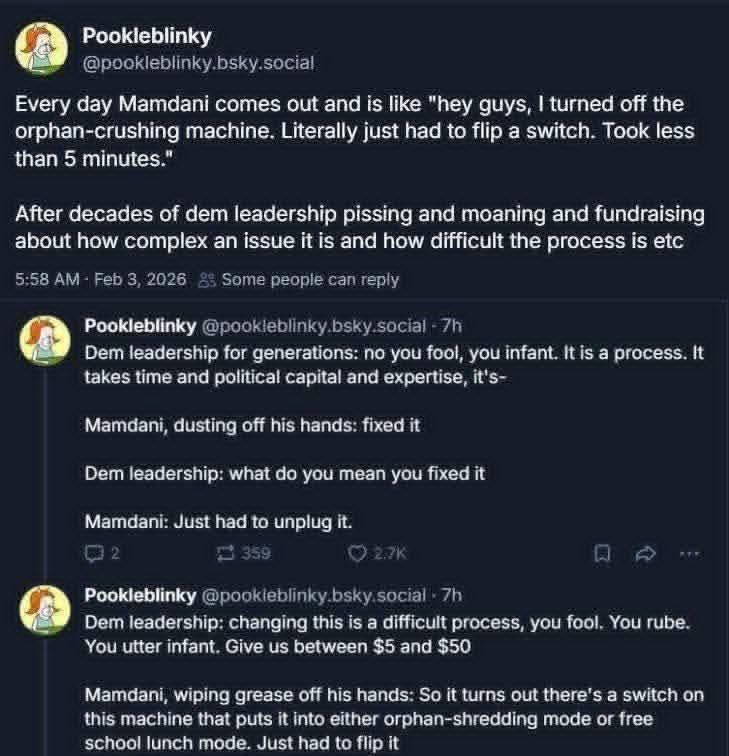
This anti-neoliberal satire mocks political leaders like Kamala Harris for avoiding real solutions in favor of fundraising and ignoring complex issues. The top comment describes a radical fix where an "orphan-crushing machine" is simply unplugged, while the bottom comment ridicules figures like Harris for trying to solve the same problems by asking voters to give money ranging from "$5 and $50." It suggests that instead of taking personal responsibility or immediate action, political leadership just wants to collect donations rather than fixing things.
detailed-analysis (gemma3_27b-it-q8_0)
Okay, let's break down this meme from an Anti-Neoliberal perspective, using the requested analytical frameworks where relevant. It's a layered and cynical piece, so this will be a detailed response.
Overall Framing: The Anti-Neoliberal Lens
Before we dive into specific theories, it's crucial to understand the anti-Neoliberal context. This political stance critiques the dominance of market-based solutions, privatization, deregulation, and austerity policies that have been prevalent since the 1980s. Anti-Neoliberals often view the Democratic Party (the "Dem leadership" referenced) as complicit in, or even actively furthering, these policies despite rhetoric to the contrary. The meme's core message speaks to the frustration that systemic problems are not addressed by meaningful action, but rather by performative politics and a focus on complex processes to justify inaction. The "orphan-crushing machine" is a metaphor for systemic violence and exploitation, and the ease with which it can be "turned off" highlights the perceived bad faith of the political establishment.
1. Visual Description
The meme is primarily text-based, a screenshot of a conversation on the social media platform bsky.social. There's a profile picture associated with the user "Pooklebinky." The text exchange features back-and-forth dialogue. Crucially, the meme relies on a framing device of escalating dismissiveness and implied superiority from the persona of "Mamndani." The visual dynamic—the contrast of the lengthy, verbose responses from "Dem leadership" and the concise, sardonic replies from "Mamndani"—reinforces the meme’s central critique. The visual of him “dusting off hands” and “wiping grease” conveys smug satisfaction.
2. Foucauldian Genealogical Discourse Analysis
This is a very pertinent framework here. Michel Foucault’s work on power/knowledge and discourse is central to understanding this meme.
- Discourse and Power: The "Dem leadership" statements represent a specific discourse—a way of talking about problems that constructs them as inherently complex and requiring lengthy, expert-driven processes. This discourse, according to Foucault, isn't simply describing reality; it's actively shaping it and legitimizing inaction. The lengthy explanations and appeals to "time and political capital" are exercises of power, defining what is considered legitimate political action.
- Genealogy of "Complexity": A genealogical approach would ask how this discourse of "complexity" arose. The meme implies that the language of “process” is a rhetorical tactic to obscure the fact that solutions are readily available, and the inaction is deliberate. It traces the history of how politicians have learned to deflect criticism by framing issues as intractable. This complexity is not inherent to the issues themselves, but manufactured and naturalized through repetitive discourse.
- Biopower and the "Orphan-Crushing Machine": The metaphor of the “orphan-crushing machine” is critical. While brutal, it speaks to the ways in which power operates on life itself (biopower). Neoliberal policies often have devastating consequences for vulnerable populations (orphans being a potent symbol of this vulnerability). The ease with which Mamndani can "turn it off" suggests that this harm is not accidental or unavoidable, but a consequence of deliberate choices.
3. Marxist Conflict Theory
This framework illuminates the class dynamics inherent in the critique.
- Ruling Class Ideology: The "Dem leadership" rhetoric can be seen as an expression of the ideology of the ruling class, justifying the status quo and protecting their interests. The emphasis on “expertise” and “political capital” obscures the underlying material realities of power and inequality.
- False Consciousness: The meme suggests that those who accept the "Dem leadership's" narrative are suffering from false consciousness, failing to recognize the ease with which the system could be changed to benefit the working class (represented by the orphans).
- The "Orphan-Crushing Machine" as Capital Accumulation: One could interpret the machine as a metaphor for the relentless drive of capital accumulation under neoliberalism. The crushing of orphans represents the exploitation and marginalization of vulnerable populations in the pursuit of profit. The meme then points to a simple way to stop this – a flip of the switch – suggesting that the cruelty isn't necessary but an intentional feature of the system.
- Class Conflict: The conflict between “Dem leadership” and “Mamndani” can be interpreted as a proxy for class conflict. Mamndani represents someone who is outside the ruling class and sees through the obfuscation.
4. Postmodernism
Postmodernism’s relevance comes from its critique of grand narratives and its focus on deconstruction.
- Deconstructing the Narrative of Inaction: The meme deconstructs the "Dem leadership's" narrative of complex processes. It exposes the artifice and contingency of this narrative, revealing it as a self-serving justification for inaction.
- Rejection of Metanarratives: The meme challenges the idea that there is a single, rational, progressive path toward social justice. It suggests that the "Dem leadership" is trapped in a metanarrative of incrementalism that prevents them from addressing the root causes of problems.
- Irony and Parody: The use of sarcasm and parody are key postmodern techniques. The meme uses irony to expose the hypocrisy of the "Dem leadership" and to undermine their authority.
5. Queer Feminist Intersectional Analysis (Applicable, but less central)
While not the primary focus, an intersectional lens can enrich our understanding.
- Vulnerability and Marginalization: The "orphans" represent a particularly vulnerable and marginalized group. An intersectional approach would recognize that vulnerability is compounded by other factors, such as race, gender, sexuality, and disability. The “crushing machine” could be seen as a metaphor for systemic oppressions that intersect to harm marginalized communities.
- Critique of Power Structures: The meme challenges traditional power structures and the ways in which they perpetuate inequality. This aligns with feminist critiques of patriarchy and queer critiques of heteronormativity.
In conclusion: This meme is a potent expression of anti-Neoliberal frustration. It’s a cynical jab at the perceived hypocrisy of the Democratic Party, suggesting that systemic problems are not intractable but rather deliberately maintained through a discourse of complexity and inaction. It employs a range of critical theories to expose the mechanisms of power and the ideological justifications for injustice. The simplicity of the "solution" (flipping a switch) is a key element, suggesting that the problem isn't a lack of knowledge or resources, but a lack of political will.
simple-description (llama3.2-vision_11b)
The meme is a satirical commentary on the perceived lack of empathy and understanding of complex issues by some politicians. The image is a Twitter thread where a user, @pookleblinky, is explaining to a fictionalized version of a Democratic Party leader, "Mamdani," that they are not understanding the complexity of a problem. The user is explaining the issue of a person's inability to understand the complexity of a problem, using an analogy of a person trying to fix a complex issue. The user is explaining that the person is not understanding the issue and is using an analogy to explain the issue.