First Seen
2026-01-18T03:27:38.383486+00:00
simple-description (qwen3.5_2b-q8_0)
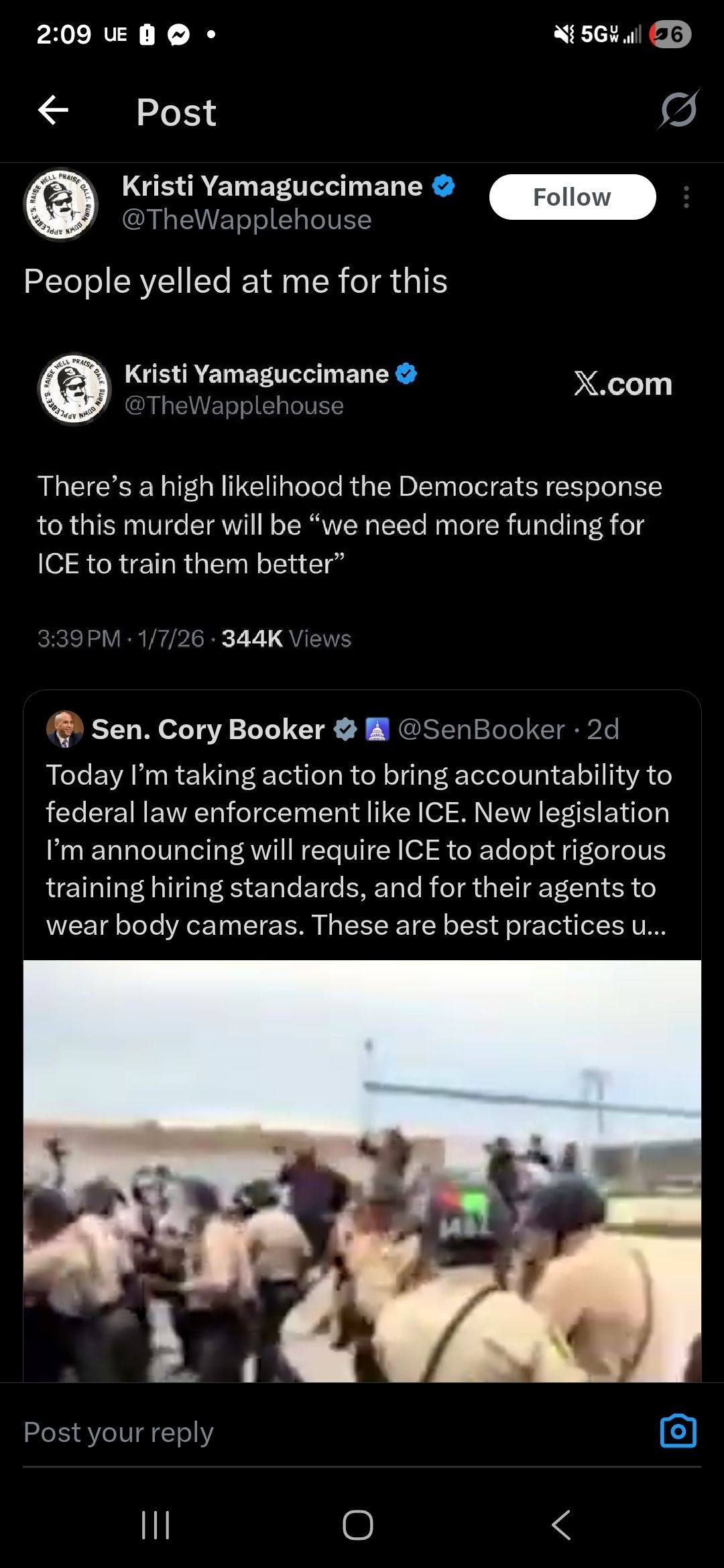
This meme argues that true justice requires accountability and oversight, rather than simply increasing police funding. It highlights Sen. Booker’s plan to enforce strict hiring standards and body cameras on ICE officers, suggesting that government rules are more effective than just throwing more money at an issue. From the Anti-Neoliberal perspective, this prioritizes human safety and structural regulation over unchecked power, viewing laws and transparency as essential countermeasures against potential abuses of state authority.
detailed-analysis (gemma3_27b-it-q8_0)
Okay, let's break down this meme from an Anti-Neoliberal perspective, incorporating relevant theoretical frameworks where they apply.
Understanding the Anti-Neoliberal Lens
First, it's essential to understand what Anti-Neoliberalism is. It’s a left-leaning political and economic ideology that critiques the rise of neoliberal policies (privatization, deregulation, austerity, free trade) that began in the 1980s. Anti-Neoliberals see these policies as dismantling social safety nets, exacerbating inequality, and increasing corporate power. They’re skeptical of mainstream political institutions and often focus on systemic critique rather than individual reforms. They tend to be critical of "solutions" that involve increasing state power or bureaucratic mechanisms without addressing underlying structural issues.
---
Visual Description
The meme juxtaposes a post from @TheWapplehouse (Kristi Yamaguchi) stating the likely Democrat response to an unspecified “murder” will be calls for more funding to “train them better,” alongside a tweet from Senator Cory Booker announcing new legislation focused on accountability for ICE (Immigration and Customs Enforcement) through better training and body cameras. Beneath this is a photograph depicting ICE agents violently arresting a man. The visual is jarring, showing the reality of ICE enforcement contrasted with the proposed “solution” of more training.
---
Marxist Conflict Theory
This is the most central framework here. The meme fundamentally points to the core tenet of Marxist conflict theory: the state (and its institutions like ICE) serves the interests of the ruling class.
- Ruling Class/Capital: ICE, from this perspective, isn’t about "border security" in a neutral sense. It’s about maintaining a cheap, exploitable labor force, suppressing dissent, and protecting the profits of capital. ICE is a tool of the capitalist class to manage the flow of labor, benefit from immigrant contributions, and maintain a system of control.
- The State as Instrument: The Democratic response (“more training”) is seen as a deflection. It doesn't challenge the fundamental function of ICE. It simply seeks to refine its operation, making it appear more legitimate. This is about managing the contradictions of the system, not dismantling it.
- False Consciousness: The meme implies that Booker and other Democrats are operating within a “false consciousness” – accepting the terms of the debate set by the ruling class. They believe that the problem is how ICE acts, not that ICE exists and is pursuing inherently oppressive goals.
- Class Struggle: The image of the violent arrest is a representation of the ongoing class struggle. Immigrants, often working-class people, are being subjected to state violence to further the interests of capital.
---
Foucauldian Genealogical Discourse Analysis
Michel Foucault's work is relevant here in terms of how power operates.
- Discourse of “Accountability”: The language of “accountability,” “training,” and “best practices” is a discourse – a system of thought that shapes how we understand the world. This discourse masks the fundamentally coercive and violent nature of ICE. It frames the issue as a problem of technique, not of justice or human rights.
- Power/Knowledge: Foucault argued that power and knowledge are intertwined. The state (through ICE) produces knowledge about immigrants (as "illegal," as "dangerous") which then justifies its power to control and punish them. The “training” proposed by Booker is a way to further refine and legitimize this power/knowledge.
- Biopower: ICE’s actions fall under Foucault’s concept of “biopower” – the ways in which the state seeks to regulate and control life itself. By controlling immigration and deportation, ICE is regulating who can live, work, and reproduce within the borders of the nation.
---
Critical Theory
The meme implicitly critiques the logic of instrumental reason, a key theme in Critical Theory (particularly the Frankfurt School).
- Instrumental Reason: The focus on "better training" embodies instrumental reason: a narrow, technical approach to problem-solving that ignores ethical and political considerations. It assumes that any problem can be solved with the right tools and techniques, without questioning the underlying values and goals.
- Domination: Critical Theorists would see this as a form of domination – a system in which reason is used to justify and maintain power imbalances. The "training" isn't about making ICE more just; it's about making it more efficient at enforcing a system of domination.
---
Postmodernism
A postmodern reading would be less central, but still relevant in a nuanced way.
- Deconstruction of Narratives: The meme deconstructs the dominant narrative around immigration and border security. It reveals the hypocrisy of calling for accountability while simultaneously upholding the institution responsible for violence.
- Skepticism of Grand Narratives: Postmodernism rejects "grand narratives" (like the idea of progress or the benevolent state). This meme rejects the idea that incremental reforms (like better training) can lead to genuine justice.
---
Why This Resonates with Anti-Neoliberals
The meme is powerful for an Anti-Neoliberal audience because it exposes the limitations of liberal reforms. It suggests that simply tinkering with the existing system (through better training, accountability measures) won't address the root causes of injustice. The Anti-Neoliberal position would likely call for abolishing ICE altogether and fundamentally rethinking immigration policy based on principles of human rights, social justice, and international solidarity. It’s a critique of the "managed decline" of human rights under a neoliberal framework.
Let me know if you’d like me to elaborate on any of these points, or explore other theoretical frameworks!
simple-description (llama3.2-vision_11b)
The meme is a screenshot of a Twitter post by Kristi Yamaguchi, where she tweets "People yelled at me for this". The tweet is in response to a video of a protest where protesters are shouting at a police officer. The meme is likely used to express frustration or anger at a situation where someone is being criticized or yelled at for something they did or said.