First Seen
2025-12-24T02:06:46.444514+00:00
simple-description (qwen3.5_2b-q8_0)
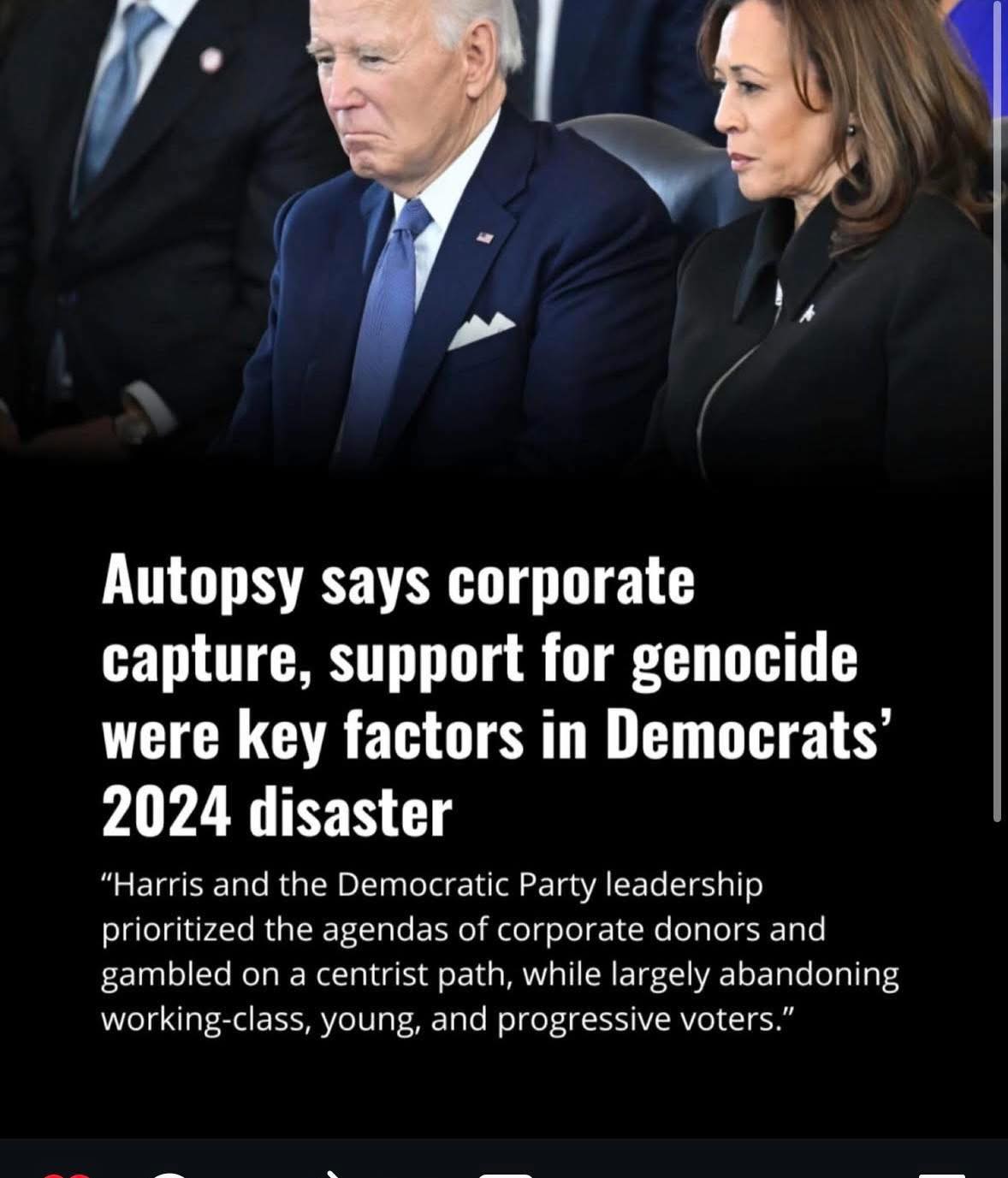
This anti-neoliberal meme critiques Joe Biden and Kamala Harris for the Democratic Party's perceived failure in the 2024 election, accusing them of prioritizing the agendas of wealthy corporate donors over the welfare of ordinary people. The text frames this shift as a "central path" gamble, implying the party abandoned working-class voters to align with financial elites who care more about capital growth than labor rights or social justice.
detailed-analysis (gemma3_27b-it-q8_0)
Okay, let's break down this meme from an anti-neoliberal perspective, applying relevant theoretical frameworks where applicable.
Overall Framing:
The meme positions the 2024 Democratic Party's performance as a "disaster" stemming from internal failings tied to corporate influence and abandonment of core progressive values. The "autopsy" framing suggests a post-mortem analysis, implying a definitive diagnosis of the party's issues, and the explicit mention of "support for genocide" is a highly charged accusation indicative of extreme disappointment. From an anti-neoliberal lens, this is a familiar narrative – the Democratic Party is seen as co-opted by capitalist interests, prioritizing them over the needs of its base.
1. Visual Description
The image shows Vice President Kamala Harris and President Joe Biden. Both are sharply dressed in dark suits, presenting a polished, establishment image. Their positioning – Harris slightly behind Biden, looking at him—can be interpreted as a hierarchy, implying her role in enacting his policies. The lighting and composition create a serious, almost somber atmosphere. Visually, it reinforces a portrayal of the establishment elite.
2. Marxist Conflict Theory
This is the most directly applicable framework. The meme is fundamentally rooted in a Marxist analysis of class struggle.
- Bourgeoisie vs. Proletariat: The "corporate donors" represent the bourgeoisie (the capitalist class), and the "working-class, young, and progressive voters" represent elements of the proletariat (the working class).
- False Consciousness: The meme argues that the Democratic Party leadership actively pursued policies favorable to the bourgeoisie despite potentially harming the proletariat. This could be seen as reinforcing a "false consciousness" among voters, where they are led to believe policies serving the elite are in their best interests.
- State Apparatus: From this view, the Democratic Party is a tool of the capitalist state, serving to maintain the existing power structure rather than challenging it. The "gamble on a centrist path" is not a neutral political strategy, but a deliberate act to appease capital.
- Genocide: The accusation of "support for genocide" points to a belief that these policies don't just harm economically, but lead to literal death and destruction, possibly referencing foreign policy decisions or systemic inequality within the U.S.
3. Foucauldian Genealogical Discourse Analysis
Foucault's work focuses on how power operates through discourse, institutions, and knowledge systems. Here's how it applies:
- Power/Knowledge Nexus: The meme challenges the dominant discourse around what constitutes "centrism" or "moderate" politics. It argues this isn’t a neutral position, but one shaped by power relations—specifically, the power of corporations to define the acceptable range of political debate.
- Genealogy of "Centrism": A genealogical analysis would trace the historical development of "centrism" as a political strategy. The meme implies it’s not an organic outcome of political evolution, but a deliberate construction designed to maintain capitalist hegemony.
- Disciplinary Power: The "autopsy" itself is a discursive act. It diagnoses, categorizes, and attempts to control the narrative surrounding the party’s failure. It aims to shift the discourse away from accepting the status quo and towards a critique of systemic issues.
4. Critical Theory
- Critique of Instrumental Reason: Critical theorists like Horkheimer and Adorno would see the Democrats' focus on corporate donors as an example of "instrumental reason"—reason divorced from ethical concerns, used solely to maximize efficiency and profit.
- Commodification of Politics: The meme suggests that political decision-making has been "commodified," treated as a transactional process where influence is bought and sold.
- Ideological Hegemony: The acceptance of corporate influence as normal within the Democratic Party is an example of ideological hegemony, where dominant ideas become normalized and taken for granted, preventing genuine change.
5. Postmodernism
While not a primary lens, some elements of postmodernism can be considered:
- Rejection of Grand Narratives: The meme implicitly rejects the "grand narrative" of the Democratic Party as a champion of the people. It asserts that the party's actions contradict its stated ideals.
- Deconstruction of Centrism: As mentioned in the Foucault section, it deconstructs the idea of centrism as a neutral or objective position.
- Emphasis on Discourse: The meme is itself a piece of discourse, attempting to challenge and disrupt the dominant narrative.
6. Queer Feminist Intersectional Analysis
This is the least directly applicable, but possible to engage with:
- Intersectionality of Oppression: If “genocide” is interpreted broadly to include systemic violence and oppression, a queer feminist intersectional analysis would highlight how these capitalist-driven policies disproportionately harm marginalized groups – people of color, LGBTQ+ individuals, women, the disabled, etc. The meme doesn’t explicitly show this, but it is compatible with an intersectional perspective.
- Critique of Neoliberal Subjectivity: Neoliberal ideology promotes an individualistic, market-driven subject. This meme would critique how the Democrats have embraced this subjectivity, prioritizing individual economic gain over collective liberation and social justice.
In conclusion, the meme is a powerful expression of anti-neoliberal frustration with the Democratic Party. It frames the party's failures as a direct consequence of its embrace of corporate power, its abandonment of its base, and its complicity in structures of oppression. It’s a stark indictment framed in the language of Marxist class struggle, Foucauldian power dynamics, and critical theory.
simple-description (llama3.2-vision_11b)
The meme is a screenshot of a news article with a headline that reads: "Autopsy says corporate capture, support for genocide were key factors in Democrats' 2024 disaster." The article is likely a satirical or ironic take on the 2024 election, implying that the Democratic Party's support for corporate interests and their own internal politics were key factors in their loss. The article's tone is likely to be humorous or sarcastic, poking fun at the idea that the Democratic Party's internal politics were a major factor in their loss.