First Seen
2025-11-11T01:11:44.464829+00:00
simple-description (qwen3.5_2b-q8_0)
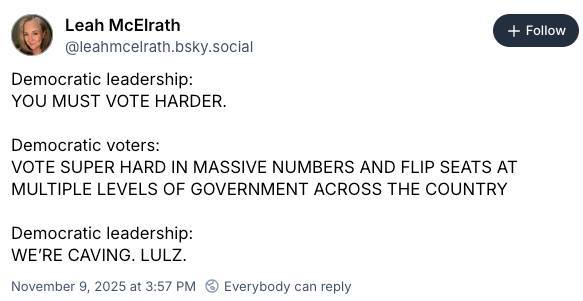
This meme captures anti-neoliberal sentiment by highlighting a clash between "leadership" (the state) and "voters," suggesting that current government action has failed to support workers while ignoring individual market choices. The text "we're caving" is used sarcastically to mock bureaucratic passivity—a critique of what critics often label as the lack of will in corporate or administrative bodies. Furthermore, the post counters neoliberalism by arguing that simply voting harder isn't enough; political pressure ("flipping seats") must be applied directly at various government levels to overcome economic inertia.
detailed-analysis (gemma3_27b-it-q8_0)
Okay, let's break down this meme from a broadly "Anti-Neoliberal" perspective, hitting the categories you requested where relevant. Given the content, it leans heavily into Critical Theory and Marxist Conflict Theory, with a bit of Postmodern nuance.
Overall Framing: Anti-Neoliberal Lens
Before diving into specific analytical frameworks, it's essential to understand the anti-neoliberal perspective. This position fundamentally critiques the dominant political and economic order – the late-stage capitalism often associated with policies of deregulation, privatization, austerity, and globalization championed by both major parties (though often executed by "centrist" or "New Democrat" factions). Anti-Neoliberals argue this system inherently exacerbates inequality, erodes social safety nets, and prioritizes profit over people. They see the mainstream political discourse as profoundly limited by this framework.
Visual Description
The "meme" is text-based. It's a sequence of statements presented as dialogue (or implied conversation) between two actors: "Democratic Leadership" and "Democratic Voters." The formatting – using ALL CAPS and the "LULZ" dismissive tone – are crucial to its effect. It visually mimics a frustrating exchange, highlighting a perceived disconnect. There is no image; the emotional weight rests entirely on the stark contrast in responses.
Foucauldian Genealogical Discourse Analysis
From a Foucauldian perspective, the meme exposes the power dynamics inherent in the discourse around elections.
- Discipline & Normalization: The call from "Democratic Leadership" – "YOU MUST VOTE HARDER" – can be seen as a disciplinary technique. It normalizes the idea that individual responsibility (voting) is the solution to systemic problems. It frames voting as a moral obligation, rather than a strategic choice within a flawed system.
- Genealogy of "Voting": A genealogical approach would trace the historical development of the idea of "voting" as the primary means of political participation. It would ask: how did this specific practice become so central? How does it obscure other forms of resistance and collective action? It reveals the power structures solidified through the normalization of this singular expression of political agency.
- The "Truth" of Political Power: The response of "WE'RE CAVING. LULZ" exposes the disconnect between the discourse of leadership and the lived reality of the voters. It suggests a cynical awareness, from within the leadership itself, that the system is failing despite the calls for increased individual effort. The "LULZ" is a post-structuralist rejection of any notion of inherent meaning or seriousness in the political spectacle.
Critical Theory
This meme is saturated with Critical Theory. It’s a direct critique of the ideological apparatus maintaining the status quo.
- False Consciousness: The meme implies that Democratic voters are being asked to participate in a system that ultimately doesn't serve their interests. The demand to "VOTE HARDER" is framed as a manipulation, a means of masking the deeper structural issues. The voters' response suggests they see through this facade.
- Hegemony: The meme challenges the hegemonic narrative that elections are the primary mechanism for change. Hegemony, in this context, refers to the dominance of a particular worldview that’s presented as natural or inevitable. The meme is arguing that this narrative is actively obscuring the failures of the system.
- Critique of Reason: The "LULZ" response is a dismissal of rational political arguments. It’s an expression of despair and disillusionment, suggesting that appeals to reason are ineffective within a system that is fundamentally irrational (prioritizing profit over well-being, for example).
- Systemic Failure: The phrase "WE'RE CAVING" is a signal that the leadership recognizes that the fundamental principles of the Democratic Party are not working.
Marxist Conflict Theory
This meme is profoundly rooted in Marxist ideas about class struggle and the inherent contradictions of capitalism.
- Class Interests: The meme implicitly points to a conflict between the interests of the Democratic Party establishment (often seen as aligned with corporate interests) and the working class. The leadership's demand to "VOTE HARDER" is seen as prioritizing maintaining power within the existing system, rather than addressing the fundamental needs of the electorate.
- False Solutions: Voting is presented as a false solution to a systemic problem. The focus on individual action (voting) distracts from the need for collective action and structural change.
- Crisis of Legitimacy: "WE'RE CAVING" suggests that the legitimacy of the Democratic Party (as a representative of the people) is eroding. The system is failing, even by the standards of those who control it.
- Ideology and Material Conditions: The meme underlines how ideology ("You must vote harder") is used to mask the unfavorable material conditions experienced by voters.
Postmodernism
While not the primary analytical lens, postmodernism contributes to understanding the meme’s cynicism and deconstruction of meaning.
- Rejection of Grand Narratives: The "LULZ" response represents a rejection of grand narratives of progress and political efficacy. It’s a dismissal of the idea that elections are a meaningful pathway to positive change.
- Simulacra and Simulation: The meme suggests that the political process has become a simulation, detached from reality. The demand to vote harder feels hollow and performative, disconnected from any genuine attempts to address systemic problems.
- Deconstruction of Meaning: The meme breaks down the traditional relationship between cause and effect. Voting should lead to change, but the meme implies that this connection has been severed.
Queer Feminist Intersectional Analysis
This perspective is less directly apparent but relevant if considering the context of anti-neoliberal movements.
- Critique of Liberal Identity Politics: Anti-neoliberal thought often critiques the limitations of liberal identity politics, arguing that focusing solely on representation without addressing systemic economic inequalities is insufficient. The meme could be interpreted as a critique of a Democratic party prioritizing symbolic gestures over material improvements.
- Interconnected Oppressions: From an intersectional lens, the meme points to how various forms of oppression (based on race, class, gender, sexuality, etc.) are often exacerbated by neoliberal policies. A demand for "more voting" doesn’t address these interconnected forms of inequality.
In conclusion, the meme is a powerful statement of disillusionment with the current political system, particularly from an anti-neoliberal perspective. It uses sarcasm and a stark juxtaposition of voices to expose the perceived hypocrisy and ineffectiveness of mainstream political discourse. It invites viewers to question the dominant narratives and consider alternative forms of political action.
simple-description (llama3.2-vision_11b)
The meme is a satirical commentary on the left-wing's perception of the Democratic Party's leadership. It implies that the party's leadership is not left-wing enough, and that the party's voters are being asked to vote for a more left-wing candidate. The text reads: "Democratic leadership: YOU MUST VOTE HARDER. Democratic voters: VOTE SUPER HARD IN MASSIVE NUMBERS AND FLIP SEATS AT MULTIPLE LEVELS OF GOVERNMENT ACROSS THE COUNTRY."