First Seen
2025-09-23T18:13:35.068918+00:00
simple-description (qwen3.5_2b-q8_0)
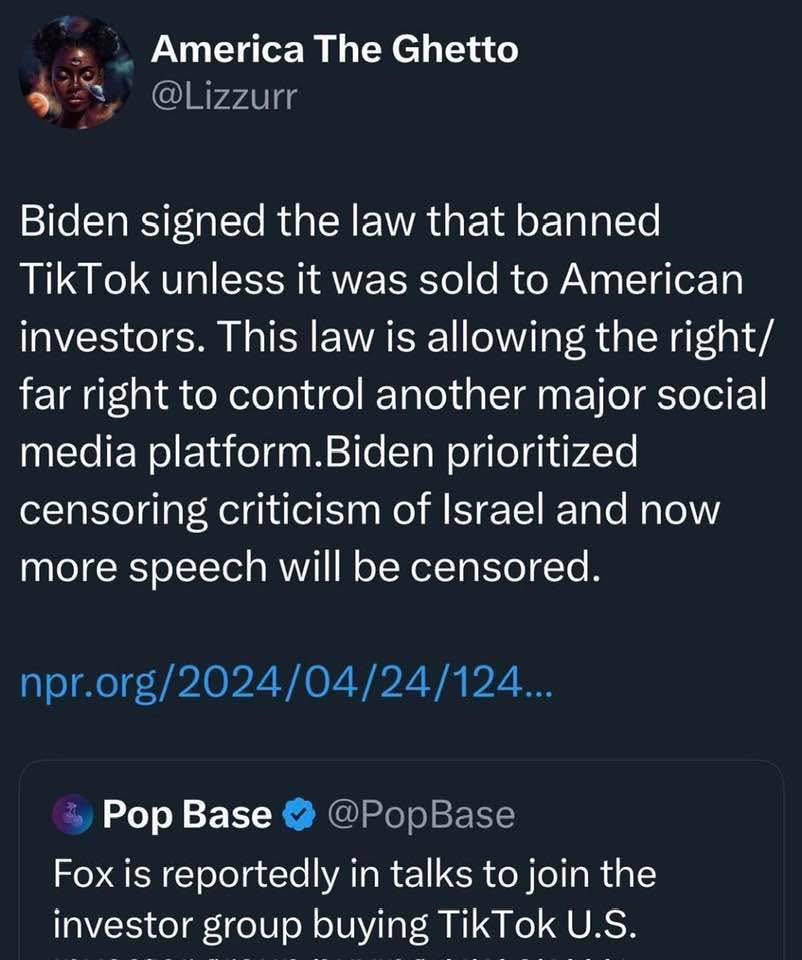
This meme portrays a political conflict where the federal government intervenes directly into private corporate structures to force major media platforms like TikTok onto their balance sheets. From an anti-neoliberal viewpoint, this is framed as excessive state regulation—a move where government agencies compel private giants (like Meta or Google) to act in line with national policy rather than pure market logic. The second tweet confirms the extent of this "state takeover," suggesting that essential communication platforms are being treated as national assets subject to specific ownership mandates.
detailed-analysis (gemma3_27b-it-q8_0)
Okay, let's break down this social media post through an anti-neoliberal lens, utilizing relevant theoretical frameworks where applicable.
Overall Context: Anti-Neoliberalism
Before diving into the specifics, it's crucial to understand the core tenets of an anti-neoliberal perspective. This viewpoint critiques the dominance of free-market principles, deregulation, privatization, and reduced government intervention in the economy. It argues that neoliberal policies have led to increased inequality, erosion of social safety nets, and the prioritization of corporate interests over public well-being. An anti-neoliberal lens also typically questions the narrative of ‘neutral’ technology and sees tech platforms as extensions of capitalist power.
Visual Description
The image consists of two Twitter/X posts stacked on top of each other. The first, from “America The Ghetto” (@Lizzurr), makes a direct claim about President Biden signing a law regarding TikTok, linking to an NPR article. The second post, from “PopBase” (@PopBase), reports that Fox is in talks to join the investor group potentially buying TikTok U.S. The posts, while not visually complex, are significant due to the content they convey.
Foucauldian Genealogical Discourse Analysis
This post very strongly lends itself to a Foucauldian analysis. Foucault was concerned with how power operates through discourse – the language, ideas, and practices that shape our understanding of the world.
- Power/Knowledge Nexus: The post highlights how the discourse of "national security" (used to justify the TikTok ban) is being deployed to create a new configuration of power. It's not simply about a foreign app; it's about establishing control over information flows and online spaces.
- Genealogy: A genealogical approach would trace the history of concerns around "foreign influence" and "online security" to understand how these concepts have evolved to justify increasing surveillance and control. The rhetoric echoes Cold War anxieties, but is being repurposed for the digital age.
- Biopower: The control over speech, specifically censoring criticism of Israel, demonstrates a form of biopower – the ways in which power operates on the level of populations, regulating their expression and beliefs. The state is not just controlling bodies; it's controlling what can be thought and said.
Critical Theory
Critical Theory examines power structures and seeks to challenge and change them. Several aspects of this post resonate with Critical Theory:
- Ideology Critique: The post challenges the dominant narrative that the TikTok ban is solely about protecting user data or national security. It suggests that it's a move to further consolidate power in the hands of corporate and political elites. The claim about censoring criticism of Israel implies the promotion of a specific ideological agenda.
- Culture Industry: TikTok is a part of the "culture industry" (a concept developed by Adorno and Horkheimer). This post suggests that the control of platforms like TikTok isn’t simply about entertainment, but about shaping public opinion and controlling the narrative.
- Hegemony: The post hints at a shift in hegemony – the dominant system of ideas and beliefs. The potential involvement of Fox (a major right-wing media outlet) suggests a further entrenchment of conservative ideology within the digital sphere.
Marxist Conflict Theory
A Marxist perspective focuses on class struggle and the role of economic power in shaping society.
- Class Warfare: The post implicitly frames the situation as a conflict between the ruling class (represented by Biden, corporate investors, and Fox) and the broader public. The ban is presented as a move to benefit the powerful at the expense of free expression and potentially the interests of TikTok's user base.
- Capitalist Control: The core issue is the control of the means of communication. TikTok, as a platform for content creation and distribution, is now being brought under the control of capitalist interests, further consolidating their power.
- Commodification of Information: Even the idea of "selling" TikTok to American investors highlights the commodification of information and the treatment of social platforms as assets to be bought and sold.
Postmodernism
Postmodernism isn’t as directly applicable here as the other frameworks, but some aspects can be relevant.
- Deconstruction of Narratives: The post challenges the “official” narrative surrounding the TikTok ban, attempting to deconstruct it and reveal the underlying power dynamics. It questions the supposed neutrality of the government and the benevolent intentions of investors.
- Simulation and Hyperreality: While not explicitly stated, the idea that a platform heavily reliant on curated content (like TikTok) already operates within a space of simulation is relevant. Transferring control to a group with a specific agenda risks amplifying that hyperreality.
Queer Feminist Intersectional Analysis
This lens is less immediately obvious but relevant given the broader context of online censorship.
- Silencing Marginalized Voices: The censorship of criticism of Israel (as the post claims) likely disproportionately impacts Palestinian voices and those critical of Israeli policy. This reflects a pattern of silencing marginalized groups.
- Intersectionality: The post can be viewed through an intersectional lens by recognizing that censorship disproportionately affects individuals at the intersections of multiple marginalized identities (e.g., Palestinians, LGBTQ+ individuals, BIPOC individuals).
- Power Dynamics: This post reveals how power imbalances affect freedom of expression and the ability to organize and advocate for social justice issues online.
In conclusion, from an anti-neoliberal perspective, this post reveals how seemingly benign policies (like a TikTok ban) are often tools for consolidating corporate and political power, suppressing dissent, and furthering a specific ideological agenda. It critiques the narrative of "national security" as a pretext for increasing control over the digital sphere and reinforces the idea that tech platforms are not neutral spaces but extensions of existing power structures.
simple-description (llama3.2-vision_11b)
The meme is a screenshot of a tweet from the Twitter account @Lizzurr, which appears to be a satirical take on the current state of social media. The tweet reads: "Biden signed the law that banned TikTok unless it was sold to American investors. This law is allowing the right/far right to control another major social media platform. Biden prioritized censorship of Israel and now more speech will be censored." The meme is likely a commentary on the current state of social media and the influence of politics in the industry.