First Seen
2025-09-23T19:49:35.467236+00:00
simple-description (qwen3.5_2b-q8_0)
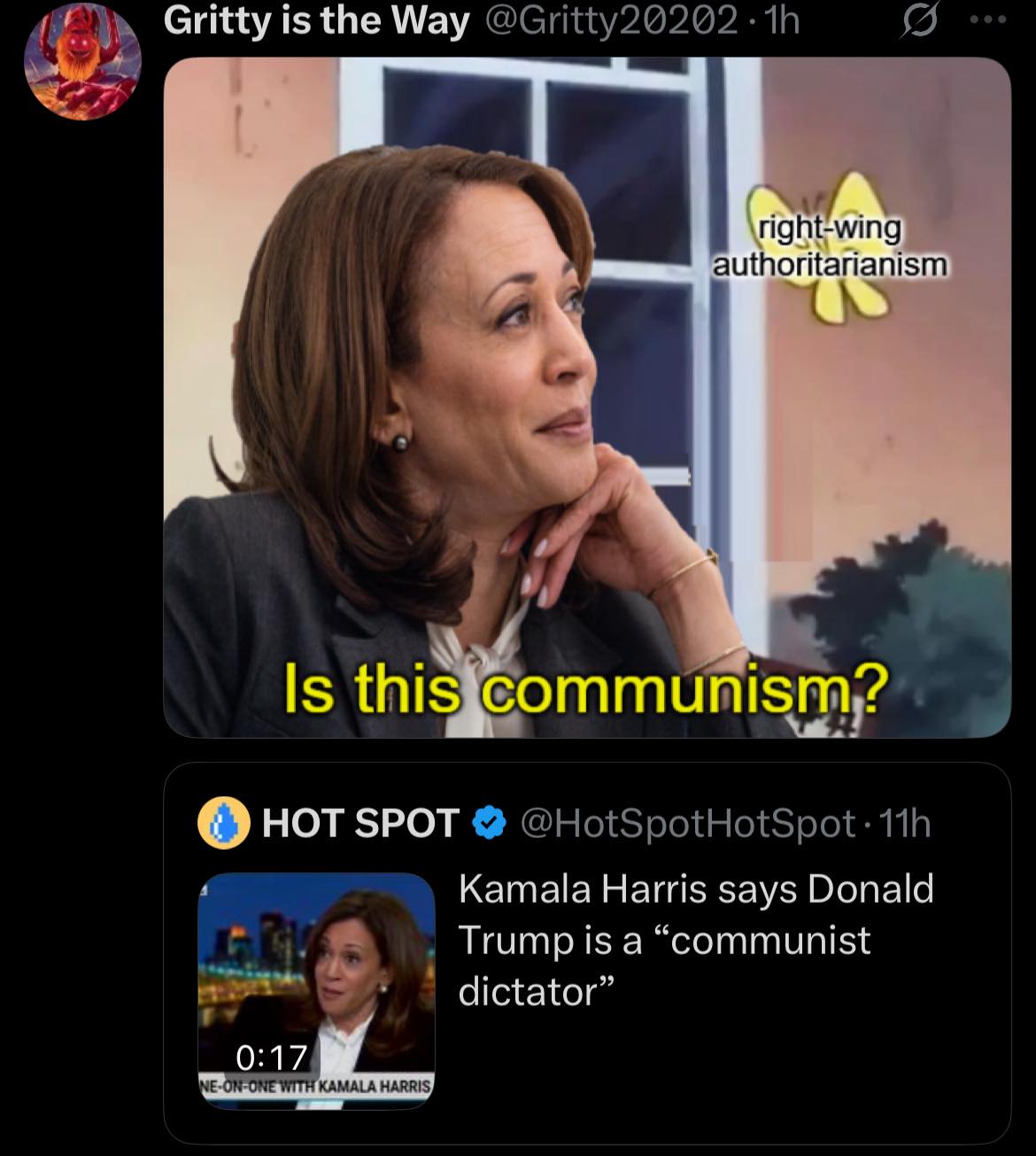
This meme plays on the anti-neoliberal distinction between liberal values and communist ideology by suggesting that Kamala Harris's defense of Donald Trump as a "communist dictator" actually advocates for state control or ownership. It argues that her support for "right-wing authoritarianism" is recontextualized from being a conservative stance into a socialist one, implying she is pushing for totalitarianism rather than democracy.
detailed-analysis (gemma3_27b-it-q8_0)
Okay, let's break down this meme through an Anti-Neoliberal lens, utilizing relevant theoretical frameworks where applicable.
Understanding the Anti-Neoliberal Context
Before diving in, it’s crucial to understand the core tenets of Anti-Neoliberalism. It's a broad, leftist political project that critiques the dominance of neoliberal policies (privatization, deregulation, austerity, free trade, etc.). It argues these policies have led to increased inequality, social fragmentation, and democratic backsliding. Anti-Neoliberals are often skeptical of mainstream political establishments, viewing both major parties as complicit in perpetuating the neoliberal order. A key aspect of this view is seeing the breakdown of traditional ideological lines, and recognizing how seemingly opposing forces can be instruments of the same underlying system.
Visual Description
The meme consists of two parts. First, a still image of Kamala Harris looking directly at the camera with a skeptical expression. Text overlays the image stating, "Is this communism?" Secondly, a tweet/video excerpt from the account @HotspotHotspot displaying a video clip of Kamala Harris stating that Donald Trump is a "communist dictator." The video has a timestamp of 0:17 and the branding “One-On-One with Kamala.” The top post is from @Gritty2020 and has the text “right-wing authoritarianism” as a label.
Foucauldian Genealogical Discourse Analysis
This meme is strongly rooted in a Foucauldian understanding of power and discourse.
- Discourse and Power/Knowledge: Foucault argued that power isn't simply repressive, but productive. It operates through discourses – systems of thought, language, and practices that shape our understanding of the world. This meme exposes how the discourse around “communism” has been weaponized to delegitimize any political opponent. It shows how the accusation of “communism” (which carries a strong historical baggage of Cold War anxieties) is deployed as a tool to control the narrative and mobilize opposition.
- Genealogy: A genealogical approach would trace the history of the term “communism” and how its meaning has shifted over time. Initially associated with utopian visions of equality, it was later distorted to be synonymous with totalitarianism and state control, particularly in the context of the Cold War. This meme reveals the absurdity of applying that label to Donald Trump, suggesting that the term has become so detached from its original meaning that it can be used to describe anything the establishment finds inconvenient.
- The "Normalization" of Extremes: The image is especially potent in its juxtaposition. By asking "Is this communism?" while referencing Harris calling Trump a “communist dictator,” the meme highlights how the political spectrum is being collapsed. It implies that the discourse of anti-communism is used to justify even authoritarian tendencies from within the establishment.
Critical Theory
From a Critical Theory perspective (drawing on thinkers like Adorno and Horkheimer), this meme is an example of how the "culture industry" produces and reproduces ideology.
- Instrumental Reason: The constant labeling of opponents as "communist" is a form of instrumental reason – reducing complex political phenomena to simplistic categories for the purpose of control. It prevents genuine critical engagement with the underlying issues.
- False Consciousness: The meme exposes how the elite’s portrayal of both Trump and communism can contribute to "false consciousness," where individuals are unaware of their own exploitation or the true nature of the power structures at play.
- The Dialectic of Enlightenment: This meme fits into the concept of the Dialectic of Enlightenment which shows how the pursuit of reason and progress (the “Enlightenment”) can paradoxically lead to new forms of barbarism and control. The anti-communist rhetoric, originally intended to defend liberal values, is shown to be utilized in ways that are deeply illiberal.
Marxist Conflict Theory
From a Marxist perspective, the meme exposes the class dynamics at play.
- Ideology as Class Struggle: The labeling of Trump as a "communist dictator" is not a genuine analysis of his policies; it’s an ideological maneuver designed to maintain the power of the ruling class. It distracts from the fact that Trump, despite his populist rhetoric, ultimately served the interests of capital by enacting tax cuts, deregulation, and other pro-business policies.
- The State as an Instrument of Class Rule: The fact that a member of the ruling class (Harris) is making this accusation further reinforces the idea that the state is not a neutral arbiter, but an instrument of class rule. The state apparatus uses discourse to suppress dissent and defend the existing order.
- False Opposition: The meme suggests that the Democratic and Republican parties aren’t actually opposed to each other. Instead they represent opposing factions within the same capitalist system.
Postmodernism
A Postmodern reading might emphasize the deconstruction of meaning and the collapse of grand narratives.
- Simulacra and Simulation: The meme suggests that the very concept of “communism” has become a simulacrum – a copy without an original. It’s a signifier that has been emptied of its substance and is now used purely for rhetorical effect.
- The Death of Grand Narratives: The meme challenges the grand narrative of “anti-communism” and suggests that it has lost its legitimacy. It shows how the political landscape has become so fragmented and chaotic that traditional ideological categories no longer apply.
In conclusion, this meme, within an Anti-Neoliberal framework, is a cynical commentary on the manipulation of language, the blurring of ideological boundaries, and the co-option of critical terms by the establishment. It's a pointed critique of how power operates through discourse, and how both major political parties are ultimately complicit in maintaining the existing neoliberal order. It is a recognition that in the present moment, the key struggle isn’t necessarily “left vs. right”, but rather against the systems of power that produce and reproduce inequality and oppression.
Disclaimer: This analysis is offered based on the stated theoretical framework and the provided image. Interpretations can vary, and this is not exhaustive.
simple-description (llama3.2-vision_11b)
The meme features a photo of Kamala Harris with a caption that questions whether she is a communist, implying that her policies are aligned with communism. The image is likely used to criticize her for being too left-wing or socialist, as the meme's creator is likely an anti-neoliberal who is critical of her policies. The text "Is this communism?" is a play on the phrase "Is this communism?" which is often used to criticize or mock someone's policies or actions as being communist or socialist.