First Seen
2025-09-20T00:49:59.611843+00:00
simple-description (qwen3.5_2b-q8_0)
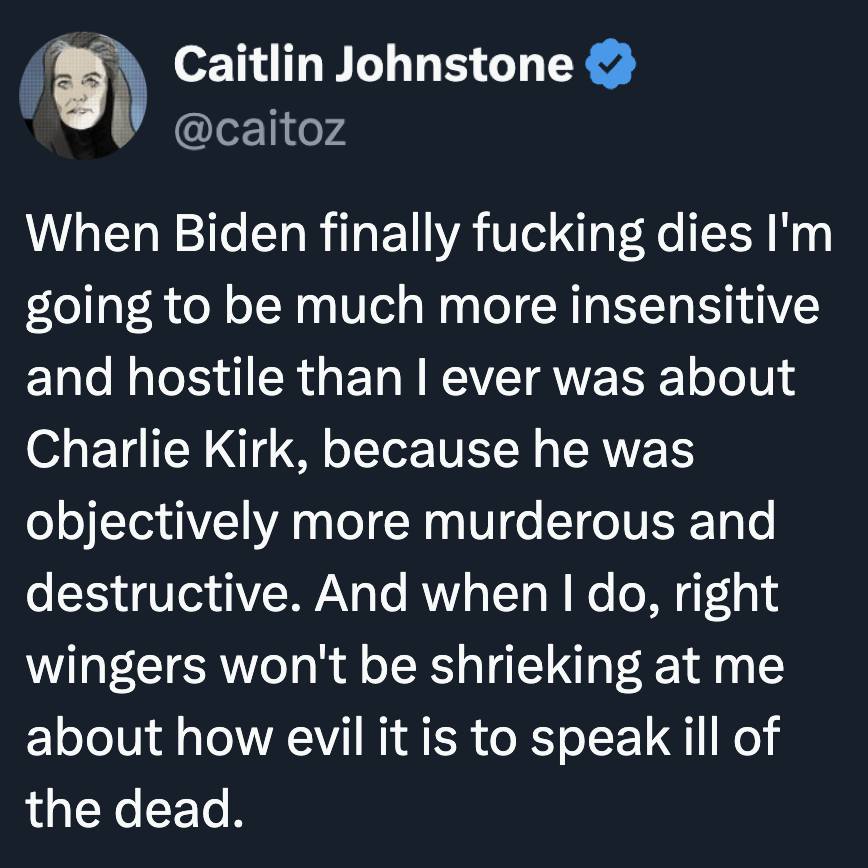
This image displays a screenshot of a controversial political tweet featuring aggressive self-defense rhetoric against figures like Biden and Charlie Kirk. The text in the image reads: "When Biden finally fucking dies I'm going to be much more insensitive and hostile than I ever was about Charlie Kirk, because he was objectively more murderous and destructive. And when I do, right wingers won't be shrieking at me about how evil it is to speak ill of the dead."
In the context of Anti-Neoliberalism, this meme attacks the idea that wealth or political power automatically grants a person moral superiority; by claiming to be "less evil" than these leaders, it mocks their arrogance and suggests they are exempt from accountability for destructive behaviors.
detailed-analysis (gemma3_27b-it-q8_0)
Okay, let's break down this meme from the perspective of an Anti-Neoliberal framework. It's a dense statement, so we'll explore the layers as requested.
Visual Description
The image is a screenshot of a Twitter post from Caitlin Johnstone (@caitoz), a prominent anti-imperialist, anti-neoliberal commentator. It shows her profile picture (a stylized portrait) alongside a direct text statement. The simplicity of the presentation is typical of Twitter and relies on concise, provocative language to grab attention.
Marxist Conflict Theory
This meme is deeply rooted in Marxist conflict theory. Here's how:
- Class Struggle & Power Dynamics: Anti-Neoliberalism, at its core, is about challenging the dominant neoliberal order—the system which has seen a massive transfer of wealth and power to the capitalist class and a corresponding erosion of social safety nets and democratic institutions. Johnstone’s statement directly addresses this by framing Joe Biden (representing the establishment, the Democratic wing of the US imperial power structure) as potentially more damaging than figures like Charlie Kirk (representing a more visibly reactionary, but ultimately subordinate element). The underlying assumption is that systemic power—the power of the state, of capital—is the primary driver of harm, not individual actors alone.
- Ideological Hegemony: The final sentence ("And when I do, right wingers won’t be shrieking at me about how evil it is to speak ill of the dead.") is a critique of the way dominant ideologies (in this case, a form of conventional, sentimental morality) are used to silence dissent. Right-wingers are presented as hypocritical enforcers of this ideology, conveniently overlooking the harms inflicted by those in power while eagerly condemning criticism of their allies. This points to the way ideology functions to maintain the status quo.
- The State as an Instrument of Class Rule: The entire premise of the meme—that Biden’s actions could be more destructive than those of a firebrand like Kirk—revolves around the understanding that the state (represented by Biden) is the ultimate instrument of class rule and imperial power. Kirk is a symptom of the system; Biden is a key architect of it. The meme argues that the harms enacted through the state are far more widespread and insidious, making their potential consequences far graver.
Critical Theory
- Critique of Political Rationality: The meme challenges conventional notions of political decorum. The idea that one should refrain from criticizing even a deceased political figure, especially on moral grounds, is seen as a tool to legitimize the existing power structure. Johnstone is asserting that moral considerations must be secondary to an analysis of systemic harm.
- Rejection of False Equivalencies: The core point—that Biden is "objectively more murderous and destructive" than Charlie Kirk—is a rejection of the liberal tendency to create false equivalencies. In other words, to place figures who are clearly operating on different levels of power and responsibility on the same moral footing. Kirk may be hateful, but his ability to inflict widespread harm is limited. Biden, as President, has the power to authorize wars, enact policies that lead to suffering, and perpetuate imperial violence.
- The Problem of "Respectability Politics": The last sentence also subtly critiques "respectability politics"—the idea that marginalized groups must conform to dominant norms to be taken seriously. In this case, the norm is deferential treatment of political figures, even in death. Johnstone is refusing to play by those rules, signaling a commitment to radical critique over polite discourse.
Foucauldian Genealogical Discourse Analysis
- Power/Knowledge: This meme implicitly examines the relationship between power and knowledge. The "right wingers" referenced are positioned as possessing a particular discourse—a set of beliefs and values—that serves to uphold a particular power structure. Their outrage at criticizing the dead is not simply a matter of morality; it’s a strategy to control the narrative and delegitimize dissent.
- Genealogy of Morality: Johnstone is challenging the genealogy (historical development) of the idea that one should not speak ill of the dead. She’s suggesting that this is not a universal moral principle, but a culturally constructed norm that has evolved to serve specific power dynamics. The historical emergence of this norm is linked to the need to legitimize authority and suppress criticism of those in power.
- Discursive Formation: This meme seeks to disrupt the discursive formation around death and politics. Usually, death invokes respect and silence. The meme actively rejects that, claiming Biden’s actions will merit harsher critique precisely because of the power he wielded.
Postmodernism
While not a central element, a touch of postmodernism is present:
- Deconstruction of "Objectivity": The use of the word "objectively" is somewhat ironic. Postmodern thought questions the very notion of objectivity, arguing that all knowledge is situated and influenced by power dynamics. Johnstone is using "objectively" as a rhetorical device to emphasize the scale of the harm caused by Biden, not as a claim to absolute truth. She is highlighting the material effects of his policies.
- Rejection of Grand Narratives: Anti-Neoliberalism, as a project, is inherently skeptical of grand narratives of progress or national greatness. It questions the idea that the US (or any powerful nation) is a force for good in the world. The meme aligns with this skepticism by focusing on the concrete harms inflicted by those in power, rather than appealing to abstract ideals.
In Summary:
From an Anti-Neoliberal perspective, this meme is a blunt, provocative statement that challenges conventional political discourse and highlights the systemic nature of harm. It rejects false equivalencies, critiques ideological hegemony, and asserts the primacy of material consequences over sentimental morality. It is a call to radical critique and a refusal to be silenced by the dominant power structure. It's not about personal dislike; it's about the stakes of power and the urgent need to confront the destructive forces of neoliberal capitalism and US imperialism.
simple-description (llama3.2-vision_11b)
The meme is a tweet from Caitlin Johnstone, a journalist and commentator, criticizing the Biden administration's handling of the COVID-19 pandemic. The tweet is written in a sarcastic and humorous tone, with the author expressing their frustration with the administration's policies and the lack of transparency. The text reads: "When Biden finally f**ks up and dies, I'm going to be so much more polite and less angry than I am now about Biden."