First Seen
2025-07-07T02:43:15.530014+00:00
detailed-analysis (gemma3_27b-it-q8_0)
Okay, let's break down this tweet from rawiya kameir from an Anti-Neoliberal perspective, incorporating the requested analytical frameworks where relevant. Given the framing of Anti-Neoliberalism, we'll center on how this tweet exposes the disconnect between performative politics, personal narratives, and the structures of power that underpin the current system.
Overall Framing: Anti-Neoliberal Lens
Anti-Neoliberalism fundamentally critiques the ideology of free-market capitalism, deregulation, privatization, and austerity. It views these policies as leading to social and economic inequality, the erosion of public services, and the prioritization of profit over people. The tweet, in this light, isn’t just about a specific politician or ad campaign, it’s about the performance of empathy and the weaponization of personal tragedy to solidify power within a system that actively causes the conditions described (healthcare access failures, precarity, etc.). It points to a deeply cynical manipulation of genuine suffering for political gain.
Visual Description
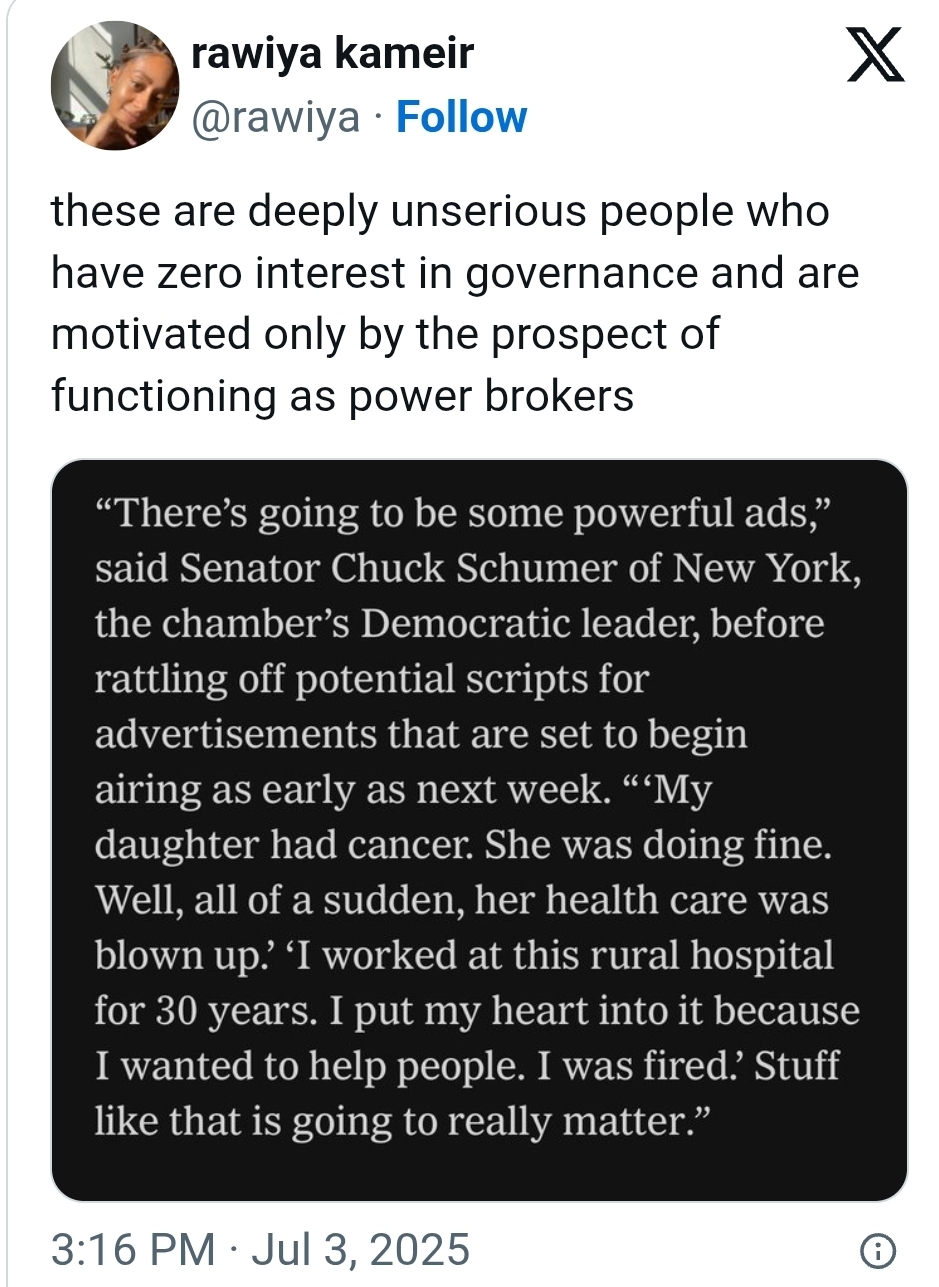
The visual element is a screenshot of a tweet from rawiya kameir (@rawiya). It includes her profile image, a dark-skinned woman with a headscarf. Below this is the tweet itself, formatted in a Twitter/X style with time and date stamps. The core of the image is the text, a direct quote from Senator Chuck Schumer, followed by a personal anecdote (presented as potentially being used for advertising). The simplicity of the visual reinforces the directness of the critique - it's the words that are doing the work.
Foucauldian Genealogical Discourse Analysis
This is extremely relevant. Foucault’s work on power and discourse, and particularly his genealogical method, is highly applicable.
- Power/Knowledge: Schumer's statement exemplifies the relationship between power and knowledge. He possesses the power to deploy narratives – in this case, a heartbreaking personal story – to shape public perception and justify (or deflect from) policies. The anecdote isn’t presented as a genuine attempt to understand the root causes of healthcare failures, but as a tool to garner sympathy and legitimize his own position.
- Discursive Formation: The discourse around “healthcare reform” is a crucial element. It's often framed within individualized narratives of suffering, masking the systemic issues driving those narratives. Schumer’s story fits neatly into this discourse, allowing him to appear compassionate without challenging the structures that led to his daughter’s situation. This tweet exposes this formation.
- Genealogy: Tracing the history of this discourse reveals how it has evolved to prioritize market-based solutions (e.g., private insurance, individual responsibility) rather than universal healthcare. Schumer, as a prominent politician, is a key figure in the continuation of this problematic genealogical line.
Critical Theory
Critical Theory, particularly drawing from the Frankfurt School, is very pertinent.
- Culture Industry: Schumer’s potential use of this story can be seen as part of the "culture industry." The anecdote is being transformed into a commodity - an emotional appeal that can be packaged and sold to the public. It's not about genuine engagement with the issue; it's about manufacturing consent.
- Commodification of Suffering: The core critique of the culture industry is precisely this: the commodification of experiences and emotions. Schumer is potentially leveraging his daughter’s experience for personal and political gain. This is an example of how deeply the logic of the market permeates even the most personal spheres of life.
- False Consciousness: The ad campaign, framed by this narrative, could perpetuate a "false consciousness" – a situation where people are unaware of the true forces shaping their lives. The focus on individual stories obscures the systemic problems and prevents meaningful collective action.
Marxist Conflict Theory
The tweet highlights the inherent conflict of interest within the capitalist system.
- Class Struggle: The anecdote implicitly points to the class-based inequalities that impact healthcare access. Someone with Schumer’s resources likely had access to better care, even within a flawed system, compared to many others. The tweet reveals the hypocrisy of a politician benefiting from a system that simultaneously disadvantages many.
- Ideology & Material Conditions: The story is ideological. It presents suffering as an individual tragedy rather than a consequence of material conditions—specifically, the prioritization of profit over people in the healthcare industry.
- The State as a Tool of the Ruling Class: Schumer, as a senator, represents the state. This tweet positions the state not as a neutral arbiter but as an instrument of the ruling class, deploying narratives to maintain its power.
Postmodernism
Postmodernism isn't as central here, but elements are present.
- Simulacra and Simulation: The potential ad campaign could be seen as a "simulacrum" – a copy without an original. It's a manufactured emotional appeal designed to mimic genuine concern. The very representation of the experience becomes more important than the experience itself.
- Deconstruction of Grand Narratives: Anti-Neoliberalism is, in part, a deconstruction of the grand narrative of "progress" and "free markets." This tweet embodies that by exposing the cynicism beneath the surface of political discourse.
Queer Feminist Intersectional Analysis
While the direct link isn't as obvious, it's still relevant.
- Interlocking Systems of Oppression: The healthcare system is not neutral; it operates within interlocking systems of oppression based on race, class, gender, and other factors. While the anecdote doesn’t directly address these intersections, it acknowledges a system that failed someone within it, raising questions about who is most likely to be failed by that system.
- Critique of the Public/Private Divide: The story points to the failures of the private healthcare system and its impact on individual lives. A queer feminist analysis would question the very notion of a clear separation between the public and private spheres, arguing that the private is always politicized.
In conclusion, rawiya kameir’s tweet is a sharp critique of the performative politics and cynical manipulation that characterize the current political landscape, as viewed through an Anti-Neoliberal lens. It highlights the use of personal narratives to obscure systemic problems, maintain power, and perpetuate a fundamentally unjust system. The analytical frameworks above help to unpack the layers of this critique and expose the deep contradictions at play.
simple-description (llama3.2-vision_11b)
The meme is a screenshot of a Twitter post from a user named @rawiya, who is criticizing a news article about a politician's statement. The article is not provided in the text, but the user is expressing their frustration with the politician's comment about the news article's focus on a politician's comment on the news article's focus on a politician's comment. The user is saying that the politician's comment is not being reported in the news article, and that the news article is not reporting the politician's comment. The user is also saying that the news article is not reporting the politician's comment, and that the news article is not reporting the politician's comment. The user is also saying that the news article is not reporting the politician's comment, and that the news article is not reporting the politician's comment.
detailed-analysis (gemma3-27b-vision)
Okay, here's an analysis of the provided Twitter post, broken down into relevant sections as requested. I'll explain why some sections don't apply if necessary.
Please note: This analysis is based solely on the provided text and visual. A full, nuanced understanding would require broader context (the speaker's history, the political landscape, etc.).
Visual Description
The image is a screenshot of a Twitter (now X) post. The profile picture is of a person with brown skin, curly dark hair, and appears to be wearing a patterned top. The username is "@rawiya" and the name associated with the account is "rawiya kameir". The tweet itself is displayed in a black rectangular box with white text. The timestamp shows "3:16 PM · Jul 3, 2025." The tweet consists of a critical statement about politicians and a direct quote attributed to Senator Chuck Schumer, followed by a personal anecdote. A small "X" icon indicating a following status is visible at the upper right of the post.
Foucauldian Genealogical Discourse Analysis
This post offers fertile ground for Foucauldian analysis.
-
Discourse & Power: The post directly critiques the discourse of politicians, framing them as motivated by self-interest ("power brokers") rather than genuine public service. Foucault would be interested in how this framing constructs the reality of politics – it doesn’t simply reveal something true, but actively creates an understanding of politicians as inherently untrustworthy.
-
Genealogy of "Ads" & Political Communication: Tracing the "genealogy" of the concept of "ads" in politics (as Schumer refers to) would be revealing. How has political communication evolved from public debate to increasingly sophisticated marketing strategies? Foucault would ask how this shift has changed the relationship between the governing body and the governed. The implication here is that politics has become performative—a matter of creating an image rather than enacting policy.
-
Power/Knowledge: The tweet implies a power imbalance. Senator Schumer, as a prominent figure, has the power to disseminate his message (through "powerful ads"). Rawiya kameir's tweet is a counter-discourse, attempting to challenge that power. The personal anecdote about the daughter and the fired employee functions as a form of "truth-telling" against the perceived manipulation of politicians.
Critical Theory
This post aligns well with Critical Theory, particularly its focus on questioning dominant ideologies and revealing power structures.
- Ideology Critique: The tweet is a direct critique of the ideology that justifies political behavior. Rawiya kameir is challenging the idea that politicians act in the public interest, suggesting instead they are driven by personal ambition and a desire for influence.
- Unmasking of Structures: The tweet seeks to "unmask" the underlying structures of power that govern political behavior. It suggests that behind the rhetoric of public service, there is a hidden agenda of self-promotion.
- Emancipation: The tweet, by exposing these dynamics, can be seen as a call for emancipation – a demand for a more transparent and accountable political system. The personal story is meant to draw sympathy and outrage, furthering that call to action.
Marxist Conflict Theory
This post can be interpreted through a Marxist lens, though it's not a direct application.
- Class Struggle (Implicit): While not explicitly about economic classes, the tweet implies a struggle between those in power (politicians) and those affected by their decisions (the daughter with cancer, the fired hospital worker). The anecdote centers the experience of someone being exploited in a healthcare system that prioritizes profit over people.
- Ideology and False Consciousness: The "powerful ads" can be seen as part of the "superstructure" in Marxist terms—a system of ideas that reinforce the dominant class's power. The tweet implies that these ads create a "false consciousness" among the public, masking the true nature of political motivations.
- Alienation: The fired hospital worker's story hints at alienation—the separation of individuals from the fruits of their labor. They put their heart into their work, only to be dismissed—a consequence of a system that prioritizes profit.
Postmodernism
The post exhibits some characteristics of Postmodern thought:
- Rejection of Grand Narratives: The tweet challenges the "grand narrative" of benevolent governance. It suggests that there is no overarching truth or purpose behind political action, only the pursuit of power.
- Deconstruction: The tweet "deconstructs" the image of the politician as a public servant, revealing what it sees as the self-serving motives beneath the surface.
- Focus on Discourse & Representation: The emphasis on "ads" and "scripts" highlights the importance of discourse and representation in shaping our understanding of reality. The message is not about the inherent truth of a situation, but about how that truth is constructed through language and imagery.
Queer Feminist Intersectional Analysis
This area is less directly applicable, but can still be considered.
- Intersectionality: The personal anecdote—the daughter with cancer and the fired worker—suggests an intersection of vulnerabilities and systems of power. The anecdote evokes feelings of a lack of care in a healthcare system that is supposed to serve the public.
- Power Dynamics & Vulnerability: The anecdote centers the experience of someone who has experienced vulnerability. The implication is that powerful figures like Senator Schumer are distanced from the everyday realities of those they govern.
- Challenge to Dominant Narratives (Subtle): While not explicitly feminist or queer, the tweet challenges the dominant narrative of power and agency. By giving voice to marginalized experiences, it questions the authority of those in power and demands a more inclusive and compassionate political system.
Important Note: This is just one possible interpretation. The meaning of the text is open to debate, and other readings are certainly possible. The richness of the text lies in its ability to evoke multiple levels of analysis.
simple-description (llama3.2-vision)
The meme is a satirical commentary on the contrast between the public's perception of powerful individuals and their actual behavior. The image features a tweet with a quote from Senator Chuck Schumer, who is known for his advocacy for social justice and his support for various progressive causes. However, the quote itself is not particularly remarkable or attention-grabbing, and it is presented in a way that is meant to be humorous or ironic rather than serious or inspirational. The tone of the tweet is critical and mocking, suggesting that the public's perception of powerful individuals is often based on their public image rather than their actual actions or policies. The use of a famous person's quote in a way that is meant to be humorous or ironic is a common technique used in satirical commentary. Overall, the meme is meant to be thought-provoking and to challenge the public's perception of powerful individuals. It is not meant to be taken seriously or to be taken as a personal attack on Senator Chuck Schumer.