First Seen
2025-07-07T02:35:42.409641+00:00
detailed-analysis (gemma3_27b-it-q8_0)
Okay, let's break down this meme from an Anti-Neoliberal perspective, utilizing relevant theoretical frameworks where applicable.
Please note: This analysis will be a complex interpretation, given the meme's inflammatory language and the inherent biases within the Anti-Neoliberal framework itself. It will aim to explain how someone within this framework would interpret it, not necessarily endorse the views presented. Also, due to the meme's aggressive tone, some analysis will be tempered to avoid merely repeating the inflammatory rhetoric.
Visual Description
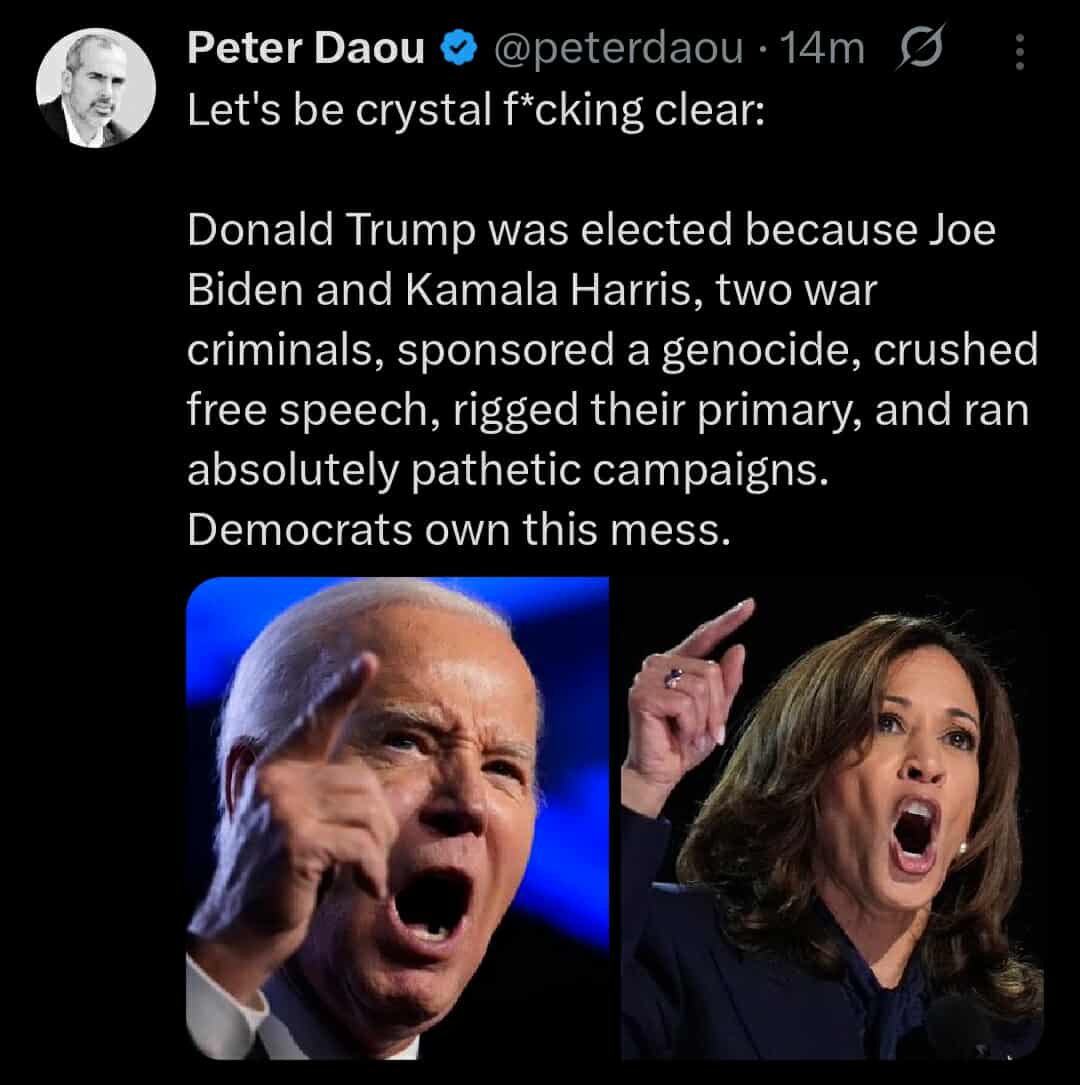
The image depicts Joe Biden shouting aggressively on the left, and Kamala Harris shouting equally aggressively on the right. Both are shown with open mouths, appearing as if caught in mid-scream. The framing is tight, focusing heavily on their faces and emphasizing the intensity of their expressions. The lighting and color scheme is stark, heightening the dramatic effect. It’s designed to evoke a sense of outrage and alarm.
Foucauldian Genealogical Discourse Analysis
From an Anti-Neoliberal perspective influenced by Foucault, this meme can be read as an attempt to dissect the discourse surrounding the 2016 election (and subsequent political realities). The Anti-Neoliberal position would see the mainstream narrative – often promoted by Democrats themselves – as a constructed reality that obscures the underlying power dynamics at play.
- Genealogy of Power: The "war criminals," "genocide," and "rigged primary" accusations aren’t necessarily taken at face value, but as symptoms of a deeper historical process of power consolidation. They’re interpreted as reflections of the Democrats' role in the rise of neoliberal policies that have caused suffering globally (through war, austerity, and displacement).
- Discursive Formation: The meme attacks the way Democrats speak about politics – their attempts to present a “reasonable,” “moderate” face while pursuing policies that Anti-Neoliberals view as fundamentally destructive. The aggressive yelling in the image is meant to expose the "hypocrisy" and underlying violence inherent in this discourse.
- Power/Knowledge: The accusation of "crushing free speech" suggests a concern about the control of narratives and the silencing of dissenting voices within the Democratic party. Anti-Neoliberals often critique the tendency to label certain viewpoints as “extremist” or “dangerous,” effectively removing them from public debate.
Critical Theory
Critical Theory, especially in its Frankfurt School iterations, would see this meme as a critique of the "instrumental rationality" of the Democratic party.
- The Culture Industry: The meme can be seen as a rejection of the carefully crafted political branding and "performative" politics of Democrats. The shouting imagery is a rejection of the smooth, sanitized presentation of political candidates.
- False Consciousness: The claim that Trump’s election was caused by the Democrats suggests the Democratic party, through its actions, created the conditions for its own downfall. This is related to the idea of "false consciousness," where individuals unwittingly support systems that harm them. The idea is that the Democratic party’s policies contributed to the conditions that allowed for a figure like Trump to rise to power.
- Critique of Enlightenment Reason: The outrage in the meme can be read as a critique of the belief in "progress" and rational solutions to complex problems. The anti-neoliberal view often argues that liberal institutions have become instruments of oppression, rather than tools for liberation.
Marxist Conflict Theory
This meme is deeply rooted in Marxist analysis of class struggle and the role of the ruling class.
- Class Reductionism (potentially): While the meme doesn’t explicitly mention class, an Anti-Neoliberal would interpret the "war criminal" and "genocide" accusations as ultimately connected to the exploitation of the working class, both domestically and internationally. The Democrats are seen as representing the interests of the capitalist class.
- Hegemony: The accusation of rigging the primary suggests a deliberate attempt by the Democratic party establishment to maintain its control and suppress alternative, potentially more progressive candidates. This speaks to the concept of hegemony – the dominance of a ruling class ideology that becomes naturalized and accepted as common sense.
- The State as an Instrument of Class Rule: The "war criminal" label implicates the Democrats in the use of state power to advance the interests of capital, often at the expense of ordinary people.
Postmodernism
While Anti-Neoliberalism doesn’t necessarily embrace postmodernism, there’s a degree of overlap in its critique of grand narratives and essentialist identities.
- Deconstruction: The meme functions as a deconstruction of the Democratic party's self-image. It tears down the façade of moderation and compassion, revealing a more sinister reality beneath the surface.
- Rejection of Meta-Narratives: The accusation that Democrats “own this mess” is a rejection of the dominant narrative that blames external factors (e.g., Russian interference, right-wing extremism) for the problems facing the United States. It places the blame squarely on the Democrats themselves.
- Relativism (potential): Anti-Neoliberals are often wary of moral absolutes. The aggressive language in the meme reflects a willingness to challenge conventional notions of right and wrong.
In Summary
From an Anti-Neoliberal perspective, this meme is not simply an expression of anger or frustration. It’s a complex attempt to expose the underlying power dynamics that shape American politics. It’s a critique of the Democratic party’s role in perpetuating neoliberal policies, suppressing dissent, and ultimately creating the conditions that allowed for the rise of Donald Trump. It utilizes a combination of Foucauldian, Critical Theory, and Marxist frameworks to deconstruct the dominant narrative and reveal a more radical alternative vision.
It's important to recognize that this is a highly subjective interpretation. The meme’s inflammatory language and the biases inherent in the Anti-Neoliberal framework make it difficult to offer a neutral analysis. However, this breakdown attempts to explain the meme's meaning from the perspective of someone who subscribes to this political ideology.
simple-description (llama3.2-vision_11b)
This meme is a critique of the 2020 US presidential election, specifically targeting the Democratic Party's candidates, Joe Biden and Kamala Harris. The text "Democrats own this mess" is a sarcastic comment implying that the Democratic Party is responsible for the country's problems, and the image is a visual representation of the anger and frustration that comes with this sentiment.
detailed-analysis (gemma3-27b-vision)
Okay, let's break down this social media post using the requested theoretical lenses. Please note that applying all of these isn’t always necessary or fruitful, and some might be stretches. I’ll highlight when that’s the case. I will attempt to be thorough but also concise.
1. Visual Description
The image is a composite. On the left is a close-up of Donald Trump speaking at a rally, mouth open in what appears to be shouting, and on the right is a similar image of Kamala Harris also with her mouth open in an expressive vocalization. The composition juxtaposes the two politicians, visually linking them, despite the post's message being accusatory towards Biden and Harris. Both images have a high degree of emotionality – suggesting aggressive or impassioned speech. The background for both photos is blurred, likely indicating a rally or public event.
2. Foucauldian Genealogical Discourse Analysis
This post is ripe for Foucauldian analysis. The text constructs a narrative of responsibility by attributing the election of Trump (and implicitly, everything that followed) to the actions of Biden and Harris. This isn't about "truth" but about the power of discourse to define events and assign blame.
- Discourse & Power: The post establishes a discourse of moral outrage and accountability. It doesn’t present evidence; it asserts a connection between actions ("war criminals," "sponsored a genocide," "crushed free speech") and a specific outcome (Trump's election). This assertion is an exercise of power—an attempt to define the narrative.
- Genealogy: A genealogical approach would investigate how these accusations gained meaning. It would look at the historical development of ideas around "war criminality," "genocide," and "free speech" to see how those concepts were deployed within a specific political context. It would trace how the meaning of these terms was constructed and used to frame the actors (Biden, Harris, Trump) in this particular way.
- Normalization: The sweeping accusations (genocide, war crimes) could be seen as an attempt to normalize extreme rhetoric. Even if not universally accepted, repeatedly deploying such language can desensitize audiences and reshape the boundaries of acceptable political discourse.
3. Critical Theory
From a Critical Theory perspective, the post can be viewed as an example of a hegemonic struggle.
- Ideology: The post presents a specific ideology – a framework for understanding the world that serves a particular (likely conservative) political agenda. This ideology positions Democrats as inherently corrupt and destructive, creating a narrative that justifies opposition to their policies.
- Domination & Resistance: This post can be seen as a form of political resistance (even if the claims are baseless). It’s an attempt to subvert the dominant narrative by presenting an alternative explanation for the rise of Trump and the perceived failures of the Democratic party.
- Critique of Reason: The level of extreme accusation within the text demonstrates a rejection of reasoned debate. Instead of engaging with evidence or arguments, the poster relies on emotional appeals and hyperbolic claims to persuade their audience.
4. Marxist Conflict Theory
While not a direct Marxist analysis, we can see elements of conflict in the post.
- Class Struggle (subtle): The accusations of corruption and manipulation could be seen as tapping into populist resentment against the political elite, implying that Biden and Harris are part of a ruling class that prioritizes its own interests over those of the people.
- Ideological Struggle: The post represents an ideological conflict between competing political perspectives. The author is attempting to delegitimize the Democratic party and rally support for an opposing worldview.
- False Consciousness: This post could also be read as an attempt to instill a "false consciousness" in the audience – convincing them that Trump’s election was a result of Democratic wrongdoing, rather than considering other factors like economic inequality or racial tensions.
5. Postmodernism
The post has elements consistent with postmodern thought.
- Rejection of Grand Narratives: The post implicitly rejects the "grand narratives" of mainstream politics and media. It doesn’t accept the conventional explanations for Trump’s election; instead, it offers a radical, alternative interpretation.
- Deconstruction of Truth: The post doesn’t rely on objective truth; it constructs a reality through subjective claims and emotional appeals. It’s not interested in accuracy; it’s interested in persuasion.
- Simulation & Hyperreality: The post could be seen as contributing to a hyperreal political landscape where image and rhetoric are more important than substance. The extreme accusations create a sense of heightened drama and spectacle that eclipses nuanced discussion.
6. Queer Feminist Intersectional Analysis
This is the weakest application of these lenses. The post itself doesn’t directly address issues of gender, sexuality, or intersectionality. However, a stretched analysis could consider:
- Patriarchal Undercurrents: Trump's appeal may have leveraged patriarchal and sexist rhetoric. By framing Democrats as responsible for preventing him from power, the post could be seen as subtly reinforcing a worldview that privileges male authority and challenges female leadership (like that of Harris).
- Dismissal of Marginalized Voices: The author’s attempt to control the narrative and silence opposing views can be seen as a form of oppression. This can affect marginalized groups that may have different perspectives on Trump’s election and its consequences.
- Intersectionality of Oppression: This is a difficult stretch, but you could argue that the post creates a narrative that reinforces existing power structures and perpetuates harm to marginalized groups by presenting a simplified and divisive understanding of complex political issues.
Disclaimer: These are interpretations based on theoretical frameworks. The actual intentions of the author are unknown, and the post can be viewed from many different perspectives. The analysis provided aims to illustrate how these theoretical lenses can be applied to understand complex social and political phenomena.
simple-description (llama3.2-vision)
The meme is a tweet from Peter Daou that criticizes the 2020 US presidential election and the subsequent administration of President Joe Biden and Vice President Kamala Harris. The tweet states that Biden and Harris were elected because of two war criminals, sponsored a genocide, crushed free speech, rigged their primary, and ran an "absolutely pathetic" campaign. The tweet also includes two images of Biden and Harris with their mouths open, as if they are shouting or speaking. The overall tone of the tweet is one of criticism and disapproval of the Biden-Harris administration.