First Seen
2025-06-25T07:21:57.880955+00:00
detailed-analysis (gemma3_27b-it-q8_0)
Okay, let's break down this meme/tweet from an Anti-Neoliberal perspective, utilizing the requested theoretical frameworks where applicable.
Overall Framing: Anti-Neoliberal Interpretation
From an Anti-Neoliberal stance, this meme represents a critique of the Democratic Party's consistent co-optation of progressive rhetoric while fundamentally maintaining a system that benefits capital and the wealthy. The core argument is that Democrats, despite positioning themselves as an alternative to Republicans, operate within the same neoliberal framework, and thus are effectively the same. The vetoed bills (affordable housing and unemployment for striking workers) highlight the limitations of "center-left" politics when facing genuine challenges to the status quo. Anti-Neoliberals would argue these bills, while seemingly progressive, likely contain concessions that ultimately reinforce existing power structures.
1. Visual Description
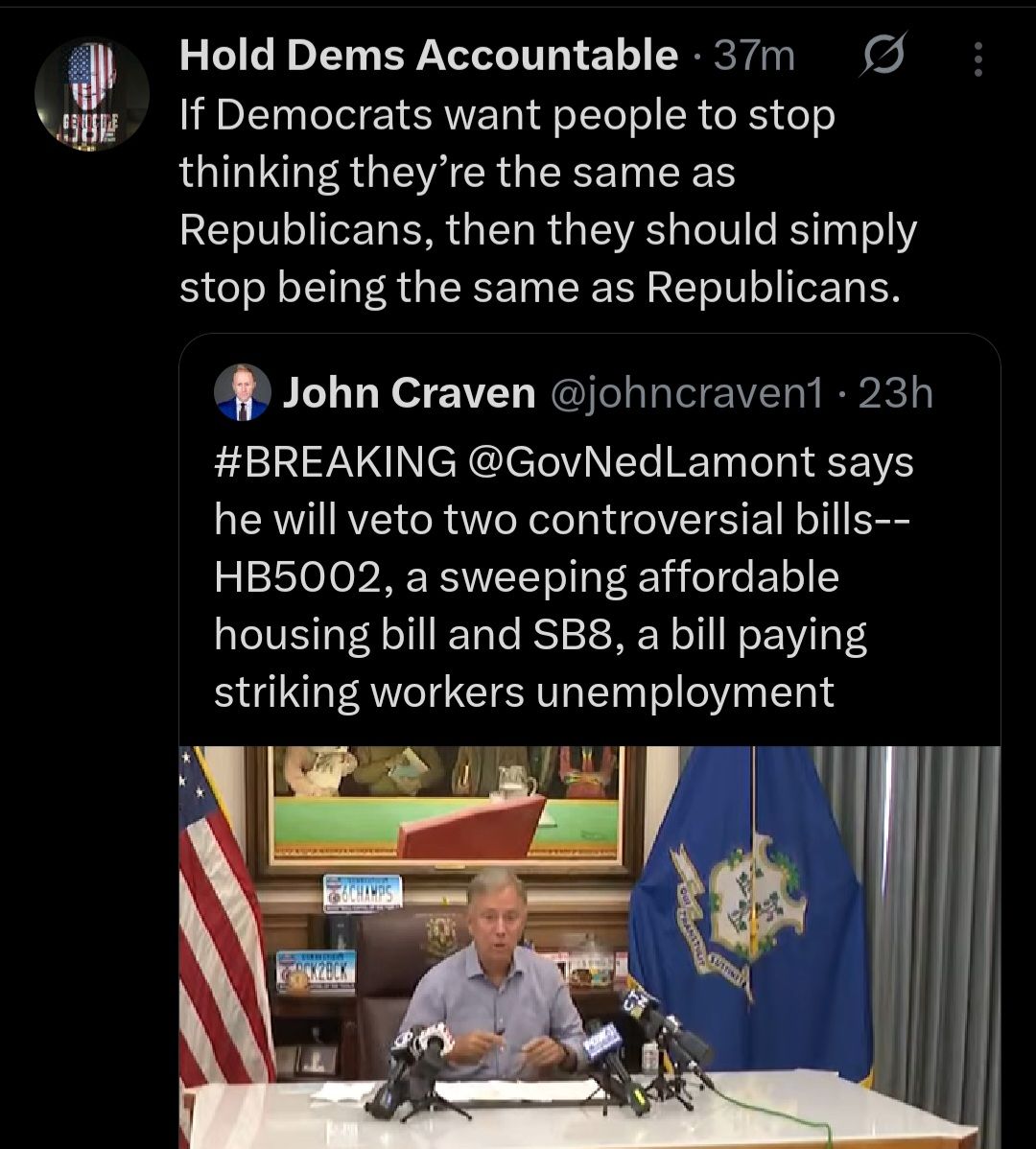
The image shows Connecticut Governor Ned Lamont during a press conference, surrounded by microphones and the state flag. He's speaking at a podium in what appears to be an official office setting. His expression is serious. The background contains various paraphernalia associated with state and local branding.
From an anti-neoliberal perspective, the visual reinforces the idea of institutional power. Lamont, as a representative of the state, embodies the bureaucratic apparatus that is seen as complicit in upholding neoliberal policies. The flags and symbols are not markers of unity or progress, but of an established power dynamic. The microphones represent the controlled narrative, where Lamont can articulate a message that ultimately serves the dominant ideology.
2. Foucauldian Genealogical Discourse Analysis
This meme is very amenable to a Foucauldian reading. Foucault explored how discourses create and maintain power relations. In this case, the discourse around the Democratic Party is one of "lesser evil" – a framing that subtly normalizes and legitimizes a system inherently detrimental to working people.
- Genealogy of "Progressive" Discourse: An anti-neoliberal reading would trace the history of "progressive" rhetoric within the Democratic Party, revealing how it’s often been deployed strategically to manage dissent and contain radical demands. The “affordable housing” and “striking worker unemployment” bills are not inherently radical; they’re presented as progressive, but within a framework that prevents more fundamental changes.
- Power/Knowledge: The image, alongside the text, points to how power operates through knowledge. The Democratic Party controls the narrative (through its media access, expert endorsements, etc.), constructing a “truth” about itself as a champion of the people, despite actions that contradict this claim.
- Governmentality: The state (represented by Lamont) operates through “governmentality,” meaning it governs not simply by force, but by shaping the conduct of citizens, instilling certain norms and values (like acceptance of “realistic” incrementalism). The veto is not merely a denial of policy, it’s a re-assertion of this governing logic.
3. Marxist Conflict Theory
This is a central lens for understanding the meme’s anti-neoliberal message.
- Class Struggle: The vetoed bills represent a loss for the working class. Affordable housing benefits those struggling with the cost of living, and unemployment benefits for striking workers empower labor in its conflict with capital. The veto sides with the interests of capital, protecting profit over people's needs.
- False Consciousness: The Democrats’ ability to garner support from working-class voters despite policies that harm them speaks to the power of ideology and “false consciousness.” People are led to believe that the Democratic Party represents their interests, even when it doesn't.
- State as an Instrument of Class Rule: From a Marxist perspective, the state (and Lamont as its representative) is not a neutral arbiter, but an instrument of the ruling class. The veto demonstrates that the state will act to defend the interests of capital, even when framed as a pragmatic or “responsible” decision.
- Neoliberalism and Capital Accumulation: The meme critiques the neoliberal prioritization of capital accumulation. Affordable housing and worker protections impede capital’s ability to maximize profit, hence the veto.
4. Postmodernism
While not as dominant a framing as Marxism or Foucault, postmodernism can contribute to the analysis:
- Deconstruction of Grand Narratives: The meme challenges the “grand narrative” of progressive politics. It deconstructs the idea that Democrats are fundamentally different from Republicans, revealing the underlying commonalities in their adherence to a capitalist system.
- Critique of Essentialism: The notion that “Democrats” are a monolithic entity with a consistent set of values is challenged. The meme suggests that there’s a performative aspect to their “progressivism”—a facade that hides a fundamentally conservative core.
- The Death of the Subject: In a broader context, postmodernism might highlight the individual's lack of agency within a system structured by power. The citizens are objects of governance and manipulated by the system.
5. Queer Feminist Intersectional Analysis
This lens is less directly apparent but still relevant.
- Intersectionality of Oppression: While the bills mentioned don’t explicitly address gender or sexuality, housing insecurity and lack of worker protections disproportionately affect marginalized communities, including women, LGBTQ+ individuals, and people of color.
- Critique of Liberal Identity Politics: The meme can be seen as a critique of liberal identity politics – the focus on representation within existing structures rather than challenging those structures themselves. Simply having a diverse slate of Democratic candidates doesn't address the systemic inequalities that perpetuate oppression.
- Power Dynamics within the Democratic Party: The meme implies that even progressive movements within the Democratic Party are constrained by the party’s overall commitment to neoliberalism, limiting their ability to advocate for truly transformative change.
In Conclusion
From an Anti-Neoliberal perspective, this meme isn't simply a political observation, it’s a call to action. It’s a demand to move beyond the confines of mainstream politics and confront the fundamental structures of power that perpetuate inequality. It's a rejection of the "lesser evil" argument and a call for radical systemic change. The meme points to the need for a political project that genuinely challenges capital, prioritizes the needs of working people, and dismantles the neoliberal order.
Let me know if you would like me to elaborate on any of these points!
simple-description (llama3.2-vision_11b)
The meme is a screenshot of a tweet from the Twitter account @HoldTheNay, which is an anti-neoliberal account. The tweet reads: "If Democrats want people to stop thinking they're the same as Republicans, then they should stop being the same as Republicans." Below the tweet is a photo of a man sitting at a desk with a laptop and a microphone, with a caption that reads: "I'm not a Democrat, I'm a Democrat who's not a Democrat."
The meme is poking fun at the idea that Democrats are trying to change their image to appeal to voters who are not Democrats. The tweet is saying that if Democrats want to be seen as different from Republicans, they should stop being the same as Republicans. The photo of the man at the desk is a joke, implying that the man is not a Democrat, but a Republican who is not a Democrat. The caption is a play on words, saying that the man is not a Democrat, but a Republican who is not a Democrat.
detailed-analysis (gemma3-27b-vision)
Okay, let's break down this image and associated text through various critical lenses. I'll organize it into sections as you requested, skipping sections that don't meaningfully apply.
1. Visual Description
The image is a screenshot of a Twitter post. It's composed of two main elements: a text-based tweet from an account named “Hold Dems Accountable” and a separate tweet from “John Craven” with an accompanying photograph.
- Tweet 1 (Hold Dems Accountable): This text advocates a seemingly simple solution to a political perception problem: for Democrats to stop being perceived as Republicans, they should "simply stop being" like them. The account's handle suggests a partisan leaning.
- Tweet 2 (John Craven): This tweet reports that Governor Ned Lamont will veto two bills: HB5002 (affordable housing) and SB8 (unemployment for striking workers).
- Photograph: A man, presumably Governor Lamont, is speaking at a press conference. He is behind a podium. There is a state flag and other banners and signage in the background, suggesting the setting is a government building. The environment appears official and somewhat sterile. The picture quality is grainy, suggesting a quick capture or a screen capture. The photo is a visual representation of the vetoed bills and the context.
2. Foucauldian Genealogical Discourse Analysis
Foucault’s approach examines how power operates through discourse, shaping knowledge and defining acceptable behaviors. Here’s how it applies:
- Discourse of “Sameness”: The "Hold Dems Accountable" tweet establishes a discourse centered around "sameness". It suggests that political identities (Democrat, Republican) are constructed through specific behaviors and stances. The statement implies there’s a perceived lack of differentiation between the two parties, and a need to re-assert difference. This isn’t about ideological substance, but about perception. This language participates in a broader discourse about political branding and the need for parties to appear distinct.
- Power/Knowledge: The tweet assumes a power dynamic where the perception of sameness weakens the Democrats. This perception, constructed through media and political messaging, becomes a form of power. The tweet proposes a solution—change behavior—to shift that power dynamic. The bills being vetoed, if passed, could have challenged the current status quo, so Governor Lamont's veto can be seen as a move to maintain existing power structures.
- Genealogy of Political Identity: Tracing the "sameness" accusation, we might ask how the perception of blurring lines between parties emerged. This is a genealogical project: exploring the historical factors and discourses that have contributed to this perception. Is it a recent development, or rooted in long-standing political alignments?
3. Marxist Conflict Theory
This lens focuses on the inherent conflicts arising from material conditions and class struggle.
- SB8 and Class Conflict: The veto of SB8 (unemployment for striking workers) is the more relevant aspect for Marxist analysis. Strikes are fundamentally about a conflict of interest between workers and the owners of capital. SB8 aimed to provide economic security for workers while engaged in collective bargaining – protecting their right to challenge the owners’ control over production. The veto effectively sides with capital, weakening the workers’ position in this conflict.
- Ideological Function of the "Sameness" Tweet: The tweet about Democrats and Republicans, while seemingly about identity, can be seen as a tactic to distract from the real material conflicts. By focusing on superficial differences, it obscures the underlying class struggles that drive political dynamics. It's a way to depoliticize the issue, framing it as a matter of branding rather than power.
- State Apparatus: The veto itself demonstrates the role of the state (the Governor) as an instrument protecting the interests of the dominant class (in this case, potentially those who would oppose supporting striking workers).
4. Postmodernism
A postmodern lens emphasizes the instability of meaning, the constructed nature of reality, and the importance of deconstruction.
- Simulacra and Simulation: The "sameness" claim can be viewed through the lens of simulacra. The tweet suggests that the parties are no longer defined by genuine ideological differences, but by representations of those differences. These representations have become detached from any "real" substance, creating a hyperreality where the perception of sameness is more important than actual policy.
- Deconstruction of Political Identity: Postmodernism would challenge the very notion of fixed political identities like "Democrat" or "Republican". These labels are seen as socially constructed and fluid, rather than essential or natural. The tweet implicitly reinforces these labels, but a postmodern critique would question their validity and the power dynamics they create.
- Fragmentation of Meaning: The juxtaposition of the tweets (one about identity, one about policy) highlights the fragmented nature of contemporary political discourse. Issues are often presented in isolation, without connection to broader systemic concerns.
5. Queer Feminist Intersectional Analysis
This lens analyzes power structures through the intersection of multiple marginalized identities (gender, sexuality, race, class, etc.). This is the least directly applicable here, but possible points to consider:
- The Vetoed Bills and Disproportionate Impact: While the bills are not inherently gendered or sexualized, they could have differentially affected marginalized groups. For example, affordable housing disproportionately affects women and people of color who are more likely to experience housing insecurity. SB8 could have empowered workers from all backgrounds, but potentially especially those in precarious employment situations (often women and people of color). The veto therefore potentially reinforces existing inequalities.
- The Power of Branding & Erasure: The "sameness" claim can be read as a silencing of dissenting voices and the erasure of the unique concerns of marginalized groups. When political parties are presented as monolithic, it becomes harder to address the specific needs of diverse communities.
- Critique of Binaries: This analysis would likely critique the binary framing of "Democrat" vs. "Republican" as overly simplistic and potentially excluding alternative political perspectives.
Let me know if you'd like me to elaborate on any of these points or explore other theoretical perspectives.
simple-description (llama3.2-vision)
This meme is a screenshot of a tweet from a Twitter account called "Hold Dems Accountable" that is criticizing a tweet from the official Twitter account of the Governor of Louisiana, John Bel ... (the tweet is not fully visible, but it seems to be a complaint about the Governor's tweet about the ...). The tweet is about the Governor's tweet about the ... (the tweet is not fully visible). The meme is criticizing the Governor's tweet about the ... (the tweet is not fully visible).