First Seen
2025-05-12T04:47:07.989341+00:00
detailed-analysis (gemma3_27b-it-q8_0)
Okay, let's break down this meme from an anti-neoliberal perspective, drawing on the requested theoretical frameworks where applicable. This is a layered meme, and the anti-neoliberal framing is crucial to understanding its bite.
Visual Description
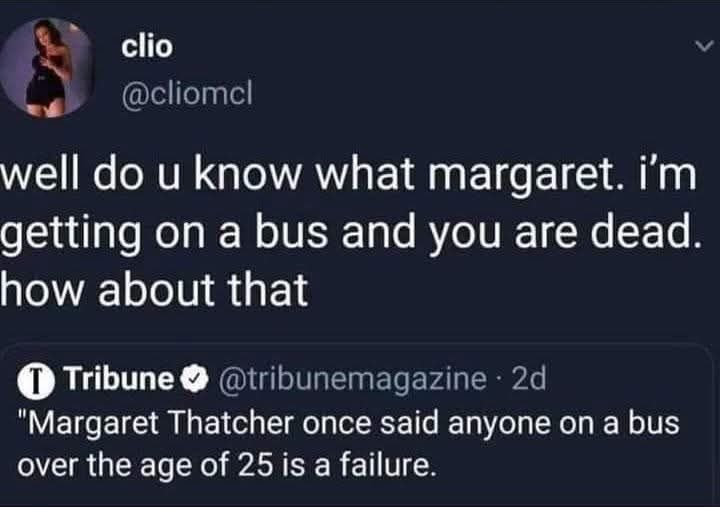
The meme consists of two parts: a tweet from @cliomcl and a quote from Tribune Magazine. The tweet itself is simple text: “well do u know what margaret. i’m getting on a bus and you are dead. how about that.” The accompanying tweet from Tribune Magazine provides context: "Margaret once said anyone on a bus over the age of 25 is a failure." There is a profile image of the tweeter @cliomcl, but this is not particularly relevant to the meaning of the meme.
Foucauldian Genealogical Discourse Analysis
This meme powerfully utilizes a Foucauldian lens. Thatcher’s comment (as reported by Tribune) isn’t just a casually harsh opinion; it's a discursive formation that embodies the neoliberal project. It establishes a specific power/knowledge relation.
- Normalizing Judgement: Thatcher’s statement is an attempt to normalize a very specific kind of success – the individual who "makes it" financially and doesn’t require public services (like buses) by age 25. It implicitly constructs "failure" as a moral failing, not a systemic consequence.
- Biopower & Discipline: This is an exercise of biopower. Neoliberalism isn’t just about economic policy; it’s about regulating life itself. The comment is a disciplining measure. It creates a system of self-policing based on achieving capitalist success. If one isn't "succeeding" according to these standards, they are marked as deficient.
- The Genealogy of "Failure": Foucault would ask us to trace the genealogy of the concept of "failure" in this context. How did this particular meaning of failure come to be dominant? It's tied to the dismantling of the post-war consensus, the rise of individual responsibility, and the demonization of state support.
- Reclaiming the Discourse: @cliomcl's response (“i’m getting on a bus and you are dead. how about that”) is a defiant reappropriation of the discourse. By actively using the bus – the symbol of "failure" in Thatcher's framework – and then asserting Thatcher’s death, the tweeter rejects the normalizing power of the original statement. It's an attempt to disrupt the power dynamic.
Critical Theory
Critical Theory helps us understand the meme as a critique of ideology.
- Ideology Critique: Thatcher’s comment is an articulation of neoliberal ideology. It valorizes individual achievement, market forces, and minimizes the role of social structures in determining life outcomes.
- False Consciousness: The meme suggests that those who accept this framing of success and failure are operating under "false consciousness"—they have internalized the values of a system that disadvantages them.
- Emancipatory Potential: The tweet’s defiant tone represents an attempt to break through this false consciousness. The claim of Thatcher’s death, while obviously metaphorical, is a symbolic act of rejecting the ideology she represents. The meme suggests a desire for a different social order.
Marxist Conflict Theory
This meme resonates strongly with Marxist conflict theory.
- Class Warfare: Thatcher's policies fundamentally shifted the balance of power in favor of capital and against labor. Her comment about the bus highlights the class dimension. Public transportation is often used by working-class people. To dismiss them as "failures" is to denigrate an entire class.
- Alienation: Neoliberalism alienates individuals from collective support systems. The emphasis on individual success and responsibility erodes solidarity and creates a sense of isolation.
- Revolutionary Sentiment: The somewhat aggressive tone of the tweet, and the "you are dead" statement, can be seen as a manifestation of simmering resentment against the inequalities produced by neoliberal capitalism. It hints at a desire for systemic change—a "death" of the old order.
Postmodernism
While not the primary lens, some postmodern elements are present.
- Deconstruction of Meaning: The meme undermines the assumed authority of Thatcher’s statement. By juxtaposing it with a casual, defiant response, it deconstructs the serious weight that was likely intended.
- Irony & Playfulness: The tweet's flippant tone and the hyperbolic "you are dead" are ironic and playful. This can be seen as a postmodern tactic to challenge dominant narratives.
- Fragmentation & Simulacra: Neoliberalism creates a world of fragmented identities and simulated experiences. The meme can be interpreted as a response to this—an attempt to assert an authentic (even if confrontational) self against a system that encourages conformity.
In summary: This meme is a sophisticated critique of neoliberalism, using a combination of historical context, Foucauldian analysis, Marxist theory, and postmodern tactics to challenge the ideology of individual responsibility and the devaluation of public services. It's a small act of resistance, a reclaiming of the narrative, and a symbolic rejection of a system that defines human worth solely by economic success.
simple-description (llama3.2-vision_11b)
The meme is a screenshot of a Twitter conversation between two users, @Clio and @ClioMCL, where @ClioMCL is discussing a news article about Margaret Thatcher's death. The user @ClioMCL is jokingly asking @Clio if she knows what Margaret Thatcher is doing on the bus, implying that she's dead. The meme is a satirical commentary on the news of Thatcher's passing, using humor to poke fun at the idea of someone being on a bus and being dead.
detailed-analysis (gemma3-27b-vision)
Okay, let's analyze this Twitter exchange through the lenses you've provided.
Visual Description
The image shows a screenshot of a Twitter exchange. The top part of the screenshot shows a tweet from a user named "clio (@cliomcl)". The user has a profile picture (obscured in this image) and their tweet states: "well do u know what margaret. i’m getting on a bus and you are dead. how about that." Below that is a tweet from "Tribune (@tribunemagazine)" with a checkmark indicating verification. This tweet states: "Margaret Thatcher once said anyone on a bus over the 25 is a failure." The background is a standard Twitter dark-mode color scheme.
Foucauldian Genealogical Discourse Analysis
This exchange is ripe for Foucauldian analysis. The original tweet (from "clio") doesn’t just state a simple fact or observation, it's a performative utterance. It challenges the historical discourse perpetuated by Margaret Thatcher about class, success, and public transport.
- Discourse & Power/Knowledge: Thatcher’s statement ("anyone on a bus over the age of 25 is a failure") isn't merely an opinion. It's an assertion of power, framing certain modes of transportation and age with a judgment of moral worth. It assumes a certain class aspiration (ownership of a car) equates to success. Foucault would argue this statement creates a social norm. The statement is a manifestation of how power operates through discourse.
- Genealogy: We can trace the genealogy of this discourse to broader societal values about individual achievement, social mobility, and the demonization of relying on public services. The statement implies a value system where self-reliance and upward mobility are paramount, and dependence on public transport signifies a lack of success.
- Clio's Counter-Discourse: The response ("i’m getting on a bus and you are dead. how about that") is an attempt to disrupt that discourse. It is a symbolic act of defiance, reclaiming the bus ride as a non-failure, and literally ‘killing’ the symbolic authority of the original statement. The user is saying, "Your judgment is irrelevant; I am re-appropriating this activity and removing your power over me." This is a re-writing of the discourse and a challenge to its established norms.
Critical Theory
This exchange is a direct confrontation of ideology and the power dynamics embedded within it.
- Ideology Critique: Thatcher's comment embodies a specific ideology – neoliberal individualism. It posits that individual success is solely determined by personal effort and choices, ignoring systemic barriers and the structural inequalities that prevent people from achieving a certain standard of living. The statement implicitly blames individuals for their circumstances.
- Emancipatory Interest: Clio’s tweet can be viewed through the lens of a critical attempt to expose the ideological underpinnings of Thatcher’s statement and reclaim the bus ride as a valid, non-shameful activity. The tweet acts as a micro-act of resistance against a seemingly harmless but deeply ingrained cultural judgement.
- Habermas’s Public Sphere: This exchange, being on Twitter, is happening within a digital public sphere. It represents a fragmented, often chaotic form of communication, but it also allows for individuals to challenge dominant narratives and engage in public debate.
Marxist Conflict Theory
Though subtle, elements of class conflict are present.
- Class & Means of Transportation: Thatcher’s statement reflects a specific class bias. The assumption that someone ‘successful’ wouldn’t need to ride the bus, implicitly favors car ownership as a status symbol. Car ownership is tied to financial capital, and the judgment made is a reflection of a class-based hierarchy.
- Ideology as False Consciousness: The comment can be interpreted as a form of ideology that perpetuates class inequalities. It reinforces the idea that relying on public services is a sign of failure, thereby contributing to a false consciousness among the working class.
- Resistance: Clio’s response, while seemingly simple, can be seen as an act of resistance against this class-based ideology. It's a rejection of the idea that success is defined by material possessions.
Postmodernism
Several aspects lend themselves to a postmodern reading.
- Deconstruction of Grand Narratives: Thatcher’s statement is a small part of a larger “grand narrative” about individualism and meritocracy. Clio’s response disrupts this narrative by rejecting its assumptions and offering a counter-narrative.
- Simulacra and Simulation: The status of being “successful” as defined by car ownership, is increasingly a simulation. The image of success is promoted through media and consumer culture, often divorced from actual material conditions.
- Intertextuality: The exchange gains meaning from the pre-existing context surrounding Thatcher’s legacy. It relies on the audience's awareness of her policies and political ideology.
Queer Feminist Intersectional Analysis
This is perhaps the most subtle, but still potentially relevant, lens:
- Challenging Normative Expectations: The implicit expectation that 'successful' people should not rely on public transportation can be linked to broader societal expectations about productivity, self-sufficiency, and the ideal citizen. These expectations are often gendered and class-based. For marginalized groups, such as women or people of color, the pressure to conform to these norms can be even greater.
- Access & Privilege: The ability to afford a car is linked to privilege. The comment about bus travel ignores those who do not have the means to own a car, potentially disproportionately affecting those who are marginalized.
- Reclaiming Space: The act of riding the bus can be seen as a reclaiming of public space for those who are often excluded from dominant narratives about success and achievement. It's a rejection of the notion that one's worth is defined by material possessions.
In conclusion, this seemingly simple Twitter exchange is surprisingly rich in meaning. It provides a useful case study for applying various theoretical frameworks to understand how power, ideology, and social norms operate within everyday discourse.
simple-description (llama3.2-vision)
The meme is a Twitter exchange between two users. The first user, "clio", is responding to someone's comment about Margaret Thatcher, a former British Prime Minister, and says "I'm getting on a bus and you are dead." The second user, "Clio", responds with a quote from a 2013 interview with Margaret Thatcher's former …
The second user says: "Margaret Thatcher once said anyone over the age of 25 is a failure." This is a quote from a 2013 interview with …
The second user continues: "I am getting on a bus and you are dead."