First Seen
2023-05-10T21:03:34+00:00
simple-description (llama3.2-vision_11b)
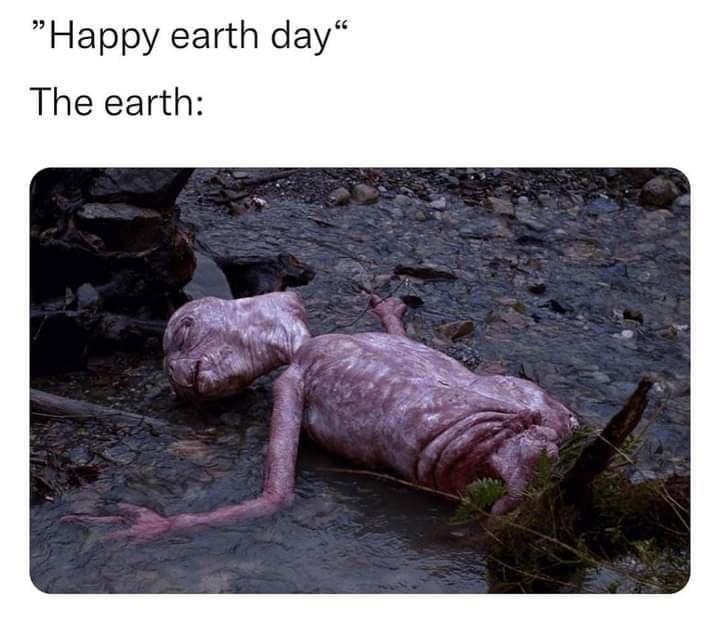
The meme is a satirical commentary on the celebration of Earth Day, a day that is meant to raise awareness about environmental issues. The image depicts a grotesque, mutated creature, implying that the planet is so damaged that even its inhabitants are suffering. The caption "Happy Earth Day" is a darkly ironic commentary on the state of the planet, suggesting that the celebration of Earth Day is a farce, and that the planet is actually dying.
detailed-analysis (gemma3-27b-vision)
Okay, here's an analysis of the image paired with the text "Happy Earth Day," broken down into the requested theoretical lenses, where applicable. Given the nature of the image, some lenses are more relevant than others.
## Visual Description
The image depicts a nude, pink/purple, humanoid creature lying in muddy, somewhat marshy ground. The creature is significantly deformed; it appears hairless, with elongated limbs, a bulbous head, and generally emaciated features. It's unclear if the creature is deceased or merely exhausted, but its prone position and the bleak environment evoke a sense of vulnerability and decay. The color palette is desaturated, with shades of gray, brown, and the unnatural pink/purple of the creature dominating. The overall impression is unsettling and jarring, a far cry from the typical celebratory imagery associated with Earth Day.
## Foucauldian Genealogical Discourse Analysis
This image, coupled with the text "Happy Earth Day," can be analyzed through a Foucauldian lens by examining the discourses surrounding "nature," "environmentalism," and "the human." The image presents a radical disruption of the romanticized, often idealized, vision of nature typically deployed in Earth Day celebrations.
Genealogy of “Nature”: The image forces us to confront what we exclude* from our understanding of "nature." We tend to prioritize landscapes, charismatic megafauna, or pristine environments. This creature, being “grotesque” and seemingly "failed" by conventional standards of biological fitness, is often excluded from narratives of natural beauty. It represents the less palatable aspects of biological existence – decay, vulnerability, and the constant struggle for survival.
Power/Knowledge: The image challenges the power/knowledge nexus that defines what is considered ‘natural’ and ‘worthy of preservation.’ The creature's abjection (the feeling of disgust and revulsion it evokes) reveals the implicit hierarchies embedded in environmental discourse. We are encouraged to protect what pleases us or conforms to our ideals of beauty, not necessarily everything that is*.
Discursive Shift: The juxtaposition with "Happy Earth Day" acts as a deliberate disruptive force*, forcing a re-evaluation of what ‘celebrating’ the earth actually means. Is it about aesthetic appreciation, or is it about accepting the totality of life, even its most unsettling aspects?
## Critical Theory
The image operates as a strong critique of dominant ideologies, especially those related to environmentalism and anthropocentrism.
Anthropocentrism: The image actively decenters* the human. It positions a non-human being as the central figure, forcing the viewer to confront a world beyond human perception and concern. This challenges the assumption that the Earth exists primarily for human benefit or enjoyment.
Ideology Critique: The seemingly celebratory "Happy Earth Day" message is revealed as potentially empty or even hypocritical*. By contrasting it with this degraded creature, the image suggests that our environmental gestures might be superficial, masking a deeper disregard for the totality of life and the darker, less appealing realities of the natural world.
* Frankfurt School: This image could be read as an example of negative dialectics. It doesn’t offer a positive vision, but rather dismantles our idealized conceptions of nature and Earth Day through an unflinching presentation of something “other.”
## Marxist Conflict Theory
While not directly representing class struggle, the image can be interpreted through a Marxist lens by highlighting the uneven distribution of vulnerability and the exploitation of the natural world.
* Alienation: The creature's state of decay and isolation can be seen as a metaphor for the alienation of both humans and non-human life within a capitalist system that prioritizes production and profit over ecological well-being.
* The Subproletariat of Life: The creature could represent a form of "subproletariat" within the biological world – those beings who are marginalized, discarded, or exploited by dominant forces. It highlights the inherent class hierarchy within the natural world, where some species thrive while others struggle for survival.
* Ecological Crisis: The image suggests that the current ecological crisis is not simply an environmental problem, but a symptom of a deeper systemic issue rooted in unequal power relations and exploitative practices.
## Postmodernism
The image resonates with postmodern themes of fragmentation, the rejection of grand narratives, and the blurring of boundaries between nature and artifice.
* Rejection of Essentialism: The image challenges the idea that there is an essential "nature" to be preserved. It presents a degraded, monstrous form of life, rejecting the romanticized ideal of pristine wilderness.
* Simulacra and Simulation: The image could be seen as a simulacrum – a copy without an original. It's a representation of “nature” that is far removed from the idealized versions we typically encounter. The text "Happy Earth Day" contributes to this sense of artificiality, creating a disjunction between the message and the image.
Deconstruction: The image deconstructs* the conventional meaning of Earth Day, revealing its underlying assumptions and contradictions. It forces the viewer to question what it truly means to celebrate the Earth.
## Queer Feminist Intersectional Analysis
This lens is perhaps the most nuanced application. The creature's "otherness," abjection, and vulnerability can be linked to feminist and queer theories.
* Abjection & "The Monstrous Feminine": The creature's deformed body and grotesque appearance evoke feelings of abjection. This connects to Julia Kristeva's concept of abjection - what is cast out in order to define the self. The creature represents a “monstrous feminine,” challenging norms of bodily beauty and challenging our ideas of what is "natural" and acceptable.
* Marginalization & Intersectionality: The creature's condition can be seen as a metaphor for the experiences of marginalized groups – those who are rendered invisible, excluded, or subjected to violence. Its vulnerability and lack of power highlight the systemic forces that marginalize and exploit certain beings.
* Challenging Normative Biology: By presenting a non-normative body, the image challenges traditional notions of biology and reproduction. It forces us to consider the diversity of life and the arbitrary boundaries we impose on it.
***
Disclaimer: These are interpretations and analyses, and the image is open to multiple readings. Different viewers will likely bring their own perspectives and experiences to the interpretation. The connections to these theoretical lenses are intended to stimulate thought and discussion.
simple-description (llama3.2-vision)
This meme is a humorous take on the traditional "Happy Earth Day" greeting. The image depicts a grotesque, zombie-like creature emerging from a muddy, polluted environment, with the text "Happy Earth Day" above it. The juxtaposition of the cheerful greeting with the horrific, polluted creature is meant to be ironic and humorous.
tesseract-ocr
*Happy earth day“ The earth: 6 a = ee : A eo Shen: >