First Seen
2025-10-20T05:01:19+00:00
simple-description (qwen3.5_2b-q8_0)
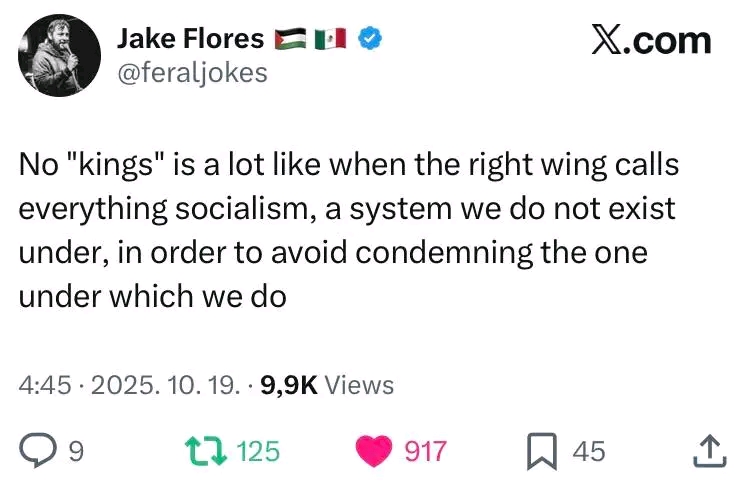
This Anti-Neoliberal meme satirizes conservative rhetoric by including the text: "No 'kings' is a lot like when the right wing calls everything socialism, a system we do not exist under, in order to avoid condemning the one under which we do." It suggests that conservatives argue there are no kings (monarchs) in free-market capitalism to defend it from socialists, but they still do this because conservatives actually live under a system where corporations or government act as sovereign entities ("kings"), forcing them to oppose socialism even though their own society exists without them.
detailed-analysis (gemma3_27b-it-q8_0)
Okay, let's break down this meme from Jake Flores (a prominent figure within the anti-neoliberal online sphere) through the lenses you've provided, focusing on how someone immersed in that category would interpret it.
Overall Category Context: Anti-Neoliberalism
Before diving into the theoretical frameworks, it's crucial to understand the anti-neoliberal position. This ideology broadly critiques the global rise of neoliberal policies (privatization, deregulation, austerity, free trade) and their effects – increasing inequality, erosion of social safety nets, the dominance of finance capital, and the hollowing out of democratic processes. It's often, though not always, situated on the left, and is highly critical of both traditional liberalism and traditional socialism (seeing the latter as often complicit in reproducing structures of power). There's a strong emphasis on grassroots movements, horizontal organizing, and an awareness of how power operates through discourse. The meme speaks to this last point—the manipulation of language and categorization to obscure and protect existing power structures.
Visual Description
The "meme" consists solely of text, posted on what appears to be X (formerly known as Twitter). The account is linked to Jake Flores, a figure recognizable to those within anti-neoliberal circles, lending authority and a specific political framing to the statement. The post has engagement stats like retweets, likes, and comments indicating it's widely circulated within the relevant online networks. The lack of visual imagery draws attention entirely to the message's content and makes it more suited for rapid sharing and commentary within online political discourse.
Foucauldian Genealogical Discourse Analysis
This is arguably the most potent lens through which to analyze this meme. Michel Foucault’s work on power/knowledge is central to anti-neoliberal thought.
- Discourse and Power: Flores is pointing to how the term "socialism" is used as a tool of power. It's not about whether something objectively is socialist, but how the label is deployed to shut down critique. When the right consistently labels anything they dislike as "socialism," it renders the term meaningless, a catch-all for negativity.
- Genealogy of "Socialism": Foucault’s genealogical method examines the historical emergence of concepts to reveal how they’re contingent and not natural or inevitable. Flores implies that the right’s definition of “socialism” isn’t based on any genuine understanding of socialist theory, but on a need to create a scapegoat. It’s a constructed category designed to ward off challenges to the status quo.
- The Will to Know/Will to Power: The constant labeling serves the “will to power.” By defining what "socialism" is (a negative thing), the right solidifies its own position and delegitimizes alternatives. This creates a binary – "us" (freedom, capitalism) vs. "them" (oppressive socialism) – which obscures the complexity of power relations.
- Avoiding Condemnation: The crucial point is that the right strategically avoids criticizing the actual systems of power (capitalism, imperialism, etc.) that they benefit from, by distracting with the "socialism" boogeyman.
Critical Theory
Critical Theory, stemming from the Frankfurt School, informs this meme by addressing the concept of ideology.
- False Consciousness: The constant labeling as "socialism" is a form of ideological manipulation – obscuring the true nature of power relations and fostering a "false consciousness" in the public.
- Instrumental Reason: The right isn’t engaging in rational debate; they’re using labels instrumentally to achieve a political goal: protecting the existing order. The “socialism” label isn’t a genuine attempt at analysis but a weapon in a power struggle.
- The Culture Industry: (Though less direct here) The meme implicitly critiques the broader "culture industry" which reinforces dominant ideologies. The endless repetition of this framing in mainstream media and political rhetoric shapes public perception.
Marxist Conflict Theory
While anti-neoliberals are often critical of traditional Marxist thought, elements of conflict theory still resonate.
- Class Struggle: Underlying the critique is the idea of a fundamental conflict between different classes. The labeling of everything as "socialism" serves to deflect attention from the class antagonisms inherent in capitalism.
- Ideological Hegemony: The constant repetition of the "socialism is bad" narrative contributes to ideological hegemony—the dominance of a particular worldview that serves the interests of the ruling class.
- Material Conditions: The meme suggests that this rhetoric is not simply about ideas, but is rooted in material interests - the desire to maintain the current economic system that benefits a small elite.
Postmodernism
This lens is somewhat less direct, but relevant:
- Deconstruction of Categories: The meme implicitly challenges the idea of fixed, stable categories. The term “socialism” has been so emptied of meaning through overuse that it’s become a rhetorical device rather than a descriptive one.
- The Instability of Truth: There's a hint of postmodern skepticism towards the idea of objective truth. The "right" doesn't care about what "socialism" actually is; they care about how it functions as a tool of control.
Queer Feminist Intersectional Analysis
This is the most nuanced connection. The "no kings" phrasing has direct resonance with queer/trans activist circles.
- Rejection of Hierarchies: "No kings" is a slogan popular within queer/trans communities advocating for a rejection of patriarchal and hierarchical structures of power. It’s a call to dismantle all forms of domination.
- Intersectionality: The critique of the right’s framing of "socialism" parallels the way they often weaponize identity politics to avoid addressing systemic oppression. By focusing on surface-level issues, they deflect attention from the underlying structures of power that affect marginalized groups. The meme suggests that the right's manipulation of language around "socialism" is analogous to their tactics regarding gender, race, or other identity categories.
- Refusal of Categorization: The rejection of being categorized under a system (like the one "we do not exist under") is a common theme in queer and trans activism, challenging normative expectations and rigid social norms.
In conclusion:
From an anti-neoliberal perspective, this meme is a sophisticated critique of how language is used to maintain power. It highlights the strategic deployment of the “socialism” label as a tactic to prevent genuine critical analysis and protect the status quo. It also subtly signals solidarity with queer and trans movements through the use of “no kings”, suggesting that the fight against capitalist domination is intertwined with the struggle against all forms of oppression. It's a piece of highly condensed political commentary that relies on shared understandings within a specific online subculture.
simple-description (llama3.2-vision_11b)
The meme is a screenshot of a tweet from a user named @feraljokes, which criticizes the idea of "kings" in a system that is supposed to be a perfect system. The tweet says: "No 'kings' is a lot like when the right wing is everything socialism, a system we do not exist under, in order to avoid condemning the under which we do." The meme is likely to be shared among those who are critical of the idea of a perfect system, particularly in the context of anti-neoliberalism.