First Seen
2025-10-20T04:59:10+00:00
simple-description (qwen3.5_2b-q8_0)
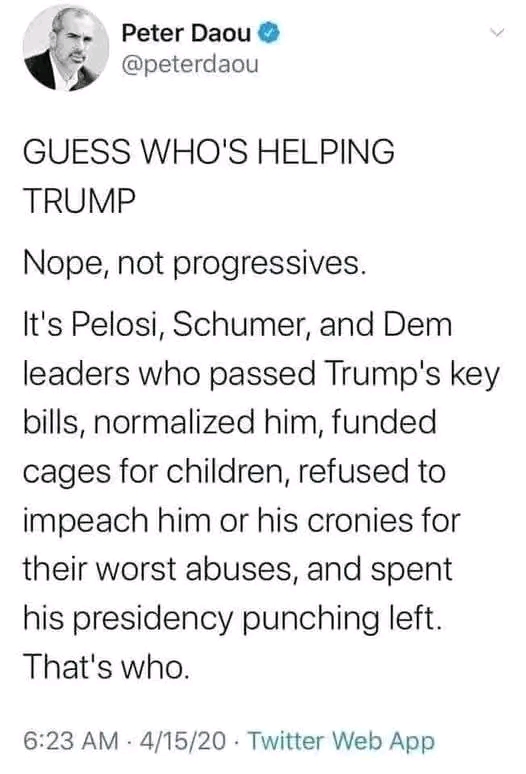
This image serves as an anti-neoliberal commentary by Peter Daou, a prominent critic of government-led economic interventions and deregulation. In this context, he is labeling modern Democrats like Pelosi and Schumer as accomplices to "progressive" policies that rely on state power rather than free markets. The text sarcastically claims these leaders helped normalize Trump by funding "cages for children," which represents the anti-neoliberal narrative of prioritizing punitive social programs (like prisons) over economic freedom and individual liberty.
detailed-analysis (gemma3_27b-it-q8_0)
Okay, let's break down this tweet/meme from an Anti-Neoliberal perspective, addressing each relevant theoretical lens.
Understanding the Anti-Neoliberal Context
Before diving into the analysis, it's crucial to understand what "Anti-Neoliberal" means here. This isn't simply "anti-conservative." Anti-Neoliberalism (often overlapping with but distinct from the broader Left) is a political and economic ideology that critiques the "Neoliberal Order" which emerged in the late 20th century. Key tenets of this critique include:
- Disillusionment with mainstream liberal institutions: A belief that the Democratic Party, despite progressive rhetoric, is deeply implicated in the same capitalist and imperial structures that cause harm.
- Focus on economic exploitation: Seeing systemic issues stemming from capitalist extraction, financialization, and deregulation.
- Critique of identity politics as a distraction: While not necessarily denying the importance of identity, a view that focusing solely on identity can obscure underlying class and economic power structures.
- Distrust of elites: A general skepticism of political establishments and "expert" opinions.
With that context in mind, here’s an analysis of the tweet:
---
Visual Description
The post is a simple text-based meme (appearing as a tweet) with a profile picture of Peter Daou, a prominent anti-neoliberal activist. The format is a rhetorical question ("Guess who's helping Trump?") followed by a defiant answer that points the finger at leading Democrats (Pelosi, Schumer). The layout is straightforward and designed for quick consumption on social media, maximizing impact through brevity and direct accusation.
---
Foucauldian Genealogical Discourse Analysis
This tweet is a prime example of a Foucauldian critique applied to the political sphere.
- Power/Knowledge: The tweet challenges the discourse that frames Trump as the sole problem. It argues that the power to enable Trump lies not just in his actions, but in the actions (or inactions) of the Democratic leadership. This isn't simply a matter of objective truth, but of how power operates through the construction of narratives. The discourse of 'resisting Trump' has, according to the tweet, become a means of concealing the Democrats' complicity.
- Genealogy: The tweet implicitly attempts a genealogy of the Trump presidency, tracing its continuity not as an aberration, but as a logical outcome of the bipartisan political system. The failures to impeach, the funding of harmful policies, and the normalization of Trump are presented as stages in this historical development, rooted in the decisions made by established power structures. It's not about individual actors being "evil" but about the way those actors operate within, and contribute to, a system of power.
- Normalization: The tweet highlights how the actions of Democratic leaders normalized Trump, thereby consolidating his power. This is a key Foucauldian concept; seemingly neutral actions (passing bills, avoiding impeachment) can contribute to the acceptance of problematic norms.
---
Critical Theory
The tweet aligns strongly with elements of Critical Theory, particularly the Frankfurt School’s critique of instrumental reason and the "culture industry."
- Critique of Instrumental Reason: The Democratic Party's focus on pragmatic compromise and "playing the game" (passing bills, avoiding controversial confrontations) is presented as a form of instrumental reason—a prioritizing of efficiency and means-ends rationality over ethical considerations. This is seen as enabling the very forces they claim to oppose.
- False Consciousness: The tweet suggests a form of "false consciousness" among the Democratic base. By constantly focusing on resisting Trump, the party can divert attention from its own failures and its complicity in the same systems that allow for Trumpism to thrive.
- Reification: The tweet attempts to de-reify the idea of the Democratic Party as a fundamentally progressive force. It challenges the narrative of Democrats as the opposition, revealing their role in upholding the status quo.
---
Marxist Conflict Theory
This is a central element to understanding the Anti-Neoliberal reading of the tweet.
- Class Conflict: The core argument is about power dynamics rooted in class. The Democrats, while representing a portion of the population, are ultimately seen as serving the interests of capital and maintaining the capitalist system, much like Trump. The critique isn’t about moral failings, but about class alignment. The tweet highlights how the Democrats’ actions benefit the ruling class at the expense of working-class people, particularly marginalized groups.
- False Opposition: The Democrats are presented as a "false opposition" – a party that pretends to challenge the system while ultimately reinforcing it. This creates the illusion of choice without addressing the fundamental problems of capitalism.
- Material Conditions: The tweet implicitly refers to the material conditions (economic inequality, austerity, the prison-industrial complex) that give rise to Trumpism. The Democrats’ complicity in these conditions is seen as a key factor in enabling Trump’s rise.
- Internal Contradictions of Capitalism: The tweet implicitly highlights the internal contradictions of capitalism, namely, the need for exploitation and control, which can manifest in authoritarian tendencies like those associated with Trump. The Democrats are seen as unable or unwilling to address these fundamental contradictions.
---
Postmodernism
While Anti-Neoliberalism isn’t inherently postmodern, some elements of postmodern thought contribute to its critique.
- Deconstruction of Grand Narratives: The tweet challenges the grand narrative of the "Resistance" to Trump, suggesting it’s a simplification that obscures the complexities of power. It questions the idea that there’s a clear-cut "good vs. evil" dynamic in politics.
- Relativism (to a degree): While Anti-Neoliberals generally don’t embrace full moral relativism, they do reject the notion that there’s an objective standard of "good" in politics. They emphasize the role of power in defining morality and truth.
- Critique of Representation: The tweet suggests the Democrats' representation of progressive values is ultimately hollow. It challenges the idea that they genuinely represent the interests of their base.
---
Queer Feminist Intersectional Analysis
While not explicitly the main focus, the mention of "cages for children" brings this lens into play.
- Intersectional Vulnerability: The image of children in cages highlights the intersectional vulnerability of marginalized groups. Immigration, race, and childhood all contribute to heightened vulnerability within a system that prioritizes control and punishment.
- State Violence: The tweet frames the "cages for children" as an example of state violence, perpetrated (and funded) by both Democratic and Republican actors. This deconstructs the idea that the Democratic Party is a protector of vulnerable populations.
- Rejection of 'Good Liberal' Narrative: It dismantles the idea of the "good liberal" who opposes harmful policies while remaining within the existing political structure.
In Conclusion:
From an Anti-Neoliberal perspective, this tweet is a concise and forceful indictment of the Democratic Party. It’s a call to move beyond the limited framework of "Resisting Trump" and to confront the underlying structures of power that allow for authoritarianism to flourish. It's a critique rooted in economic exploitation, a distrust of elites, and a desire for systemic change—not just a change in leadership. The tweet is designed to provoke, disrupt, and challenge conventional assumptions about the political landscape.
simple-description (llama3.2-vision_11b)
This meme is a satirical commentary on the perceived lack of progress in the US Congress, particularly among the Democratic Party. The image appears to be a tweet from Peter Daou, a former Democratic Party strategist, that lists several Democratic Party leaders, including Nancy Pelosi, Chuck Schumer, and Nancy Pelosi's housemate, who he claims are not doing enough to help President Trump. The text also mentions that these leaders are not making progress and are not doing enough to help President Trump.