First Seen
2025-05-01T21:24:23.902053+00:00
detailed-analysis (gemma3_27b-it-q8_0)
Okay, let's break down this meme, "The Tech Bro Pipeline," through the lens of an anti-libertarian perspective, employing the requested theoretical frameworks where applicable. This meme is highly critical of a specific trajectory within the tech industry and its ideological underpinnings.
Visual Description
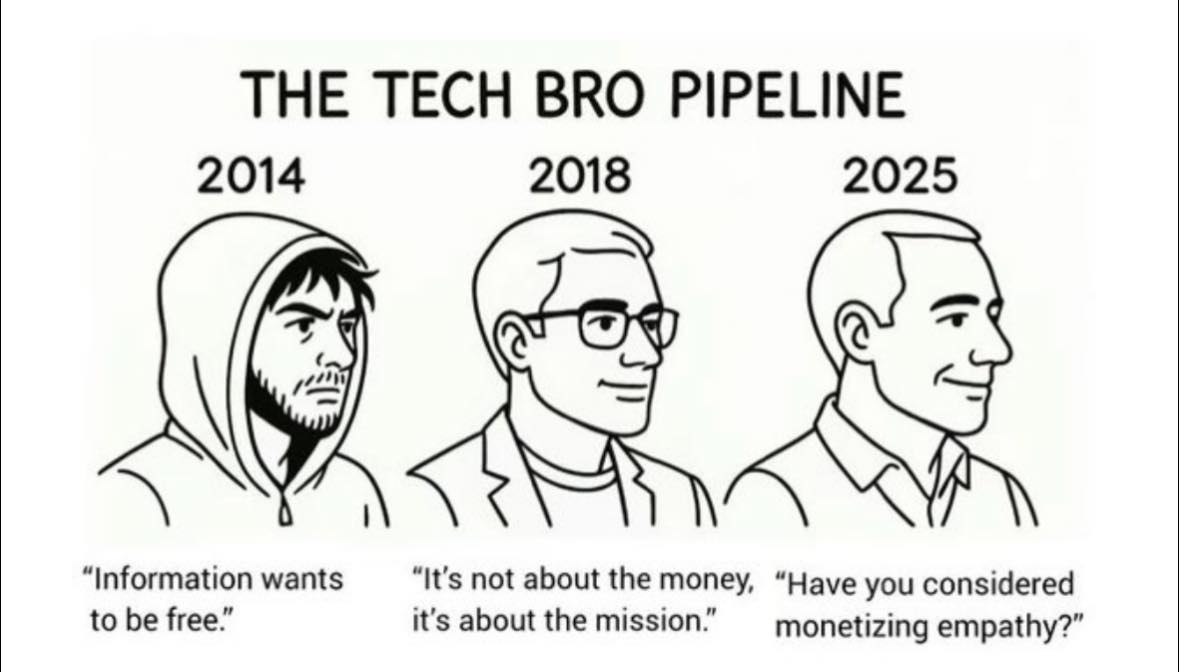
The meme presents three panels, each representing a stage in the evolution of a stereotypical "tech bro" persona, marked by years: 2014, 2018, and 2025.
- 2014: A figure with a hooded sweatshirt and a beard, looking somewhat brooding. The caption reads, "Information wants to be free." This evokes the early, ostensibly idealistic days of the internet and early tech disruption, often associated with a libertarian ethos.
- 2018: A figure with a cleaner haircut, wearing glasses and a collared shirt. The caption is, "It’s not about the money, it’s about the mission.” This signals a shift—the idealism is still present, but now framed around a “mission,” hinting at the co-opting of idealistic language for business purposes.
- 2025: A figure in a suit, looking polished and confident. The caption reads, “Have you considered monetizing empathy?" This is the punchline, and the most damning—it showcases the ultimate outcome of this pipeline: the commodification of even the most human emotions.
The progression is visually clear, depicting a transition from anti-establishment "hacker" vibe to polished corporate executive.
---
Foucauldian Genealogical Discourse Analysis
This meme powerfully illustrates a Foucauldian analysis of power/knowledge. The very discourse around technology shifts over time.
- Early Discourse (2014): The "Information wants to be free" slogan operates within a discourse of digital libertarianism. This discourse relies on the notion of natural rights (information as a fundamental right) and limited government intervention. This is presented as a radical challenge to established power structures, but Foucault would argue it’s already a particular configuration of power that privileges certain kinds of freedom (e.g., freedom from regulation) and obscures others.
- The Shift (2018): The "mission" framing represents a move towards biopower. Tech companies begin to define their mission around "improving" or "solving" human problems, which allows them to exert control over aspects of life previously considered outside the realm of economic or political regulation. It’s not just about maximizing profit, but about shaping human behavior in the service of that profit.
- The Culmination (2025): “Monetizing empathy” is the height of this biopower. It’s the application of capitalist logic to the most intimate and vulnerable aspects of human experience. It’s about creating markets where none existed before, turning emotions into data points, and extracting value from human connection.
Foucault’s genealogy exposes the historical contingency of these discourses, demonstrating how what appears to be natural or inevitable (like the “free flow of information”) is actually constructed through specific power dynamics. The meme shows how that initial seemingly radical stance ultimately gets absorbed and repurposed by the very system it claimed to challenge.
---
Critical Theory
From a critical theory perspective, this meme critiques the instrumental reason and the culture industry.
- Instrumental Reason: The tech bro's journey embodies the reduction of all values—including empathy—to their instrumental worth. Critical theorists like Max Horkheimer and Theodor Adorno would see this as a symptom of the Enlightenment’s increasing dominance of reason as a tool for domination. Empathy doesn't exist as an end in itself, but as a means to an end (profit).
- The Culture Industry: The meme implies that the tech industry operates as a culture industry, producing not genuine connection or liberation, but standardized, commodified experiences that reinforce the status quo. The original libertarian rhetoric of 2014 is re-packaged and sold back to us as a “mission” and, ultimately, as a product.
- False Consciousness: The progression represents a kind of false consciousness. The tech bro starts believing he's disrupting the system, but ends up being a key player in reproducing and expanding capitalist logic.
The meme demonstrates how capitalist rationality infiltrates even the realm of feelings, turning them into commodities.
---
Marxist Conflict Theory
This meme is a pointed commentary on the contradictions of capitalism.
- Capital Accumulation: The pipeline illustrates the relentless drive for capital accumulation. The initial focus on "free information" is quickly replaced by the pursuit of profit, then by the attempt to extract value from even the most intimate human experiences. It highlights the fact that under capitalism, everything eventually becomes a commodity.
- Alienation: The transformation of the tech bro represents a form of alienation. He becomes alienated from his original ideals, from genuine human connection, and from his own creative potential. He is reduced to a function within the capitalist system.
- Class Consciousness: The meme implicitly calls for class consciousness. It encourages us to recognize the systemic forces at play and to resist the commodification of human experience. It’s a critique of the capitalist class and its tendency to exploit everything for profit.
The meme effectively shows how the inherent contradictions of capitalism—its need for endless growth and its tendency to commodify everything—lead to a dehumanizing outcome.
---
Postmodernism
A postmodern reading might focus on the breakdown of grand narratives and the simulacrum.
- Death of the Author/Grand Narratives: The early libertarian rhetoric ("Information wants to be free") can be seen as a remnant of a grand narrative (the idea of technological progress leading to liberation). The meme suggests that this narrative is collapsing. There is no authentic "mission" behind the tech bro's actions, just a succession of simulations.
- Simulacra and Simulation: The progression of the tech bro's image illustrates Jean Baudrillard's concept of simulacra. The "mission" and "monetizing empathy" are not representations of anything real, but are simulations that have become detached from reality. They are empty signifiers that circulate within the tech industry. The original ideal of "free information" becomes a hyperreality that bears no resemblance to its initial promise.
---
Queer Feminist Intersectional Analysis
This is where the meme gains further weight. The tech bro is implicitly a white, cisgender, heterosexual male.
- Interlocking Systems of Oppression: The “pipeline” reinforces existing power dynamics. The commodification of empathy is particularly harmful to marginalized groups who are already often expected to perform emotional labor for dominant groups. Their experiences are exploited and repackaged for profit.
- Emotional Labor: The push to “monetize empathy” disproportionately impacts women, people of color, and LGBTQ+ individuals, who are often socialized to prioritize emotional responsiveness and are frequently employed in roles requiring emotional labor. This meme suggests that capitalism will extract even that labor for profit.
- Exclusion and Erasure: The stereotype of the “tech bro” itself is indicative of the exclusionary culture of the tech industry, which historically has been dominated by white men. The meme highlights how this culture perpetuates itself by co-opting and distorting progressive ideals.
In short, this meme underscores how the commodification of empathy—facilitated by this pipeline—is not a neutral phenomenon, but one that reinforces existing systems of power and oppression.
Let me know if you'd like me to elaborate on any of these sections or explore other theoretical angles!
simple-description (llama3.2-vision_11b)
The meme is a satirical commentary on the shift in societal values and the changing expectations of the "tech bro" archetype. The image depicts a series of three characters, each representing a different era, with a quote from each that highlights the evolving attitudes towards freedom, money, and empathy. The meme pokes fun at the changing values of the "tech bro" archetype, from a free-spirited individual in 2014 to a money-hungry entrepreneur in 2018, and finally to a socially conscious individual in 2025 who prioritizes empathy and kindness.
detailed-analysis (gemma3-27b-vision)
Okay, here's an analysis of the image, broken down into sections as requested. I'll skip sections where the image doesn't strongly lend itself to those frameworks.
Visual Description
The image is a black and white cartoon depicting a progression labeled "The Tech Bro Pipeline." It features three panels, each representing a year: 2014, 2018, and 2025, each showing a side profile of a man who appears to be a stereotypical "tech bro".
- 2014: The man is depicted wearing a hooded sweatshirt, and a beard. He appears somewhat rough and earnest. The text below says, "Information wants to be free."
- 2018: The man is shown wearing a blazer with glasses. He has a clean-cut look. The text below says, "It’s not about the money, it’s about the mission."
- 2025: The man is sharply dressed and clean-shaven, with a polished appearance. The text below says, "Have you considered monetizing empathy?"
The style is minimalist, relying on line drawing to convey a sense of evolution or progression. The progression implies a shift in values and focus.
---
Foucauldian Genealogical Discourse Analysis
This image is ripe for a Foucauldian reading. The "Pipeline" is a discourse itself. A discourse, according to Foucault, isn't simply a way of talking, but a system of thought, ideas, practices, and power relations. This image traces a genealogy of this "tech bro" discourse, revealing how it shifts and changes over time.
- Power/Knowledge: In 2014, the "tech bro" positions himself as a liberator of information, a disruptor. This positions him as possessing a particular kind of knowledge about information access, and using that knowledge to wield power by challenging traditional systems.
- The Shift: By 2018, the discourse has subtly shifted. The focus moves from "free information" to a "mission." This is a crucial move—it redefines the goal of tech disruption not as inherent good, but as a means to something else, which is implicitly the accumulation of power and capital. The emphasis on "mission" provides a veneer of moral justification.
- Discipline and Control: By 2025, the discourse has reached its logical endpoint: the monetization of empathy. This is a profoundly disturbing shift because it demonstrates the complete subsumption of human emotion into the logic of capital. Foucault would argue this represents a form of biopower – the control and manipulation of life itself, now including emotional life – for the benefit of economic interests. The "Pipeline" demonstrates how a once-radical idea (free information) can be normalized, repurposed, and ultimately integrated into existing power structures, functioning to further discipline and control individuals within a capitalist system.
---
Critical Theory
This image serves as a potent critique of the development of tech culture and its relationship to broader societal structures.
- Instrumental Rationality: The progression can be seen as an example of Max Horkheimer and Theodor Adorno’s concept of “instrumental rationality.” What begins as a seemingly idealistic notion (free information) becomes increasingly instrumentalized—used as a means to an end, specifically profit.
- Commodification of Everything: The image is a stark illustration of the core tenet of Critical Theory: the tendency of capitalist systems to commodify everything, even intangible things like empathy. Empathy, a fundamentally human capacity for understanding and sharing the feelings of others, is recast as a marketable resource.
- Loss of Authenticity: The evolution of the “tech bro” himself mirrors a loss of authenticity. From a somewhat scruffy, passionate advocate, he transforms into a polished, calculating entrepreneur. This is a critique of the way capitalism tends to erase individuality and replace it with a standardized, consumerist persona.
---
Marxist Conflict Theory
The image perfectly embodies conflict theory, with its focus on power imbalances and the exploitation inherent in capitalist systems.
- Class Struggle: The “tech bro” represents a particular class – the technologically adept, largely white-male, entrepreneurial class – that wields increasing power in the contemporary world. The progression depicts how this class increasingly leverages technology and innovation not for the benefit of society as a whole, but for its own enrichment.
- Exploitation: The monetization of empathy can be seen as a new form of exploitation. By turning emotional connection into a commodity, the tech bro class is capitalizing on a fundamental human need. The promise of "connection" is used to extract value.
- Ideology: The initial claim of "free information" serves as an ideology – a set of beliefs that justifies the actions of the tech bro class. It masks the underlying power dynamics and portrays them as benevolent disruptors, when in reality they are reinforcing existing inequalities.
---
Postmodernism
A postmodern interpretation would emphasize the image's deconstruction of grand narratives and its highlighting of the fluidity of identity and meaning.
- The Death of Ideals: The image suggests a skepticism towards grand ideals. The initial claim of “free information” is not sustained, but rather morphed into a cynical pursuit of profit. This reflects a postmodern distrust of overarching systems of belief.
- Simulacra and Simulation: The polished exterior of the 2025 “tech bro” can be interpreted as a simulacrum – a copy without an original. His persona is a constructed image, designed to appeal to investors and consumers, rather than reflecting authentic values.
- Meta-Narrative Collapse: The image's very structure – the "Pipeline" – is a meta-narrative, a story about a progression. But the content of that progression reveals the hollowness of that narrative. The story doesn’t lead to positive social change, but to the commodification of empathy.
Let me know if you'd like me to elaborate on any of these analyses!
simple-description (llama3.2-vision)
This meme is a humorous illustration of the evolution of a "tech bro" character from 2014 to 2025. The text above the images reads "The Tech Bro Pipeline" and the text below each image is a quote that reflects the changing attitude of a tech bro over time. The quotes are: "Information wants to be free" (2014), "It's not about the money, it's about the mission" (2018), and "Have you considered monetizing empathy?" (2025).