First Seen
2025-02-27T05:49:56.157349+00:00
detailed-analysis (gemma3_27b-it-q8_0)
Okay, let's break down this meme through an anti-libertarian lens, utilizing the requested theoretical frameworks where applicable. This is a complex meme relying on irony and subversion, and an anti-libertarian reading will focus on how it critiques market fundamentalism and reveals underlying power dynamics.
Overall Context: The meme is employing a political compass format—a visual tool often used (and often critiqued) for categorizing political ideologies. The compass positions ideologies based on two axes: economic (left/right) and authoritarian (top/bottom). An anti-libertarian stance fundamentally rejects the core tenets of libertarianism (minimal state intervention, individual liberty above all) and often actively advocates for robust state intervention to address social and economic inequalities. This meme uses the compass against its typical purpose, to highlight the absurdity of allowing basic healthcare to be governed by market forces.
---
Visual Description
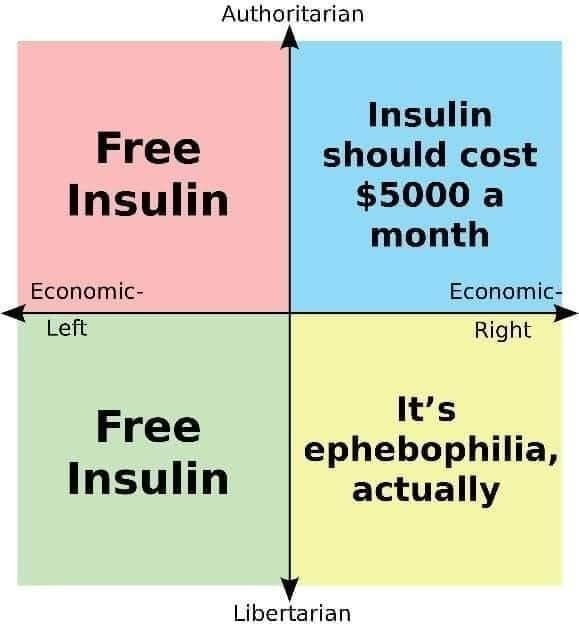
The meme depicts a political compass with four quadrants. Each quadrant contains a statement concerning insulin access.
- Top Left (Authoritarian-Left): "Free Insulin" - This presents a straightforward socialist/communist position advocating for universal access to a life-saving medication.
- Top Right (Authoritarian-Right): "Insulin should cost $5000 a month" – This represents a position fundamentally aligned with unchecked capitalism and the prioritization of profit over human life. It’s deliberately shocking and callous.
- Bottom Left (Libertarian-Left): "Free Insulin" – Again, advocating for accessibility.
- Bottom Right (Libertarian-Right): "It's ephebophilia, actually" – This is the key subversive element. It's a completely non-sequitur, intended to expose the utter lack of moral grounding or rational connection in libertarian thought. The statement suggests that the focus on individual liberty and the rejection of state intervention can devolve into justification for any kind of harmful behavior.
---
Foucauldian Genealogical Discourse Analysis
A Foucauldian reading focuses on the discourse surrounding insulin access and how power operates through that discourse. The meme exposes how the “free market” discourse is constructed to normalize and legitimize the outrageous price of insulin.
- Discipline and Biopower: Insulin is not just a commodity, it's a crucial element of biopower - the power to control and regulate life itself. Allowing its price to be determined by the market subjects individuals to a form of discipline. Those unable to pay are essentially excluded from life, or forced to make desperate choices.
- Genealogy of Profit: The genealogy (the historical tracing of the development) of the high cost of insulin reveals a power/knowledge relationship. Pharmaceutical companies have actively shaped the narrative around research & development costs, patent protection, and "value," justifying exorbitant prices.
- The "Ephebophilia" Statement: This disrupts the discourse entirely. Foucault’s work suggests that power operates through seemingly unrelated discourses. By introducing a completely unrelated and disturbing concept like ephebophilia, the meme reveals the fragility of the libertarian justification system. It suggests that if the foundational principle is simply “individual liberty regardless of harm,” then anything becomes permissible.
---
Critical Theory
From a Critical Theory perspective (drawing from thinkers like the Frankfurt School), this meme critiques the ideology of late capitalism and its impact on human well-being.
- Commodification of Life: The meme exposes how capitalism reduces even essential human needs like healthcare to commodities, governed by the laws of supply and demand rather than ethical considerations.
- False Consciousness: The acceptance of $5000/month insulin as a potentially acceptable outcome of a “free market” represents a form of false consciousness. Individuals are led to believe that this system is natural or inevitable when, in fact, it serves the interests of capital.
- Critique of Instrumental Reason: The "ephebophilia" statement embodies a critique of instrumental reason – the idea that reason is solely used to achieve ends, without questioning those ends themselves. Libertarianism, in this view, is driven by an instrumental reason focused solely on maximizing individual freedom without moral or social constraints.
---
Marxist Conflict Theory
This meme directly highlights class conflict within a capitalist system.
- Exploitation of Need: The high cost of insulin isn't accidental; it’s a result of the capitalist system's inherent tendency to exploit basic human needs for profit. Pharmaceutical companies, driven by the need to accumulate capital, exploit the life-or-death dependence of diabetics.
- Class Struggle: The struggle for affordable insulin is a manifestation of class struggle. Those who can afford it are insulated from the consequences, while those who cannot are systematically disadvantaged.
- Alienation: The system alienates individuals from their own health and well-being, as access to essential medication becomes contingent on wealth rather than need.
---
Postmodernism
While not the strongest theoretical fit, a postmodern reading can focus on the deconstruction of meaning.
- Deconstructing the “Free Market”: The meme dismantles the notion of a neutral “free market.” It shows how this concept is a constructed narrative that obscures power relations.
- The Absurdity of Non-Sequitur: The "ephebophilia" statement exemplifies postmodernism’s embrace of the absurd. It demonstrates that the logic of libertarianism, when pushed to its extreme, leads to a breakdown of coherent meaning and ethical boundaries.
---
Queer Feminist Intersectional Analysis
This is applicable, though requires some nuance.
- Intersectional Vulnerability: Access to insulin (and healthcare generally) is not distributed equally. Marginalized groups – particularly queer and trans people, people of color, and disabled individuals – face systemic barriers to accessing care, exacerbating the effects of high costs.
- Challenging Normative Concepts of "Freedom": The libertarian emphasis on individual freedom often ignores the social and material conditions that limit the freedoms of marginalized groups. It prioritizes the freedom of the powerful over the freedom to live with dignity for everyone.
- Exposing the Dark Side of "Individualism": The ephebophilia statement, while shocking, can be interpreted as highlighting the dark side of extreme individualism – the potential for harmful behavior when social responsibility and ethical considerations are completely absent.
In conclusion, the meme functions as a potent anti-libertarian statement. It leverages irony, absurdity, and a subversive deployment of the political compass to expose the moral bankruptcy of a system that prioritizes profit over human life. It's a visual argument for robust state intervention to ensure access to essential healthcare for all.
simple-description (llama3.2-vision_11b)
The meme is a chart that divides the political spectrum into four quadrants, with "Free Market" and "Free Stuff" on one side and "Government Control" and "Free Stuff" on the other. The chart is labeled as "Economic Left" and "Economic Right" and has the following text: "Free Market: Free Stuff. Government Control: Free Stuff". The meme is saying that the left and right sides of the political spectrum are both offering "free stuff", implying that both ideologies are equally flawed.
detailed-analysis (gemma3-27b-vision)
Okay, let's break down this political compass meme, applying the requested theoretical frameworks where applicable.
Visual Description
The image is a political compass, a common online meme format. The vertical axis is labeled "Authoritarian" (top) to "Libertarian" (bottom). The horizontal axis is labeled "Economic Left" (left) to "Economic Right" (right). The four quadrants are filled with short statements.
- Top Left (Authoritarian-Left): "Free Insulin"
- Top Right (Authoritarian-Right): "Insulin should cost $5000 a month"
- Bottom Left (Libertarian-Left): "Free Insulin"
- Bottom Right (Libertarian-Right): "It's ephebophilia, actually."
The meme utilizes irony and satire, juxtaposing the urgent need for affordable healthcare (insulin) with an absurd and disturbing statement.
Critical Theory
The meme is ripe for critical theoretical analysis. The central issue - access to life-saving medication - exposes the domination inherent in capitalist systems. Critical theory, particularly in the Frankfurt School tradition, would see the high cost of insulin as a form of social control. The need for insulin, a necessity for those with diabetes, is exploited to generate profit, creating a dependency and vulnerability within the population.
The juxtaposition of the "ephebophilia" statement acts as a disruptive element. Critical theorists would see this as a deliberate attempt to derail or obscure the genuine concern of affordable healthcare by introducing an unrelated and shocking claim. It's a form of ideological distraction, obscuring the real power dynamics at play. The meme reveals how the discourse around healthcare can be readily hijacked and manipulated.
Marxist Conflict Theory
From a Marxist perspective, the meme embodies the fundamental class conflict at the heart of capitalist society. The high cost of insulin is not merely a market failure, but a deliberate outcome of a system that prioritizes profit over human need. The pharmaceutical industry, driven by profit maximization, creates a situation where essential medication becomes inaccessible to those who cannot afford it.
The meme highlights the exploitation of individuals with diabetes, who are forced to rely on a system that extracts surplus value from their need for survival. The "ephebophilia" statement, while absurd, can be interpreted as a symbolic representation of the alienation inherent in capitalism, where basic human needs are twisted and distorted for profit. It serves as a shocking disruption of the conversation about insulin costs, mirroring the way the capitalist system itself distorts and alienates individuals from their basic needs.
Foucauldian Genealogical Discourse Analysis
Foucault’s approach would focus on the power/knowledge relationship surrounding insulin and its cost. The meme reveals how the discourse around healthcare is not neutral, but shaped by specific power structures. The statement "Insulin should cost $5000 a month" demonstrates how the pharmaceutical industry exercises power through the construction of market values. This 'cost' isn't a natural consequence of production but a constructed justification for profit.
The "ephebophilia" statement is a key point for Foucauldian analysis. It’s an attempt to discourse-shift and undermine the legitimacy of the debate about insulin access. It’s a tactic to derail the conversation by introducing an entirely unrelated and shocking claim, demonstrating how discourse can be manipulated to control the narrative. A genealogical approach would trace the historical development of these discourses – the evolution of pharmaceutical pricing, the changing definitions of health and wellness, and the emergence of online rhetoric and meme culture – to understand the power dynamics at play.
Queer Feminist Intersectional Analysis
While less directly apparent, this meme can also be examined through a queer feminist intersectional lens.
- Disrupting Normative Discourse: The intentional absurdity of the "ephebophilia" statement can be seen as a disruptive tactic, challenging the 'normal' discourse surrounding healthcare and forcing a reassessment of the issues at play. This aligns with queer feminist approaches that question established norms and power structures.
- Access to Healthcare: Access to healthcare is disproportionately impacted by factors of race, class, gender, and sexuality. Marginalized groups often face greater barriers to healthcare access, and the high cost of insulin exacerbates these existing inequalities. A queer feminist approach would highlight these intersectional dimensions of the problem.
- Subversion: The subversion of expected political arguments can be seen as a tactic to draw attention to the absurdity of a system that prioritizes profit over human life.
Postmodernism
Postmodern analysis would focus on the meme’s self-referentiality and deconstruction of meaning. The juxtaposition of the mundane (insulin cost) with the shocking ("ephebophilia") is a deliberate attempt to destabilize traditional modes of understanding. The meme does not offer a solution, but rather highlights the fragmentation and absurdity of contemporary discourse. It can be viewed as a critique of grand narratives and a celebration of the contingent, fragmented nature of reality. The meme rejects the notion of a singular, coherent meaning, embracing ambiguity and irony.
Let me know if you’d like me to elaborate on any of these analyses or explore other theoretical perspectives.
simple-description (llama3.2-vision)
The meme is a Venn diagram-style chart that humorously explores the relationship between free insulin and various ideologies. The chart's sections are labeled with terms like "Libertarian," "Anarchist," and "Socialist," and each section contains a statement or joke related to free insulin. For example, the "Anarchist" section says "It's free, because it’s free."