First Seen
2025-05-14T21:25:05.324830+00:00
detailed-analysis (gemma3_27b-it-q8_0)
Okay, let's break down this meme from an anti-incel perspective, utilizing the requested theoretical frameworks where applicable. Given the meme's content, several of these frameworks will be very relevant.
Visual Description
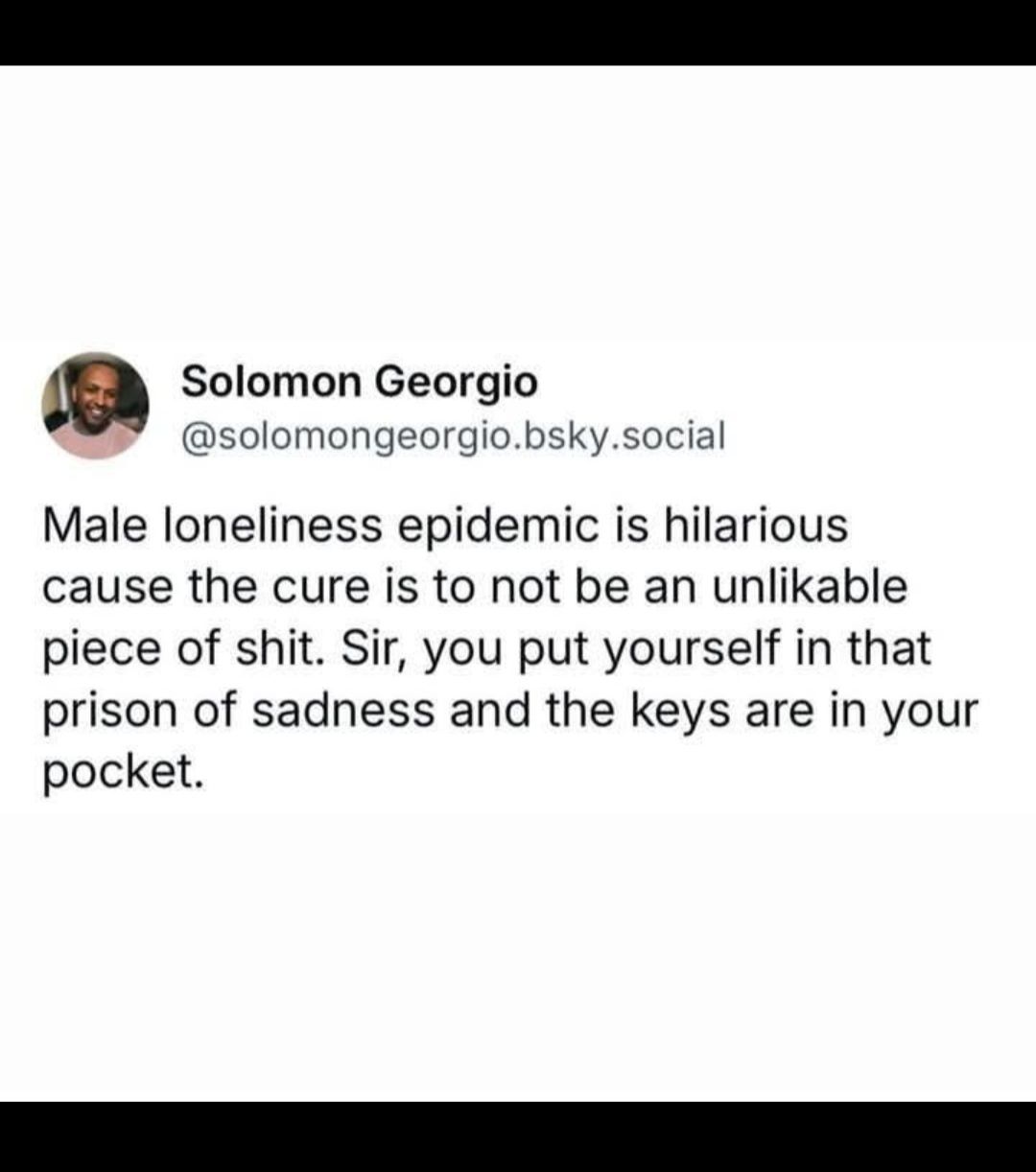
The image is a simple screenshot of a post from a social media account (@solomongeorgio.bsky.social). It features a profile picture of a man, and then text. The text is the core of the meme's message, consisting of a blunt statement about the perceived ridiculousness of male loneliness, followed by a metaphor about self-imprisonment and possessing the means to liberation. The visual presentation is minimal and direct, relying entirely on the punchline delivered through text. The "Sir" adds a layer of dismissive irony.
Foucauldian Genealogical Discourse Analysis
This meme is highly relevant to Foucault's ideas of power, discourse, and self-regulation. The "male loneliness epidemic" as framed by incel/manosphere rhetoric isn't a naturally occurring phenomenon but a discursive construction. Incel ideology relies on creating a narrative of victimization ("women don't want us," "society hates us"). Foucault would argue that this narrative is a specific way of understanding and talking about relationships, gender, and worth, and it creates a certain power dynamic.
The meme directly attacks this discourse. It’s deconstructing the incel narrative of external forces oppressing men. The "prison" metaphor isn’t about external constraints but about internal ones – the traits and behaviors (being "unlikable") men themselves cultivate and embrace.
The “keys in your pocket” represent agency and the capacity for self-change. The incel narrative actively denies this agency. It implies men are helpless victims, whereas this meme argues they have the power to alter their own behavior and mindset. Foucauldian genealogy would look at how the history of gender roles, masculinity, and societal expectations has led to this specific way of framing loneliness and how this meme intervenes in that history.
Critical Theory
Critical Theory, particularly the Frankfurt School's focus on ideology, is also relevant. The incel narrative can be seen as a form of false consciousness. Men are led to believe their problems are caused by external forces (women, society) rather than by the internal contradictions of patriarchal structures and harmful expectations surrounding masculinity.
This meme is a critique of that ideology. It’s suggesting that the "problem" isn't with the world, but with a narrow, self-defeating understanding of how to navigate it. It implicitly argues that men need to critically examine their own behavior, attitudes, and expectations. This aligns with Critical Theory’s emphasis on demystification and uncovering the underlying power relations that shape our perceptions.
The dismissive "Sir" is a rhetorical tool challenging the authority and self-importance often found in incel rhetoric. It destabilizes the position of the "victim."
Marxist Conflict Theory
While less direct than the other frameworks, Marxist conflict theory offers some insights. The incel narrative often focuses on competition for sexual partners, presenting it as a zero-sum game (men losing to "Chads"). This can be loosely mapped onto a Marxist framing of scarcity and competition for resources (in this case, reproductive access or validation).
The meme subtly challenges this by shifting the focus away from external competition and towards internal characteristics. It suggests the issue isn’t a lack of available partners, but a self-imposed limitation ("being unlikable") that prevents individuals from participating in social exchange. It’s not about overthrowing the "Chad" bourgeoisie, but about improving oneself.
Queer Feminist Intersectional Analysis
This is crucial. The incel movement is inherently misogynistic and often relies on racist and homophobic rhetoric. This meme directly combats that.
The meme deconstructs the expectation of entitlement to romantic or sexual attention that is central to incel ideology. This entitlement is rooted in patriarchal assumptions about male dominance and female submissiveness. By stating the "cure" is to not be "unlikable", the meme implicitly critiques the idea that men are owed anything by women.
Further, "unlikable" is a loaded term. From a Queer Feminist perspective, it exposes how incel ideology often equates being "unlikable" with deviating from hyper-masculine norms. The meme doesn’t offer a specific path to “likability”, but the very assertion challenges the incel narrative’s narrow definition of acceptable masculinity. It hints that the problem isn’t a lack of attraction, but an unwillingness to move beyond harmful, rigid gender roles. The meme implicitly understands that concepts of "likability" are socially constructed and are deeply intertwined with power dynamics.
In essence, the meme is a concise and pointed dismantling of the incel narrative, using sarcasm and a powerful metaphor to challenge victimhood, demand self-reflection, and reject patriarchal entitlement. It’s a form of counter-discourse aimed at disrupting the harmful ideology of the manosphere.
simple-description (llama3.2-vision_11b)
This meme is a satirical take on the "Incel" (Involuntary Celibate) community, a subculture known for its misogynistic and anti-social views. The meme pokes fun at the idea that being an "Incel" is a legitimate reason for being unhappy in life, implying that the Incel community's self-pity and lack of self-improvement is a "cure" that is not effective.
detailed-analysis (gemma3-27b-vision)
Here's an analysis of the image/text, broken down into the requested sections. Please note that some sections will be more robust than others, as not all theoretical lenses fit equally well.
Visual Description
The image displays a screenshot of a social media post (likely from "Bsky") made by user "Solomon Georgio." The post features a profile picture of a man in a black and white photo, followed by text. The background of the post is a simple dark grey. The text itself is the core focus and contains the statement about male loneliness.
Foucauldian Genealogical Discourse Analysis
This post is ripe for Foucauldian analysis. The language ("unlikable piece of shit," "prison of sadness") immediately constructs a discourse around male loneliness, but one that judges rather than simply describes.
- Power/Knowledge: The post asserts power through defining what constitutes an "unlikable" man and implies that loneliness is a self-inflicted punishment. The user is positioning themselves as a source of knowledge – a speaker who understands the "cure" for loneliness – and thereby wielding power over the defined subject (the lonely man).
- Discipline & Normalization: The implied "cure" functions as a disciplinary mechanism. It establishes a norm of likability/avoidance of sadness. The lonely man is positioned as deviant from this norm, and the "cure" suggests self-regulation to conform. The statement implies that men should be able to control their sadness and strive for likability, reinforcing societal expectations.
- Genealogy: Tracing the "genealogy" of this discourse would require examining how expectations about male stoicism, self-reliance, and social acceptability have developed historically. This discourse likely draws on long-standing norms of masculinity that discourage emotional vulnerability. The implication is that this "epidemic" is due to a failure to adhere to these norms.
- The Keys in Your Pocket: This metaphorical statement is powerful. It suggests agency—the man holds the power to unlock himself, but simultaneously chooses not to. This reinforces the discourse of personal responsibility and minimizes potential structural factors that contribute to loneliness.
Critical Theory
From a Critical Theory perspective (particularly drawing on the Frankfurt School), this post highlights how seemingly individual problems like loneliness are deeply intertwined with broader societal structures.
- Ideology: The post reflects and reinforces an ideology that prioritizes likability and emotional control, particularly for men. It obscures the potential systemic causes of loneliness—capitalist alienation, social isolation fostered by technology, or the pressure to conform to restrictive gender roles—by focusing solely on individual "failure."
- Commodification of Self: The emphasis on "likability" can be seen as a reflection of a commodified self in late capitalism. Men are pressured to present themselves as marketable, desirable entities, and failure to do so (resulting in loneliness) is framed as a personal failing.
- Critique of Enlightenment Rationality: While not explicit, the implied "cure" relies on a sort of rational self-control. A critical theorist might question the assumption that rationality is inherently liberating, pointing out how it can also be used to reinforce oppressive norms.
Queer Feminist Intersectional Analysis
This section is where the analysis becomes particularly nuanced.
- Masculinity and Vulnerability: The post directly addresses male loneliness, a subject often discouraged in traditional masculinity. Queer and feminist perspectives critique the harm of rigid gender roles that prevent men from expressing vulnerability and seeking support. The post implicitly reinforces the expectation of stoicism before seemingly offering a solution that doesn't address the source of the issue.
- Intersectionality: While the post doesn't explicitly address intersectionality, it's crucial to remember that experiences of loneliness are shaped by multiple intersecting identities (race, class, sexuality, disability, etc.). A Black man, for example, might experience loneliness differently than a white man due to the additional burdens of racial discrimination and systemic marginalization.
- Critique of "Fixing" Men: The phrasing of "cure" and the focus on individual responsibility could be seen as perpetuating a problematic pattern of asking individuals (particularly men) to fix themselves rather than addressing the systemic issues that contribute to their suffering. A feminist perspective would question who benefits from this framing.
It’s important to note that these interpretations aren't exhaustive. Different theoretical lenses will yield different insights, and the richness of the post lies in its capacity for multiple readings.
simple-description (llama3.2-vision)
This meme is a humorous take on the concept of the "male loneliness epidemic" and the idea that men are often expected to be strong and stoic, but are actually struggling with feelings of loneliness and isolation. The text reads: "Male loneliness epidemic is hilarious because the cure is to not be an unlikable piece of shit. Sir, you put yourself in that prison of sadness and the keys are in your pocket." The meme is poking fun at the idea that men are often expected to be tough and not show emotions, but are actually struggling with feelings of loneliness and isolation.