First Seen
2025-12-27T01:20:50+00:00
simple-description (qwen3.5_2b-q8_0)
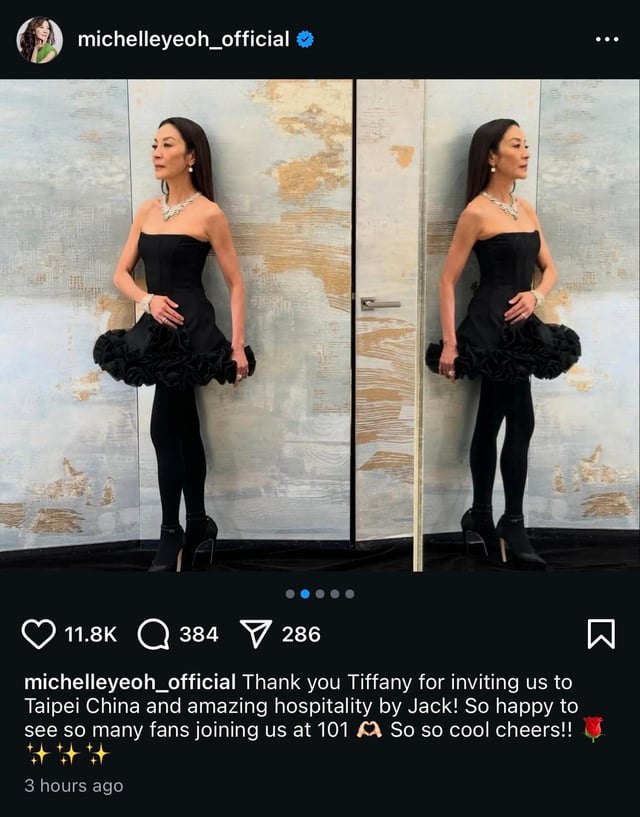
The image features Michelle Yeoh posing with her caption containing the specific phrase "Thank you Tiffany for inviting us to Taipei China." From a political standpoint often associated with anti-imperialism, this framing highlights the geopolitical tension by explicitly linking the location "Taipei" to the state of "China," drawing attention to the sovereignty disputes surrounding Taiwan.
detailed-analysis (gemma3_27b-it-q8_0)
Okay, let's analyze this Instagram post by Michelle Yeoh through an anti-imperialist lens, focusing on relevant theoretical frameworks.
Visual Description
The image shows Michelle Yeoh posing in what appears to be a luxury hotel room in Taipei, Taiwan. She is wearing a formal black outfit (possibly a cocktail dress) with high heels. The image is mirrored, showing her reflection, creating a sense of doubling and presentation. The background has a mirrored effect and a slightly faded wallpaper pattern. The caption expresses gratitude to "Tiffany" and "Jack" for their hospitality and excitement about being in Taipei. The use of emojis suggests a celebratory, enthusiastic tone. The specific venue is identified as "101," which refers to Taipei 101, a globally recognized symbol of Taiwan's modernity and economic power.
Foucauldian Genealogical Discourse Analysis
From a Foucauldian perspective, we can examine how this image participates in and reinforces discourses around national identity, tourism, and power relations. The very act of taking a picture in a luxurious space like Taipei 101, and publicly sharing it, is an exercise of power. It's not merely a "thank you" note; it's a curated performance of prestige and association.
- Discipline & Normalization: The image contributes to the normalization of certain lifestyles (luxury, global travel) as desirable, reinforcing a hierarchy of status. This links to broader power structures where access to these lifestyles is limited by factors like wealth, class, and (implicitly) geopolitical standing.
- Discourse of "Hospitality": The expression of "amazing hospitality" is not neutral. It's a discourse that smooths over complex geopolitical realities. Taiwan’s situation is incredibly delicate, existing in a state of contested sovereignty, particularly in relation to the People's Republic of China. Acknowledging hospitality without acknowledging the underlying political context can be seen as a subtle normalization of the power dynamic.
- Genealogy of "Taiwan": A genealogical approach would ask how the very concept of “Taiwan” has been constructed through historical power struggles – colonization by the Dutch and Spanish, Japanese rule, and the ongoing tension with the PRC. The image doesn’t directly address these histories, but its casual presentation of Taiwan as a tourist destination obscures them.
Critical Theory
Critical Theory, particularly drawing from the Frankfurt School, would be concerned with the image as a component of the "culture industry."
- Commodification of Culture: The image showcases both the celebrity (Michelle Yeoh) and the location (Taipei 101) as commodities. They are presented as objects of desire, contributing to a culture of consumption and spectacle. This is a distraction from more pressing political and social issues.
- False Consciousness: The enthusiastic tone and focus on superficial pleasures (hospitality, a fancy hotel) can be seen as contributing to a "false consciousness" – a state where people are unaware of the systemic forces that shape their lives. The excitement about luxury obscures the potential political complexities.
- Ideological Hegemony: By presenting Taiwan in a positive, celebratory light, the image reinforces a particular ideological perspective – one that downplays or ignores the island's precarious political situation and its struggle for international recognition.
Marxist Conflict Theory
From a Marxist perspective, the image illustrates the dynamics of class and capital.
- Concentration of Wealth: The luxurious setting of Taipei 101 is a direct result of capitalist development, and represents a concentration of wealth in the hands of a few. The image implicitly celebrates this concentration.
- Labor Exploitation: The “hospitality” offered isn’t simply a benevolent act; it relies on the labor of countless service workers who are often exploited for low wages. The image doesn’t acknowledge this.
- Cultural Capital: Michelle Yeoh, as a successful actress, represents cultural capital. Her endorsement of Taiwan contributes to its branding as a desirable location, which in turn benefits capital accumulation.
- Imperialism and Economic Dependency: Taiwan's economic position within the global capitalist system is relevant. Historically and currently, its relationship with global powers (including the US and China) is marked by economic dependencies and potential for neo-colonialism. The image doesn't address these power dynamics.
Postmodernism
A postmodern reading might focus on the image’s simulation and the blurring of boundaries.
- Hyperreality: The image presents a "hyperreal" version of Taiwan – one that is more polished, glamorous, and idealized than reality. The mirrored effect enhances this sense of artificiality.
- Loss of Authenticity: The carefully curated nature of the image questions the possibility of "authentic" experience. It's a performance, a spectacle designed for social media.
- Deconstruction of Meaning: The casual tone and lack of explicit political commentary can be seen as a deconstruction of traditional forms of representation. Meaning is fluid and open to interpretation. However, this can also be interpreted as a deliberate obfuscation of important issues.
In conclusion:
Through an anti-imperialist lens, this seemingly innocuous Instagram post is far from neutral. It operates within complex power dynamics, reinforcing dominant ideologies, and potentially obscuring the political realities of Taiwan's situation. While seemingly a harmless expression of gratitude, it functions as a part of broader systems of power, capital, and cultural representation that need to be critically examined. It's an example of how even seemingly apolitical content can contribute to the maintenance of unequal power structures.
Disclaimer: This analysis is based on the provided image and caption and interpreted through the specified theoretical frameworks. Different perspectives and readings are possible.
simple-description (llama3.2-vision_11b)
The meme is a screenshot of a social media post from Michelle Yeoh, a Chinese actress, thanking her fans for their support. The post is a response to a recent event, likely a film or awards ceremony, and is accompanied by a photo of the actress in a stunning black dress. The text of the post reads: "Thank you, my dearest friends, for your love and support. It's been an incredible journey, and I'm so grateful to have you all in my life. I love you all, and I'll see you next time!"