First Seen
2026-04-02T05:29:07+00:00
simple-description (qwen3.5_2b-q8_0)
From an anti-imperialist perspective, this story highlights a critique of US foreign policy as aggressive expansionism—specifically regarding the movement of large military forces into another nation's territory without full sovereign consent. The text specifically cites plans to deploy "10,000 ground troops to the Middle East" and frames the operation as part of a "US war of aggression against Iran," which critics often view as an imposition of foreign power in the name of security rather than self-defense.
detailed-analysis (gemma3_27b-it-q8_0)
Okay, let's break down this image and its accompanying text through the lens of Anti-Imperialism, incorporating the requested theoretical frameworks where applicable.
Image & Text Overview
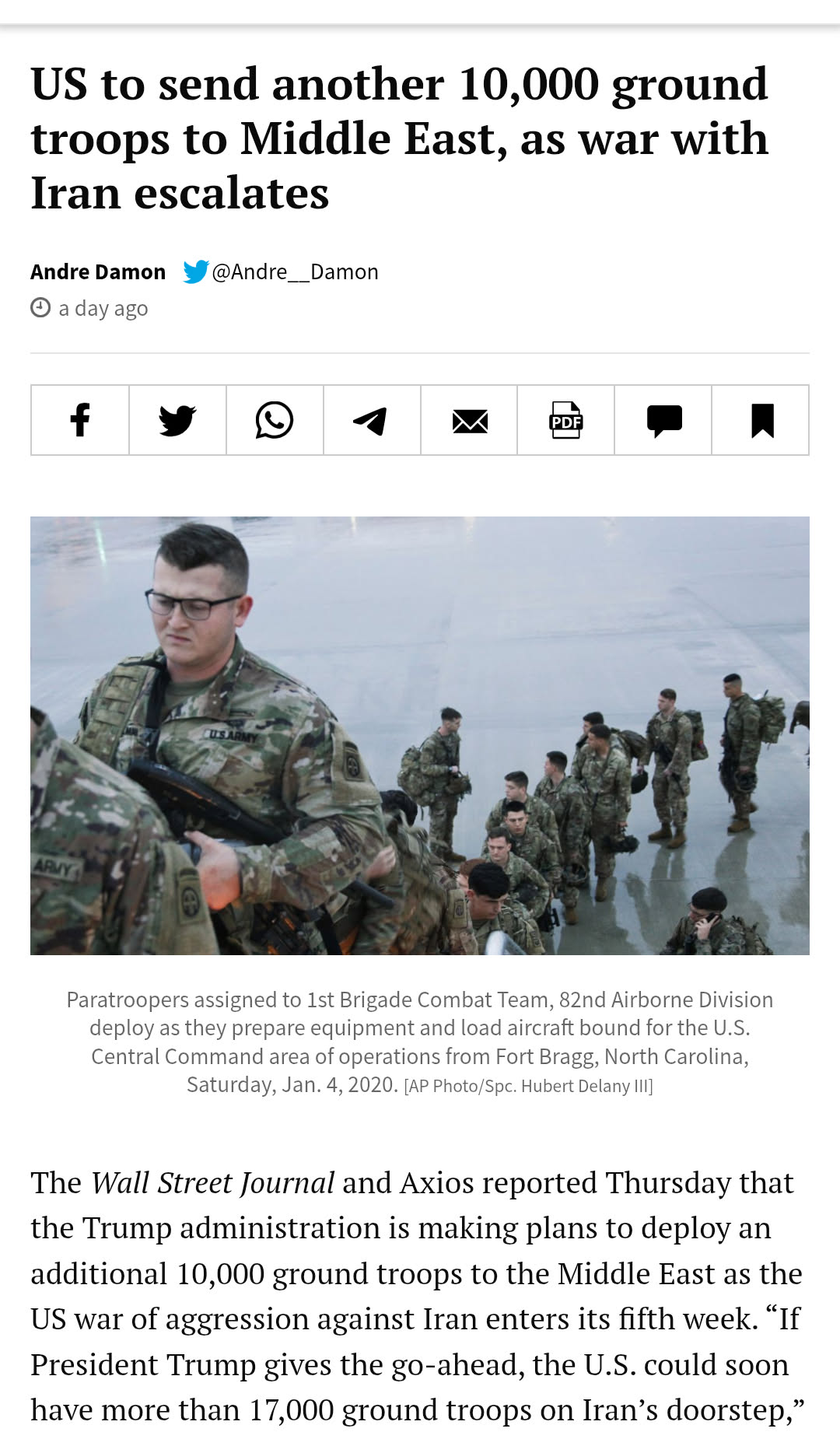
The image features US paratroopers preparing for deployment, presumably to the Middle East, with a news headline announcing a planned deployment of an additional 10,000 ground troops as tensions with Iran escalate in January 2020. The text frames this escalation as a "war of aggression."
Visual Description
The image itself is a striking depiction of military readiness and power. The soldiers are shown in a standardized formation, meticulously preparing equipment. The focus on the individual soldier at the forefront, with a serious expression, emphasizes the human cost of the deployment. The background of military equipment (aircraft) reinforces the scale of the impending operation. The visual message is one of organized strength, and inherent threat.
Marxist Conflict Theory
This image is powerfully explained through a Marxist lens. It illustrates core tenets of the theory:
- Imperialism as a Stage of Capitalism: The deployment of troops is directly linked to the pursuit of economic and geopolitical interests. Imperialism, according to Marxists, is a natural outgrowth of capitalism's need for new markets, resources, and cheap labor. The Middle East, rich in oil and strategically important, fits this profile.
- Class Conflict: The soldiers pictured are predominantly from the working class. They are sent to fight in a conflict that primarily benefits the capitalist class (corporations, politicians, arms manufacturers) who profit from war and resource control. There's a clear power imbalance where the working class bears the physical and emotional burden of war while the ruling class reaps the economic rewards.
- State as an Instrument of Class Rule: The state (represented by the military deployment) acts as an instrument of the capitalist class, protecting their interests through force. The "war of aggression" framing suggests this isn’t a defensive action but one motivated by expansion and profit.
- False Consciousness: Marxist theory suggests that individuals may not fully understand the underlying class interests at play and may be persuaded to support policies that ultimately harm them. The military industrial complex and patriotic propaganda can contribute to this.
Foucauldian Genealogical Discourse Analysis
Foucault's work helps us understand how the "truth" about this conflict is constructed through discourse.
- Power/Knowledge: The way the media (and the state) frames this deployment as a necessary response to Iranian aggression is a demonstration of power/knowledge. This framing defines the acceptable parameters of debate and legitimizes the use of force. The very language used ("aggression," "escalation," "threat") constructs a narrative that justifies military intervention.
- Genealogy of War: A genealogical approach would trace the historical development of the ideas and justifications used to wage war. The idea of the US as a "defender" of global order, or the "war on terror," are not natural or inevitable but are constructed through historical processes and specific discourses.
- Disciplinary Power: The image itself embodies disciplinary power. The soldiers' uniform, their rigid formation, and the meticulous preparation symbolize the discipline and control imposed by the state. This discipline is not just physical but also ideological, shaping their worldview and obedience.
Critical Theory
Critical Theory builds on Marxist ideas but expands them to consider broader issues of culture and ideology.
- The Culture Industry: The media coverage surrounding the deployment can be seen as part of the "culture industry," which reproduces dominant ideologies and reinforces the status quo. The narrative of US as a benevolent power intervening in a chaotic region serves to legitimize imperialism.
- Instrumental Reason: The rationalization of war based on strategic interests and national security is an example of "instrumental reason." The focus on efficiency and control obscures the ethical and human costs of conflict.
- Critique of Enlightenment Ideals: Critical theorists question the Enlightenment ideals of reason and progress, arguing they can be used to justify domination and exploitation. The idea of "spreading democracy" can be a guise for imperial control.
Anti-Imperialism
The overarching context of Anti-Imperialism is crucial here. The image and text represent a classic example of what anti-imperialists critique:
- Neo-colonialism: This deployment can be viewed as a form of neo-colonialism – the exercise of economic and political control without direct political rule. The US seeks to maintain its influence in the Middle East through military presence and intervention.
- Sovereignty & Self-Determination: The deployment violates the sovereignty of Iran and the right of its people to determine their own future.
- Anti-War Sentiment: The “war of aggression” framing and the implicit questioning of US motivations align with the anti-war stance central to anti-imperialist thought.
- Critique of US Exceptionalism: The belief that the US has a special right or obligation to intervene in other countries is challenged by an anti-imperialist perspective.
In conclusion, the image, when viewed through the lens of Anti-Imperialism and supported by frameworks like Marxism, Foucault and Critical Theory, becomes a potent symbol of the ongoing dynamics of power, exploitation, and resistance in the 21st century. It reveals the underlying economic and ideological forces driving military intervention and the human cost of imperial ambitions.
simple-description (llama3.2-vision_11b)
This meme is a satirical commentary on the US military's role in the Middle East. The image shows a news article with the headline "US to send another 10,000 ground troops to Middle East, as war with Iran escalates." The article reports that the US is planning to deploy an additional 10,000 ground troops to the Middle East as the war with Iran continues to escalate. The article is likely intended to be critical of the US's military actions in the region, as it has been accused of perpetuating a cycle of violence and creating a state of perpetual war. The article may be using a satirical tone to critique the US’s actions, or it may be using a serious tone to report on the news. The article is likely intended to be critical of the US’s military actions in the region, as it has been accused of perpetuating a cycle of violence and creating a state of perpetual war. The article may be using a satirical tone to critique the US’s actions, or it may be using a serious tone to report on the news. The article is likely intended to be critical of the US’s military actions in the region, as it has been accused of perpetuating a cycle of violence and creating a state of perpetual war. The article may be using a satirical tone to critique the US’s actions, or it may be using a serious tone to report on the news. The article is likely intended to be critical of the US’s military actions in the region, as it has been accused of perpet
The final answer is: This meme is a satirical commentary on the US military's role in the Middle East. The article reports that the US is planning to deploy an additional 10,000 ground troops to the Middle East as the war with Iran continues to escalate. The article is likely intended to be critical of the US’s military actions in the region, as it has been accused of perpetu.