First Seen
2026-04-02T05:31:00+00:00
simple-description (qwen3.5_2b-q8_0)
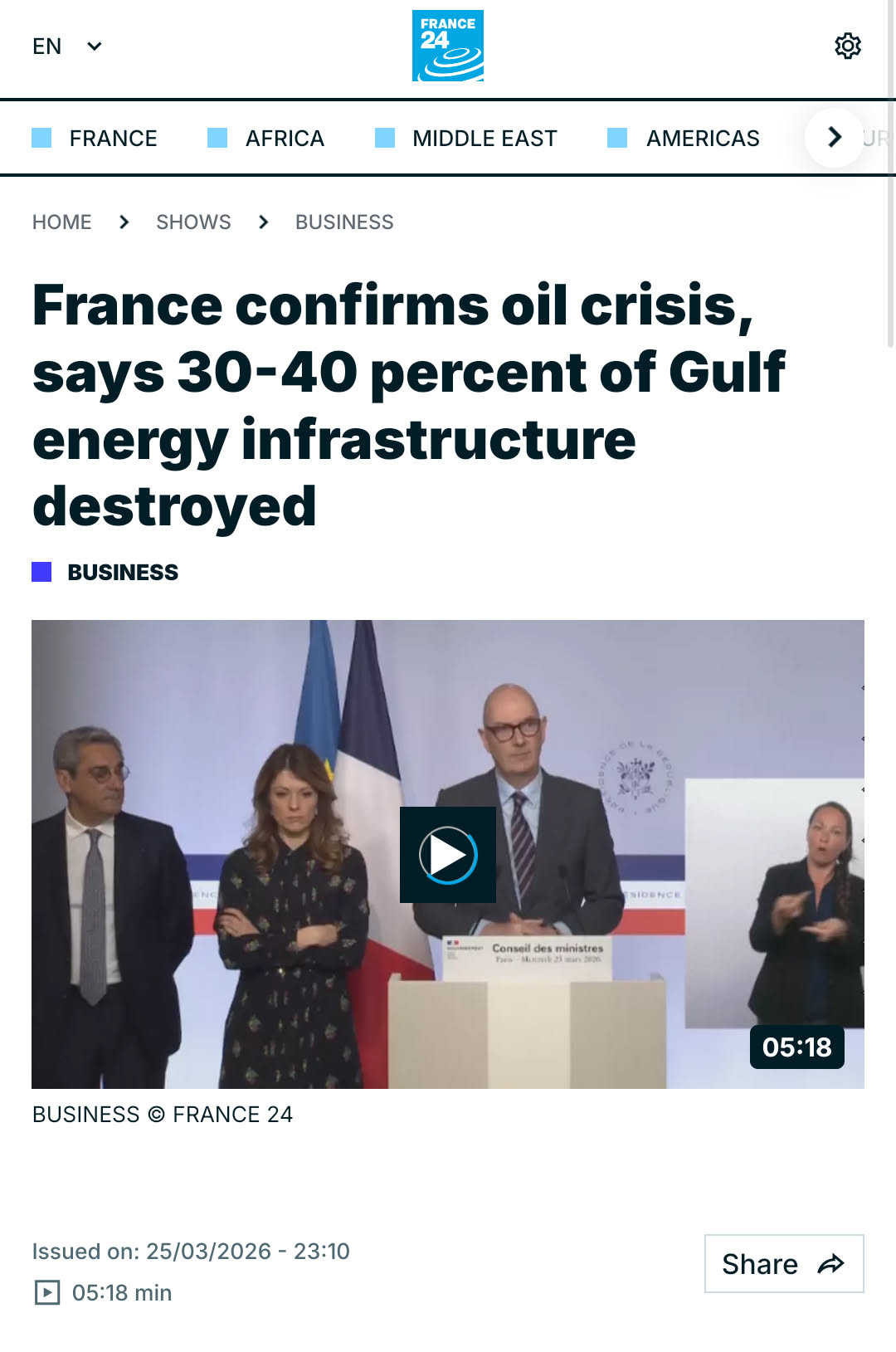
This news report describes a major European power claiming that a wealthy, influential neighbor (often viewed as an imperialistic state) has destroyed 30-40 percent of essential oil infrastructure. From an anti-imperialist perspective, this is presented as evidence of dominance—the ability to destroy critical energy systems necessary for the survival and economic stability of dependent regions. The image includes text from the French Council of Ministers confirming these specific damaging claims regarding the Gulf states.
detailed-analysis (gemma3_27b-it-q8_0)
Okay, let's analyze this news item from the perspective of an "Anti-Imperialism" category. The core argument here is that the situation presented (damage to Gulf energy infrastructure and resulting oil crisis) can be understood as a consequence of, or intertwined with, historical and ongoing imperialist dynamics.
Visual Description
The image shows three men in suits and one woman partially visible on the right, standing in front of a backdrop that reads "Conseil des ministres," suggesting a governmental or official setting, specifically French. The men appear to be engaged in a press conference or briefing. The central figure, the man with glasses, is the focal point, appearing to be delivering information. The setting suggests a degree of formality and authority. The time stamp on the lower right suggests this is recent (2026 in this case). The overall composition suggests a controlled communication of information from power.
Foucauldian Genealogical Discourse Analysis
From a Foucauldian perspective, this event isn't simply an "oil crisis," but a manifestation of power/knowledge formations built over centuries of colonial and neo-colonial history.
- Discourse of Energy Security: The discourse of "energy security" is itself a product of imperial power. The need to secure energy resources implies that those resources are considered essential to a specific way of life – a way of life largely built on industrialization, consumption patterns, and power structures established through colonialism. The framing of damage to infrastructure as a “crisis” reinforces this discourse and its inherent power dynamics.
- Genealogy of Control: The history of oil extraction in the Gulf isn’t simply about finding and utilizing a resource. It's a genealogy of control. From early British interests to the later dominance of Western oil companies and the US, the Gulf's oil has been integral to Western (and French, specifically in this case) economic and geopolitical interests. Any disruption to this flow of resources – whether from internal conflicts, “terrorism,” or other actors – is perceived as a threat to these established power relations.
- Normalization of Intervention: The very act of France confirming damage and discussing a "crisis" can be seen as an exercise of power. It subtly positions France as a key actor in responding to the situation, justifying potential intervention (diplomatic, economic, or even military) under the guise of "stability."
Marxist Conflict Theory
This event is deeply rooted in class struggle on a global scale.
- Imperial Core-Periphery: The Gulf region acts as a "periphery" in the global capitalist system, primarily serving as a source of raw materials (oil) for the “core” (Western nations like France). The damage to infrastructure represents a disruption of this exploitative relationship.
- Control of Means of Production: The issue isn’t just about oil; it’s about control over the means of production. The infrastructure itself represents capital concentrated in the hands of a few, often Western-aligned, entities. Damage to this infrastructure is a potential blow to that concentrated power.
- Profit Motive & Conflict: The drive for profit inherent in capitalism leads to competition and conflict over resources. The situation in the Gulf can be understood as a manifestation of these conflicts, whether they originate from rival states, corporations, or resistance movements. The French "confirmation" of the crisis could be a prelude to maneuvers to protect their economic interests in the region.
Critical Theory
Critical theory would analyze this event through the lens of ideologies and power structures.
- Ideology of Progress & Development: The Western narrative of "progress" and "development" often masks the exploitative realities of resource extraction. The focus on restoring oil production, framed as essential for the global economy, reinforces this ideology, obscuring the social and environmental costs borne by the Gulf region.
- Instrumental Reason: The emphasis on "fixing" the infrastructure and restoring the flow of oil exemplifies instrumental reason – a purely technical, efficiency-driven mindset that ignores ethical and political considerations. It prioritizes the smooth functioning of the capitalist system over the well-being of people and the environment.
- Commodification of Life: The oil itself represents the commodification of life – turning a natural resource essential for sustaining life into a commodity traded for profit. The "crisis" is, therefore, a crisis in this commodification process.
In Summary:
From an Anti-Imperialist lens, this news item isn't just about a technical issue with energy infrastructure. It is a symptom of long-standing power imbalances, exploitation, and historical injustices. It highlights how the pursuit of resources, driven by capitalist interests and sustained by imperial ideologies, continues to shape global events and create conflict. The framing of the event by a French source should be regarded with scrutiny, considering the country's own history of colonial involvement and its continued interests in the region.
Disclaimer: This analysis is based on the information provided in the image and the specified theoretical framework. It is a complex issue with multiple interpretations, and this is just one possible perspective.
simple-description (llama3.2-vision_11b)
The meme features a screenshot of a news article from France24, with the headline "France confirms oil crisis, says 30-40 percent of Gulf energy infrastructure destroyed" in bold, black text. The image includes a video player with a play button and a timer, indicating that the article is accompanied by a video report. The image is surrounded by a white border, with a blue and white logo for France24 at the top. The background of the image is a light gray color. The article itself is not visible in the image, but it appears to be a news report about the impact of the oil crisis on the Gulf region. The image is likely intended to convey the seriousness of the situation and the need for action to address the crisis. Overall, the image is a simple but effective visual representation of a news article, using a clear and concise format to convey important information.