First Seen
2026-02-05T23:13:22.307831+00:00
simple-description (qwen3.5_2b-q8_0)
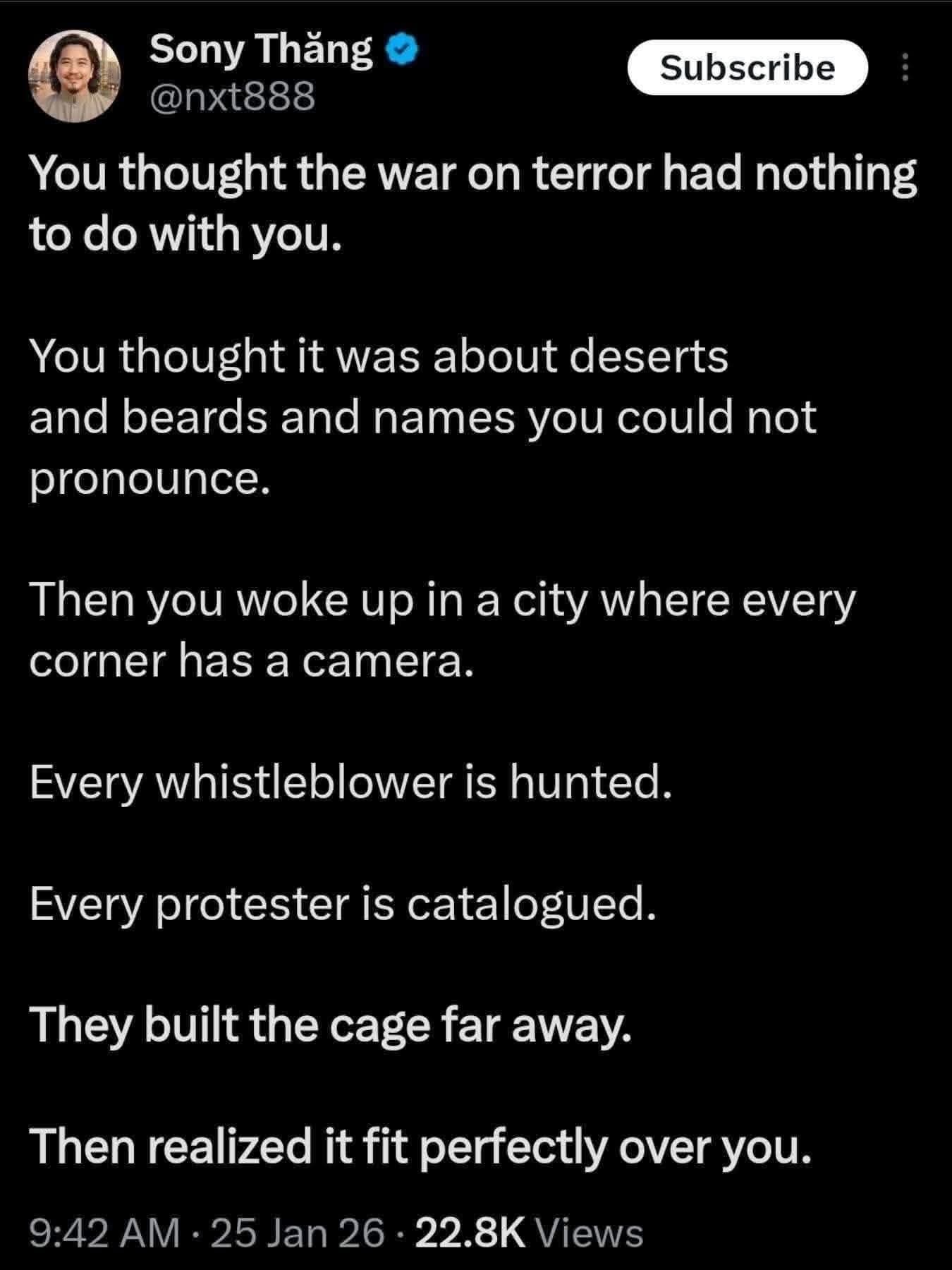
This cynical tweet satirizes the rapid shift from abstract political debates about terrorism to a paranoid reality where even protesters are monitored by hidden cameras. It mocks the idea that the world is only dangerous because it has been built and controlled by "them," using the text "Every protester is catalogued" to highlight the loss of privacy and total control in modern life.
detailed-analysis (gemma3_27b-it-q8_0)
Okay, let's break down this meme through the lens of Anti-Imperialism, incorporating relevant theoretical frameworks as applicable.
Overall Interpretation: The Meme as a Critique of the "War on Terror" and its Domestic Consequences
The meme fundamentally argues that the “War on Terror” wasn’t about distant conflicts in the Middle East, but a pretext for expanding surveillance and control within the borders of ostensibly democratic nations. It depicts a shift from a perceived external threat to an insidious internal repression, ultimately targeting dissent and eroding civil liberties. The core message is that the real victims of the War on Terror are people at home, not just those in the countries being invaded.
Visual Description
The meme is text-based, a series of declarative statements presented sequentially. It's stark and relies on its conciseness and cumulative effect. There's no imagery to distract from the core argument; the simplicity amplifies the sense of encroaching dread and inevitability. The progression from a feeling of distance ("thought it had nothing to do with you") to a feeling of entrapment ("fit perfectly over you") is crucial to its impact.
Foucauldian Genealogical Discourse Analysis
This meme is highly resonant with Michel Foucault’s work on power, discourse, and surveillance.
- Genealogy of Power: Foucault argued power isn't simply top-down or repressive, but is productive and operates through discourses. The “War on Terror” discourse (the language, narratives, and justifications surrounding it) constructed a specific “truth” about the world, justifying exceptional measures. The meme suggests the genealogy of this discourse led to the modern surveillance state.
- Panopticism: The line "every corner has a camera" immediately invokes Foucault’s concept of the Panopticon. The Panopticon is a prison design where inmates are always potentially observed, leading to self-regulation. The meme argues we now live in a social Panopticon, where constant surveillance—even the possibility of surveillance—shapes behavior.
- Discipline & Punish: The statements about whistleblowers being hunted and protestors being cataloged are illustrative of disciplinary power. The state doesn't necessarily need to always punish, but the threat of punishment and the system of categorization (cataloging protestors) function to control and normalize behavior.
- Biopower: The meme touches on Foucault's concept of biopower, the way modern states exert control over life itself. By cataloguing protestors and hunting whistleblowers, the state is attempting to manage and control populations, identifying and suppressing dissent.
Critical Theory (Frankfurt School)
The meme aligns with key concerns of Critical Theory:
- Instrumental Reason: The “War on Terror” can be seen as an example of instrumental reason gone awry. Initially presented as a response to a specific event, it was used to justify an expansion of power based on supposedly rational calculations (security) but ultimately led to irrational outcomes (eroding civil liberties).
- Manufactured Consent: The meme implicitly critiques the idea that public opinion was genuinely informed about the War on Terror. The narrative was carefully crafted and disseminated to gain “consent” for policies that ultimately served the interests of powerful actors.
- The Culture Industry: Though not directly evident in the text, one can extrapolate that the media, as part of the culture industry, played a role in manufacturing consent and normalizing surveillance.
Marxist Conflict Theory
From a Marxist perspective, the “War on Terror” functions as a distraction and a tool for maintaining class power.
- False Consciousness: The initial framing of the conflict ("deserts and beards and names you could not pronounce") encourages a focus on external threats, diverting attention from the underlying economic and class inequalities that fuel conflict. It reinforces a "us vs. them" mentality that obscures the true power dynamics.
- State Apparatus & Repression: The expanded surveillance state represents the state apparatus acting in the interests of the ruling class to suppress dissent. Whistleblowers and protestors (often challenging the status quo) are targeted to maintain the existing power structure.
- Imperialism & Capital: The "War on Terror" itself can be seen as a project of neo-imperialism, serving to secure access to resources and markets, further benefiting capital. The expansion of domestic surveillance supports this agenda by neutralizing opposition.
Postmodernism
The meme utilizes some postmodern tendencies:
- Deconstruction of Grand Narratives: The core message deconstructs the grand narrative of the “War on Terror” as a simple struggle against evil. It reveals the underlying power dynamics and how the narrative was used to justify oppressive measures.
- Focus on Discourse: The meme, like Foucault, emphasizes the importance of discourse. It’s the way the "War on Terror" was talked about that enabled its expansion and domestic consequences.
- Relativism: The realization that the cage fits "perfectly" can imply the lack of inherent freedom, suggesting that the idea of 'freedom' is a construction.
Queer Feminist Intersectional Analysis
While not immediately central, an intersectional lens adds layers to the analysis:
- Marginalized communities disproportionately impacted: Surveillance and state violence, stemming from the War on Terror, have consistently been disproportionately directed towards marginalized communities (people of color, Muslims, LGBTQ+ individuals). These groups are often the first to be targeted and the most vulnerable to the erosion of civil liberties.
- The Body as a Site of Control: The increased surveillance constitutes a form of control over bodies, particularly those of people already marginalized. The meme implicitly acknowledges how bodies become subject to scrutiny and regulation under these conditions.
- Silencing Dissent: The targeting of whistleblowers and protestors also silences those who challenge patriarchal, white supremacist, and capitalist structures.
In Conclusion:
The meme's power comes from its ability to condense a complex critique of the “War on Terror” and its aftermath. It's a stark warning about the dangers of unchecked power, the insidious nature of surveillance, and the importance of challenging dominant narratives. It resonates deeply within an Anti-Imperialist framework, and can be effectively analyzed through a variety of critical theoretical lenses.
simple-description (llama3.2-vision_11b)
The meme is a satirical commentary on the concept of "you" as a person being held in a prison or prison-like situation, where you are forced to work as a slave or a slave-like person. The text reads: "You thought the war on terror had nothing to do with you. You thought it was about deserts and beards and names you could not pronounce. Then you woke up in a city where every corner has a camera. Every whistleblower is hunted. Every protester is catalogued. They built the cage far away. Then they realized it fit perfectly over you." This is a commentary on the idea of the "war on terror" and the use of surveillance and control to control the population.