First Seen
2026-01-20T18:44:41.257748+00:00
simple-description (qwen3.5_2b-q8_0)
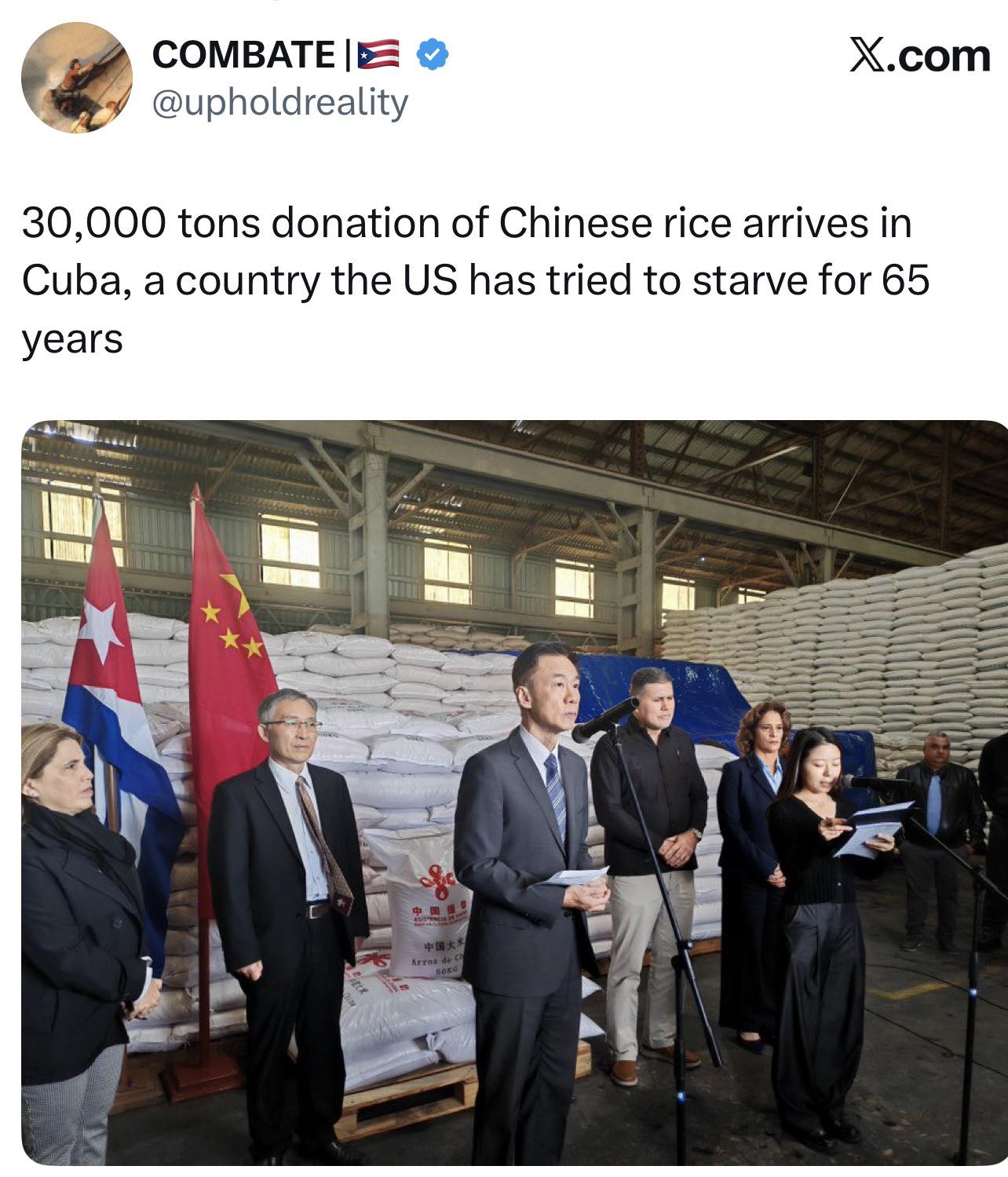
This meme presents a scene inside a massive warehouse filled with sacks of rice, flanked by the flags of Cuba and China while people speak at microphones. A caption explains that this 30,000-ton donation arrived in Cuba—the country the US historically tried to starve for 65 years. By framing this aid as a strategic move against American power, the meme argues that China is using international support to undermine Western influence and subvert regional politics.
detailed-analysis (gemma3_27b-it-q8_0)
Okay, let's break down this image and its accompanying text from the perspective of an Anti-Imperialism framework, using the requested analytical lenses where relevant.
Overall Interpretation: This post presents the Chinese rice donation to Cuba as a direct counter to decades of U.S. policy aimed at destabilizing Cuba, implicitly through economic means (specifically, food scarcity). It’s a celebratory assertion of anti-imperialist solidarity and resistance.
Visual Description
The image depicts a formal scene: a donation ceremony for 30,000 tons of rice from China to Cuba. Key visual elements include:
- Flags: The Cuban flag and the Chinese flag are prominently displayed, positioned side-by-side. This visually represents a diplomatic alliance.
- Rice Sacks: Stacks of rice sacks are visible, labeled with Chinese characters, serving as the tangible evidence of the donation. The sheer volume implied by the stacks emphasizes the scale of support.
- People: A group of officials (likely Cuban and Chinese, and some observers) stand around a speaker, presumably giving a speech during the ceremony. Their formal attire signals importance and official endorsement.
- Setting: The ceremony is taking place inside a warehouse, suggesting it's a practical, logistical event—not simply symbolic. The warehouse is modest, maybe even a bit dilapidated, adding to a visual contrast with the official presentation of the aid.
Marxist Conflict Theory
This post strongly aligns with Marxist Conflict Theory. The core tenets of this theory focus on class struggle, exploitation, and the inherent contradictions within capitalist systems.
- Imperial Core vs. Periphery: The US-Cuba relationship historically exemplifies the dynamic between the ‘imperial core’ (the US, a dominant capitalist power) and the ‘periphery’ (Cuba, a developing nation). The US has sought to maintain economic control over Cuba, hindering its economic independence and self-determination.
- Economic Warfare: The claim of “trying to starve [Cuba] for 65 years” speaks to a long history of U.S. embargoes and sanctions. From a Marxist perspective, these sanctions aren’t simply about political disagreement; they are a tool of economic warfare designed to undermine a socialist government that challenged U.S. capitalist interests. Sanctions create artificial scarcity, impacting the Cuban working class.
- Solidarity & Alternative Alliances: The Chinese donation represents a challenge to U.S. hegemony and the emergence of alternative economic and political alliances. China, as a rising economic power, is positioned as a counter-force to US imperialism, offering aid and support to nations resisting U.S. dominance. This demonstrates a shift in the balance of power and the potential for a multi-polar world.
- Class interests: The donation directly impacts the material conditions of the Cuban working class by alleviating food shortages. This addresses a basic need, and supports the survival and resilience of the socialist project in Cuba.
Foucauldian Genealogical Discourse Analysis
Michel Foucault's work focuses on how power operates through discourse – language, knowledge, and social practices. A genealogical approach would trace the history of the discourses surrounding Cuba and the US relationship.
- Discourse of "Enemies": The U.S. has historically constructed a discourse around Cuba as an enemy – a communist threat to its geopolitical interests. This discourse justified decades of hostility, including the embargo, and framed Cuba as an illegitimate state.
- Discourse of "Humanitarian Intervention": The U.S. often presents its foreign policy as driven by humanitarian concerns (democracy, freedom). However, a Foucauldian analysis would reveal the power dynamics embedded within this narrative. The embargo, for example, could be framed as a way to force democracy on Cuba, but it also creates immense suffering.
- The Re-writing of History: The post itself is a counter-discourse. It re-frames the narrative, highlighting the U.S.'s destructive actions and praising China’s supportive role. It is a conscious attempt to challenge the dominant US-centered narrative about Cuba.
- Power/Knowledge: The statement that the U.S. has "tried to starve" Cuba relies on a particular understanding of history and economic policy. It's a claim that requires examining the power structures that shape our knowledge about U.S.-Cuba relations and the mechanisms by which the embargo impacted access to food.
Critical Theory
Critical Theory, particularly as developed by the Frankfurt School, analyzes societal power structures and critiques systems of domination.
- Critique of Rationality: The US policy of sanctions toward Cuba, presented as "rational" economic policy, is subject to critique. Critical theorists would argue that this 'rationality' masks a deeper agenda of maintaining US hegemony and suppressing a socialist alternative.
- Ideology and Hegemony: The US has cultivated an ideology that justifies its actions towards Cuba, portraying the embargo as necessary for promoting democracy. Critical theory examines how this ideology works to maintain US hegemony, shaping public opinion and legitimizing US power.
- Emancipation: This post celebrates the Chinese aid as a step towards Cuban emancipation from U.S. control. Critical theory is fundamentally concerned with identifying and overcoming forms of domination, and this act of solidarity is presented as a positive force in that process.
Postmodernism (Limited applicability, but present)
While the post is generally a straightforward assertion, elements of postmodern thought can be detected:
- Deconstruction of Narratives: The post implicitly deconstructs the dominant U.S. narrative about Cuba, challenging its legitimacy and highlighting its negative consequences. It rejects the idea of a singular, objective truth about U.S.-Cuba relations.
- Relativism: While the post clearly favors the Cuban/Chinese perspective, postmodernism's emphasis on the relativity of truth suggests that there are multiple valid interpretations of events.
- Anti-Foundationalism: There's a subtle rejection of the idea that U.S. policies are based on universal moral principles. The post implies that these policies are rooted in self-interest and a desire to maintain power.
Queer Feminist Intersectional Analysis (Least applicable here, but can be stretched)
This is the least relevant lens for this specific post, but we can explore it briefly.
- Intersectionality and Impacts: The impacts of a US-imposed famine would not be experienced equally. Marginalized groups within Cuba (women, LGBTQ+ individuals, people of color, etc.) would likely experience disproportionate hardship. The Chinese aid, while broadly beneficial, could be analyzed through this lens to see if it’s distributed equitably to all segments of Cuban society.
- Challenging Imperialist Masculinity: Anti-imperialist struggle can be linked to critiques of patriarchal power structures. Imperialism is often framed through narratives of dominance and control, which have clear parallels with patriarchal forms of domination. The act of supporting Cuba’s self-determination could be seen as a rejection of this patriarchal, imperialist mindset.
In conclusion, this post is a clear expression of anti-imperialist sentiment, framed through a narrative that challenges U.S. hegemony and celebrates solidarity with Cuba. It lends itself most powerfully to analysis through Marxist Conflict Theory and Foucauldian Discourse Analysis, but also benefits from insights from Critical Theory and even, to a lesser extent, Postmodernism. The lack of focus on gender/sexuality means the Queer Feminist Intersectional Analysis is the least pertinent approach here.
simple-description (llama3.2-vision_11b)
This meme is a satirical commentary on the United States' foreign policy and its treatment of Cuba. The image shows a tweet from the account "COMBATE" with the text "30,000 tons of Chinese rice arrives in Cuba, a country the US has tried to starve for 65 years." The meme is using the irony of China, a country known for its authoritarianism and human rights abuses, providing aid to a country the US has historically tried to starve, to highlight the hypocrisy of the US's foreign policy.