First Seen
2026-01-07T02:52:55.112204+00:00
simple-description (qwen3.5_2b-q8_0)
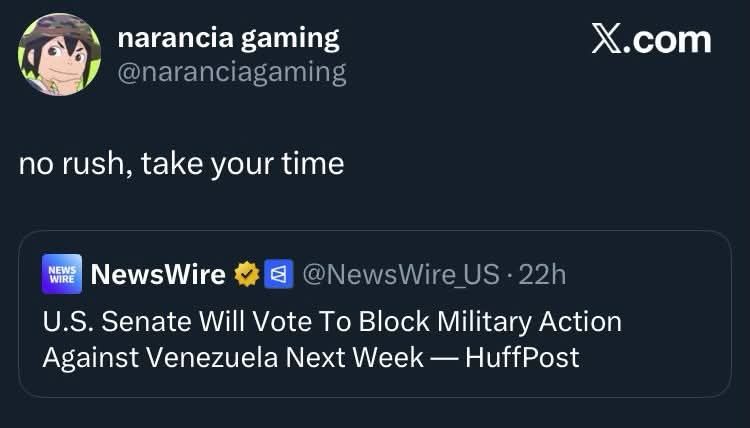
This meme serves as a satirical critique of American imperialism in Latin America, specifically highlighting a alleged conspiracy between powerful U.S. media outlets and invading military forces to obstruct Venezuelan independence. By displaying a NewsWire report that claims to "block" military action against Venezuela next week, the image mocks Washington-based journalism for allegedly working alongside the invasion ("HuffPost") to prevent liberation for Venezuelans. The caption "no rush, take your time" is directed at the American gamer "narancia gaming"—a famous pro- Chavez ally—humorously suggesting that this major media institution was too slow to get a critical story out so his political allies wouldn't have to wait.
detailed-analysis (gemma3_27b-it-q8_0)
Okay, let's break down this meme through the lens of anti-imperialism, utilizing the requested analytical frameworks where applicable.
Overall Context: This meme operates as a darkly sarcastic commentary on the repeated pattern of the United States contemplating, threatening, and sometimes engaging in military intervention in Latin American countries. The "no rush, take your time" phrase delivered after news of a potential vote to block military action is dripping with irony. It’s a critique of the normalization of interventionism and the implied assumption that intervention is a default option.
Visual Description
The post features a Twitter/X layout. The account "@naranciagaming," appears to use an anime avatar. Below that is the text "no rush, take your time." Underneath is a post from "NewsWire" detailing the U.S. Senate's upcoming vote on blocking military action against Venezuela, citing HuffPost as the source. The simplicity of the visual, coupled with the stark text, amplifies the sarcasm. The anime avatar does not contribute directly to the anti-imperialist analysis, but its presence might signal a younger, internet-native audience likely familiar with meme culture and critical discourse.
Foucauldian Genealogical Discourse Analysis
This meme is highly relevant to a Foucauldian analysis. Michel Foucault’s work explores how power operates through discourse. The very discussion around Venezuela and U.S. intervention relies on a historically constructed discourse of American exceptionalism, national security, and the "responsibility to protect" (R2P).
The meme challenges this discourse by revealing its inherent absurdity. The discourse normalizes the idea of U.S. military intervention as a legitimate tool of foreign policy. The fact that the news is about blocking intervention is presented as exceptional. "No rush, take your time" implicitly mocks the casual way intervention is considered, as if it’s merely a matter of bureaucratic scheduling.
The genealogy would examine how this discourse evolved—tracing it through the Monroe Doctrine, the Cold War, the "War on Drugs," and more recent interventions. The meme functions as an interruption within that discourse, highlighting the power dynamics and assumptions inherent in it.
Critical Theory
The meme embodies a core tenet of Critical Theory—the critique of ideology. The dominant ideology often presented is that the United States needs to be a global policeman. This ideology is used to justify interventions that serve economic or strategic interests disguised as humanitarian efforts.
The sarcasm here exposes this ideology. It reveals the underlying power structures that allow the U.S. to even consider intervening in Venezuela in the first place. The meme implicates those who accept the premise of intervention as inherently justifiable. It's a call to critically examine the narratives that shape our understanding of international relations and question why such interventionist impulses even arise.
Marxist Conflict Theory
From a Marxist perspective, the situation highlights the inherent conflict between imperialist powers (the U.S.) and nations attempting to pursue independent development (Venezuela). The potential intervention isn’t presented as a benevolent act, but rather as a manifestation of capitalist expansion. Venezuela's wealth (particularly its oil reserves) is a crucial factor.
The meme points to the material interests driving the potential intervention. The "no rush, take your time" sarcasm can be read as highlighting the calculation of how to best secure those resources, even if it requires disregarding international law or the sovereignty of another nation. The underlying conflict is not about "democracy" or "human rights," but about economic control. The delay in acting is not based on ethical concerns, but on ensuring the optimal strategy for maintaining dominance.
Postmodernism
While less direct, a postmodern reading can be applied. The meme deconstructs the grand narratives of U.S. foreign policy—narratives that often claim universal values and moral superiority. By using irony, it challenges the notion of objective truth and exposes the constructed nature of these narratives.
The meme relies on intertextuality—it assumes the audience is aware of the history of U.S. interventionism. The power comes from the juxtaposition of a seemingly innocuous phrase ("no rush, take your time") with a serious political event. It emphasizes the subjective interpretation of reality and questions the authority of official accounts.
Queer Feminist Intersectional Analysis
This framework is a less obvious fit, but can still contribute. Intersectional analysis would highlight how imperialism doesn't just impact national economies and political structures, but also deeply affects the lives of people within those nations, particularly marginalized groups.
Military intervention and political destabilization disproportionately affect women, LGBTQ+ individuals, and Indigenous communities. These groups often experience heightened violence, displacement, and economic hardship as a result of conflict. The meme, though not directly addressing these specific impacts, can be seen as a rejection of the forces that create those conditions.
The rejection of military intervention is linked to a broader concern for the wellbeing of all people, especially those who are most vulnerable under structures of power.
In summary, the meme isn't simply a witty observation, but a pointed critique of U.S. imperialism. It leverages irony to expose the normalization of interventionism and challenge the underlying ideologies that justify it, while invoking an understanding of the historical and economic context.
simple-description (llama3.2-vision_11b)
The meme is a screenshot of a tweet from a user named "narancia gaming" with the text "no rush, take your time" and a link to a news article from the "NewsWire" with the headline "U.S. Senate Will Vote To Block Military Action Against Venezuela Next Week". The meme is likely a commentary on the political news of the time, using a humorous and sarcastic tone to poke fun at the idea of the U.S. Senate's decision to block military action against Venezuela.