First Seen
2025-12-09T23:03:25.052448+00:00
simple-description (qwen3.5_2b-q8_0)
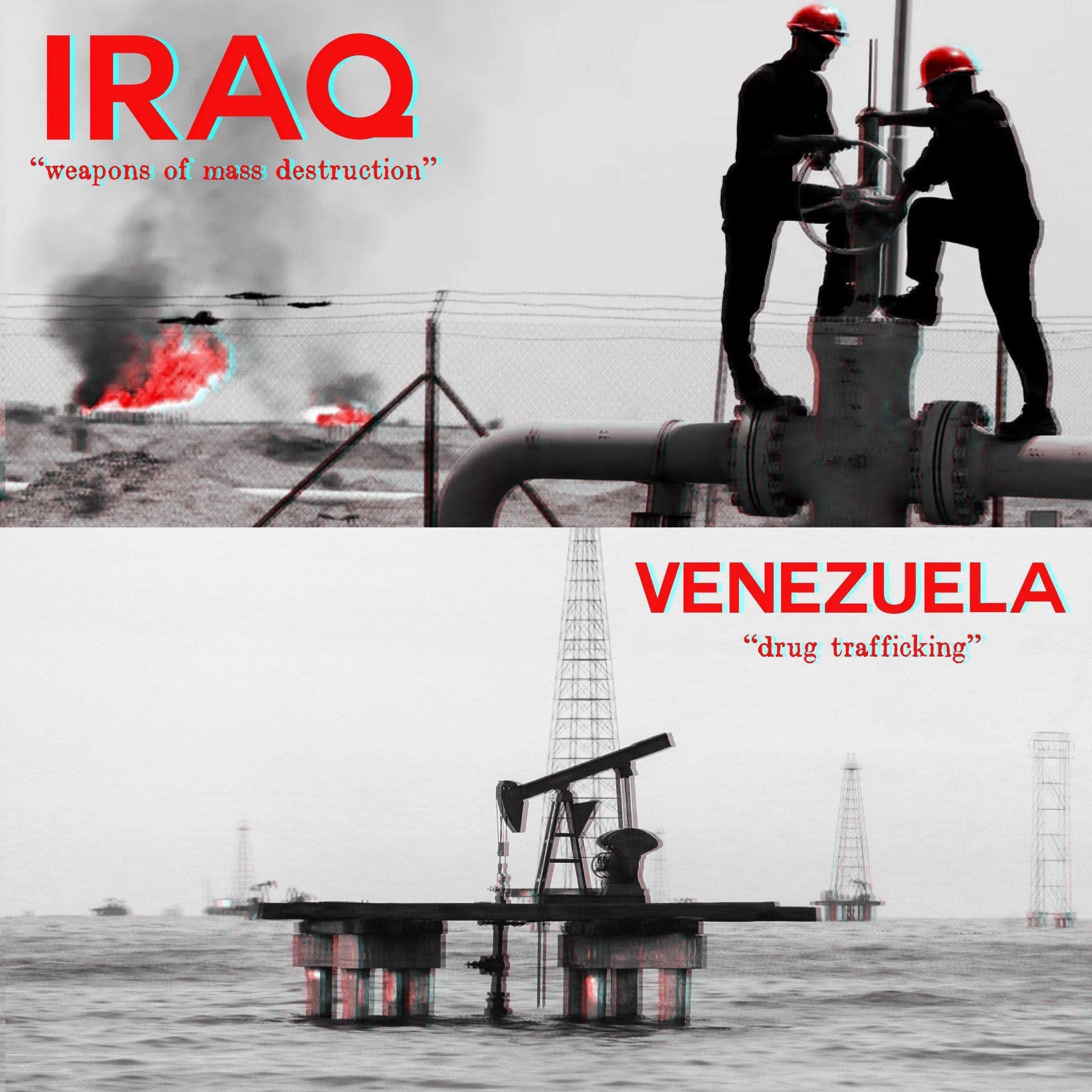
The image presents a satirical comparison using large red headers: "IRAQ," captioned "weapons of mass destruction," and "VENEZUELA," captioned "drug trafficking." The top section shows industrial workers in hard hats manipulating valves on a pipe structure against a background of burning fire, while the bottom section displays an oil pump jack floating in the water. From this anti-imperialist perspective, the meme suggests that Western powers are more concerned with the perceived military threat of Iraqi oil (depicted as weapons-grade) than Venezuelan oil production, framing one country solely as a drug trafficking problem.
detailed-analysis (gemma3_27b-it-q8_0)
Okay, let's break down this meme through the lens of anti-imperialism, exploring relevant theoretical frameworks.
Visual Description
The meme is a diptych, divided into two contrasting images.
- Top Section (IRAQ): Shows a desert landscape with what appears to be oil infrastructure (pipelines, valve structures). A blurred, fiery explosion is happening in the background. Text at the top boldly states “IRAQ” and, in smaller text, "weapons of mass destruction."
- Bottom Section (VENEZUELA): Depicts offshore oil platforms in a sea. A man in a uniform is climbing on the oil rig. Text states “VENEZUELA” and in smaller text “drug trafficking.”
The color scheme is somewhat desaturated, lending a harsh, documentary-like quality. The overall effect is a juxtaposition designed to invite comparison.
Critical Theory
This meme draws heavily on Critical Theory, specifically the Frankfurt School’s critique of ideology. It's a clear attempt to expose what it views as a double standard in how global powers (primarily the US and its allies) frame narratives about different countries.
- Ideology and Narrative Control: The core argument is that the “weapons of mass destruction” claim against Iraq, used as justification for the 2003 invasion, was a manufactured pretext. The meme points out that this justification allowed for military intervention and resource control.
- Power Dynamics: The framing of Venezuela as primarily concerned with "drug trafficking" is presented as a deliberate distortion, aimed at legitimizing intervention or sanctions. The meme suggests this is a way to demonize a nation that challenges the established power structures by controlling its own resources.
- Deconstructing the "Objective" Truth: Critical Theory challenges the idea of neutral, objective reporting. The meme suggests that both narratives – the alleged WMDs and the "drug trafficking" – are constructs created to serve specific political and economic agendas.
Marxist Conflict Theory
The meme directly aligns with Marxist Conflict Theory. At its heart, it’s about the struggle over resources and the exploitation of one nation by another.
- Resource Control: The images both center on oil infrastructure. Oil is a crucial global commodity, and control over it is a key driver of geopolitical conflict. The meme suggests that both Iraq and Venezuela are targets because of their oil reserves.
- Imperialism as Economic Exploitation: Marxist theory views imperialism as a late stage of capitalism where core nations exploit peripheral nations for resources and labor. The meme suggests that the narratives used against Iraq and Venezuela are tools to facilitate this exploitation.
- Class Struggle on a Global Scale: The meme implies a global class struggle where powerful nations (representing the "bourgeoisie") seek to control and exploit weaker nations (representing the "proletariat") for economic gain.
Foucauldian Genealogical Discourse Analysis
Michel Foucault’s work on discourse and power is exceptionally relevant here.
- Discourses and Power/Knowledge: Foucault argues that "discourse" isn't just language, but a system of thought, knowledge, and power. The meme suggests that the discourses surrounding Iraq and Venezuela are constructed to legitimize power relations. The discourse of "weapons of mass destruction" created a justification for war, while the discourse of "drug trafficking" justifies economic pressure.
- Genealogy and Historical Context: A genealogical approach would trace the history of these discourses. The meme implicitly invites us to question how these narratives came to dominate, who benefited from them, and what other narratives were suppressed.
- Discipline and Normalization: The consistent labeling of Venezuela as a "narco-state" (even if unsubstantiated) functions as a form of discipline, normalizing intervention and sanctions in the eyes of the public.
Postmodernism
While not the primary framework, aspects of Postmodernism are present.
- Deconstruction of Grand Narratives: The meme rejects the "grand narratives" offered by mainstream media and governments. It challenges the idea of a single, objective truth about Iraq or Venezuela.
- Relativism and Perspective: The meme implies that the perception of these countries is shaped by the perspective of those in power. It argues that there’s no neutral viewpoint.
- Simulacra and Simulation: One could argue that the "weapons of mass destruction" narrative was a simulacrum – a copy without an original – used to create a justification that wasn’t based on reality. Similarly, the focus on "drug trafficking" might be a distortion that obscures the real political and economic issues.
In conclusion:
The meme is a concise, visually arresting expression of anti-imperialist sentiment. It utilizes the techniques of critical theory, Marxism, and Foucauldian analysis to expose what it sees as a biased and manipulative portrayal of Iraq and Venezuela, ultimately suggesting that both nations are targeted because they resist the dominance of powerful global interests.
Disclaimer: This analysis is based on the information provided in the image and a theoretical understanding of the specified frameworks. Interpretations can vary, and this is just one possible reading of the meme.
simple-description (llama3.2-vision_11b)
The meme is a commentary on the US's foreign policy, specifically the use of military force and economic sanctions to control and exploit other countries. It juxtaposes two images, one of a US military operation in Iraq and one of an oil rig in Venezuela, with the text "Iraq: 'weapons of mass destruction'" and "Venezuela: 'drug trafficking'". The meme highlights the hypocrisy of the US's actions, using one excuse for war in Iraq and another for a perceived threat in Venezuela.