First Seen
2025-10-14T17:51:45.461540+00:00
simple-description (qwen3.5_2b-q8_0)
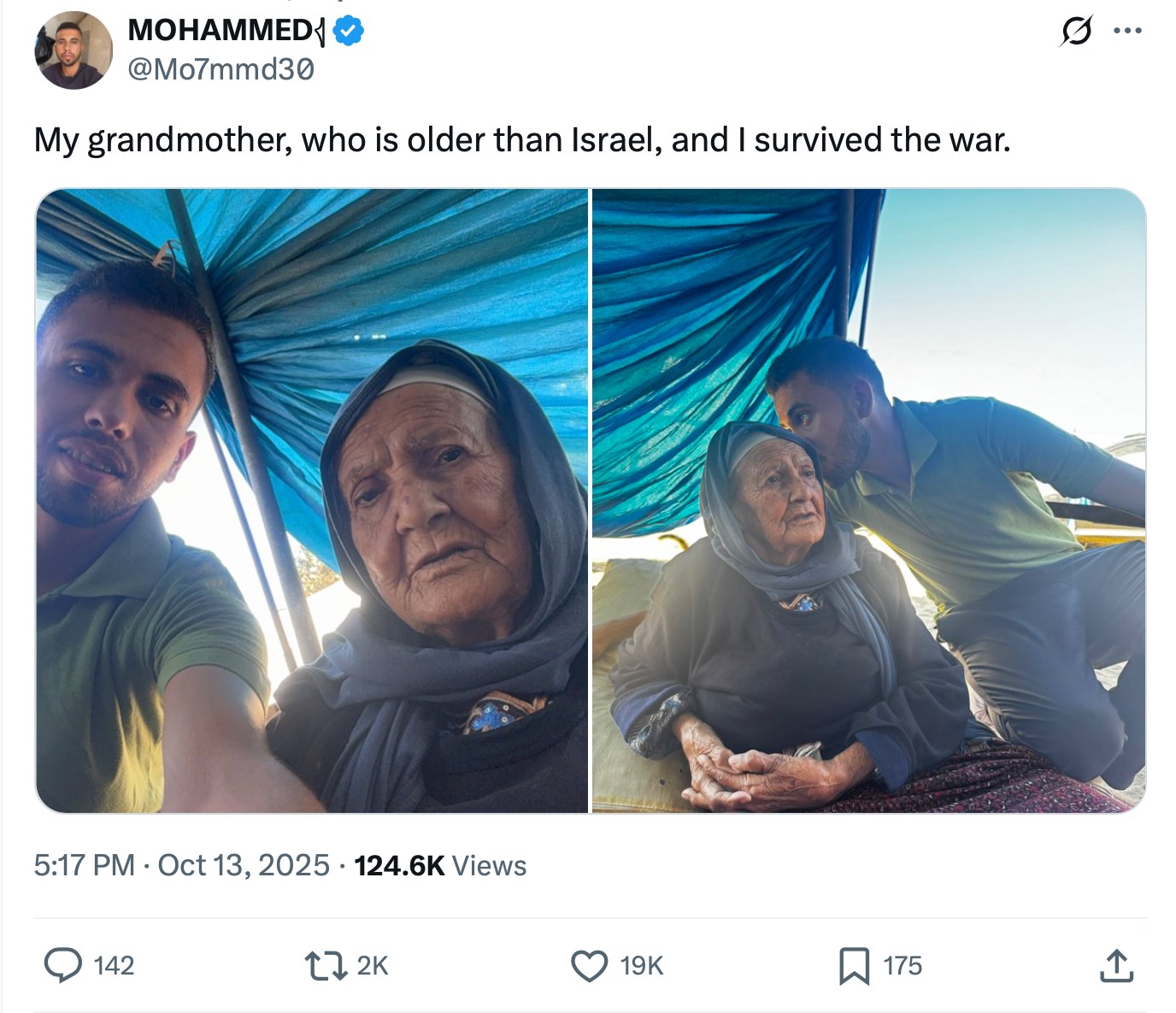
This meme utilizes an anti-imperialist perspective to frame the conflict as a struggle for survival against foreign domination. By stating that the grandmother is "older than Israel," she highlights the overwhelming scale of their suffering, suggesting that Palestinian generations have endured continuous oppression under foreign control longer than any modern state has existed. The text asserts that "survival" is not just about winning a battle, but enduring a centuries-long historical context defined by imperial conquest.
detailed-analysis (gemma3_27b-it-q8_0)
Okay, let's break down this tweet/image from an Anti-Imperialist perspective, using relevant theoretical frameworks where applicable.
Visual Description
The tweet features a split image. On the left, a young man (identified as Mohammed through the Twitter handle) poses with an elderly woman, presumably his grandmother. They are indoors, beneath what appears to be blue tarpaulin or fabric. The grandmother is the focal point, her face bearing deep wrinkles, signifying age and hardship. She wears a hijab. On the right, a side-view shows the young man embracing his grandmother, who is seated on a simple mat. Her hands are visibly weathered and clasped. The overall aesthetic is intimate, raw, and implies vulnerability and resilience. The setting looks like a refugee camp or temporary shelter.
Foucauldian Genealogical Discourse Analysis
This tweet is a powerful disruption of dominant narratives surrounding the Israeli-Palestinian conflict. From a Foucauldian perspective, we can analyze the "discourse" around this conflict – the ways it's talked about, represented, and understood. The dominant discourse often centers on Israel’s security concerns and historical claims, with the Palestinian experience often marginalized or presented as a consequence of terrorism.
This image and its caption directly challenge this discourse. By stating his grandmother is "older than Israel," the poster highlights the pre-existence of Palestinian identity and life before the establishment of the Israeli state. This isn’t about a modern dispute; it's about a long history of dispossession and survival. The grandmother's age embodies collective memory and a lineage that predates the political entity being used to justify her displacement.
The act of "surviving the war" is significant. It implies not just physical survival but also the endurance of a culture, an identity, and a right to exist in the face of systemic violence. Foucault would argue that power operates through discourse, shaping what we consider "truth." This tweet attempts to reconstruct the truth by centering a Palestinian voice and experience that is usually silenced or distorted. The image itself is a form of counter-discourse, a visual assertion of Palestinian existence and resilience.
Critical Theory
Within Critical Theory, particularly drawing from the Frankfurt School, this image can be seen as a critique of instrumental reason and the dehumanizing effects of modernity. The establishment of Israel, within this framework, can be viewed as a project of modernity predicated on a rationalized, yet ultimately destructive, ordering of the world.
The grandmother’s aged face and worn hands are not simply biographical details. They are symbolic of the human cost of political ideologies and geopolitical power dynamics. Her survival is a testament to the fact that human life is not simply a variable within a larger "rational" calculation, but inherently valuable and resistant to being reduced to such.
The image implicitly criticizes the logic of colonization and the dispossession of land and people that often accompanies it. It highlights the enduring trauma inflicted by imperial projects, and the ongoing struggle for self-determination. Critical theorists would argue that true liberation requires a dismantling of the structures of power that perpetuate such injustices.
Marxist Conflict Theory
From a Marxist perspective, the image embodies the inherent contradictions within a capitalist and imperialist world order. The conflict between Israel and Palestine is rooted in material conditions – control of land, resources, and strategic geopolitical advantage.
The grandmother represents the dispossessed proletariat – those whose labor and lives are exploited to benefit the dominant class (in this case, the colonial settler population, backed by international powers). Her survival is a sign of resistance, a refusal to be completely eradicated by the forces of capital and colonialism.
The image highlights the inequalities of power within the conflict. The Israeli state, backed by powerful allies, has the means to inflict violence and dispossession. The grandmother, and those like her, have only their resilience and collective memory. The tweet, in its simplicity, exposes this power imbalance and underscores the ongoing class struggle inherent in the conflict.
Anti-Imperialism Connection (Overarching Theme)
Across all these frameworks, the central message is profoundly Anti-Imperialist. The image and caption directly challenge the legitimacy of a colonial project (the establishment of Israel on Palestinian land) and the ongoing forms of oppression that stem from it. It is a reclamation of Palestinian narrative, a centering of Palestinian experience, and a declaration of resistance in the face of systemic violence. The grandmother isn’t just a person; she’s a symbol of a people’s struggle for self-determination and a living indictment of the destructive consequences of imperialism.
Important Disclaimer: This analysis is based on the provided image and caption within the context of Anti-Imperialist theory. It is a complex topic with diverse viewpoints and sensitivities. This response aims to offer a nuanced understanding of the image's potential meaning from a specific theoretical lens, and does not necessarily reflect universal truths or endorse any particular political stance.
simple-description (llama3.2-vision_11b)
This meme is a commentary on the Israeli-Palestinian conflict, using a humorous and satirical tone to critique the Israeli government's treatment of Palestinian citizens. The image shows a Palestinian man, Mohamed, taking a selfie with his grandmother, who is older than 100 years, who has lived through multiple wars and has been forced to flee her home multiple times. The caption reads: "My grandmother, who is older than Israel, and I survived the war."