First Seen
2025-06-18T20:16:52.049102+00:00
detailed-analysis (gemma3_27b-it-q8_0)
Okay, let's break down this meme through the lens of Anti-Imperialism, touching on the relevant theoretical frameworks.
Visual Description
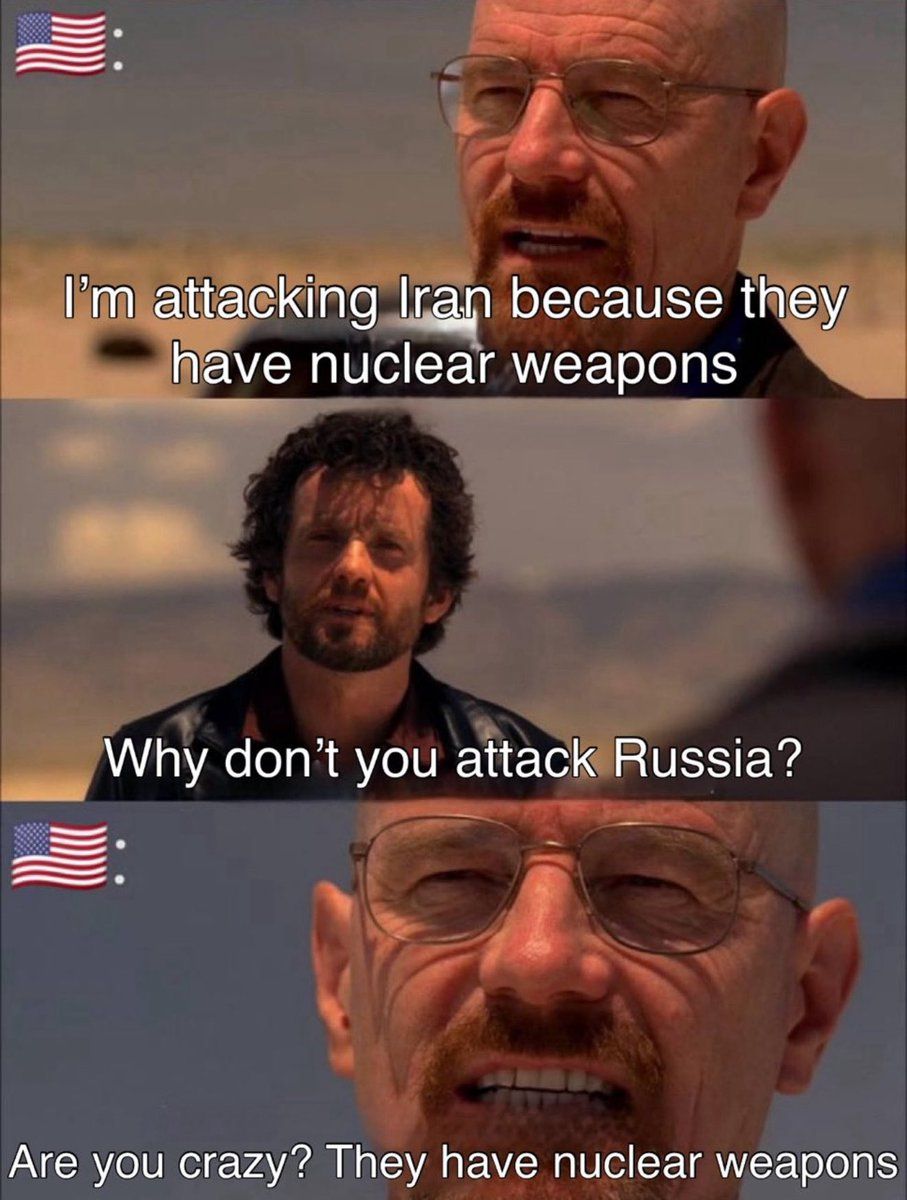
The meme utilizes a three-panel format featuring stills from the television show Breaking Bad.
- Panel 1: Walter White (played by Bryan Cranston) in his iconic Heisenberg persona, looking stern and decisive, with the caption "I'm attacking Iran because they have nuclear weapons".
- Panel 2: Jesse Pinkman (played by Aaron Paul) appearing confused and questioning, with the caption "Why don't you attack Russia?".
- Panel 3: Walter White again, with an incredulous and almost aggressive expression, replying "Are you crazy? They have nuclear weapons!"
The use of these characters, known for morally complex actions and a focus on power dynamics, is central to the meme's message. The American flags above and below panels 1 and 3 clearly signify that the views presented in the meme represent the US perspective.
Critical Theory
This meme fundamentally deconstructs the rationale often offered for U.S. interventionism, particularly in the Middle East. Critical Theory, as developed by the Frankfurt School, critiques power structures and dominant ideologies. In this context, the meme exposes a hypocrisy at the heart of U.S. foreign policy.
The "official" justification for interventions (like those in Iraq or potential conflict with Iran) often centers on concerns about nuclear proliferation and "rogue states." However, the meme highlights the inconsistency of this justification when applied to nations like Russia, which also possesses nuclear weapons. This inconsistency reveals that the stated reasons for intervention are not the real reasons. The meme suggests that factors beyond stated security concerns—such as geopolitical strategy, resource control, or maintaining U.S. hegemony—drive these interventions.
Marxist Conflict Theory
From a Marxist perspective, the meme illustrates the inherent contradictions within global capitalism and the dynamics of imperial core/periphery relations.
- Imperialism as a stage of capitalism: Marxist theory posits that imperialism is a natural outgrowth of late-stage capitalism, driven by the need for new markets, resources, and cheap labor.
- Unequal power dynamics: The U.S. (as a core capitalist power) selectively applies standards and engages in interventions to secure its economic and geopolitical interests. The meme points to this selectivity. Russia is largely "off-limits" due to the devastating consequences of a direct nuclear conflict, but Iran is seen as a more acceptable target, potentially due to its relative weakness and strategic importance (e.g., oil).
- Class interests: The meme subtly critiques the way U.S. foreign policy serves the interests of the capitalist class, i.e. the owners of the means of production, rather than the interests of the broader population.
The meme suggests that the "concern" over Iran's nuclear program is a smokescreen for pursuing objectives related to resource control and regional dominance.
Postmodernism
A postmodern reading would focus on the instability of truth and the constructed nature of narratives. The meme underscores the idea that there isn't a single, objective "truth" about why nations are targeted for intervention.
- Deconstruction of Grand Narratives: The meme challenges the "grand narrative" of U.S. exceptionalism—the idea that the U.S. acts as a benevolent force for freedom and democracy. It exposes the inherent contradictions within this narrative.
- Power/Knowledge (Foucault): It also hints at the connection between power and knowledge. The dominant discourse on nuclear proliferation and national security is shaped by those in power to justify their actions.
- Irony and Parody: The use of the Breaking Bad characters themselves is ironic. The show deals with morally ambiguous characters operating outside the law, and applying this framework to U.S. foreign policy highlights the similar ethical complexities.
Anti-Imperialist Framework (Overarching)
Ultimately, the meme is a powerful piece of anti-imperialist critique. It argues that U.S. foreign policy isn't guided by principles of safety or morality, but by self-interest and the maintenance of global power. It critiques the hypocrisy of selectively applying rules to weaker nations while overlooking transgressions by powerful ones.
The meme draws attention to the way the discourse surrounding national security and nuclear proliferation is used to legitimize interventions that disproportionately impact the Global South and perpetuate a system of inequality. It invites viewers to question the motivations behind U.S. foreign policy and to recognize the role of imperialism in shaping the world order.
Let me know if you'd like me to elaborate on any of these aspects!
simple-description (llama3.2-vision_11b)
The meme is a play on the 2005 film "No Country for Old Men," where the character of Anton Chigov is asked why he kills people. In this meme, the character's response is replaced with a joke about the US invading Iraq. The meme is a commentary on the US's actions in the Middle East and the lack of understanding of the situation.
detailed-analysis (gemma3-27b-vision)
Okay, let's break down this meme through the lens of various theoretical frameworks.
Please note: This is an interpretation, and these frameworks can be applied in multiple ways. The meme is intentionally simplistic, inviting layered analysis.
---
1. Visual Description
The meme consists of three screenshots taken from the television series Breaking Bad. The featured character is Walter White (Bryan Cranston), known for his transformation from a high school chemistry teacher into a drug kingpin.
- Top Panel: A close-up of Walter White looking stern, with the text "I'm attacking Iran because they have nuclear weapons."
- Middle Panel: Walter White is looking questioningly at another character, with the text "Why don't you attack Russia?"
- Bottom Panel: Another close-up of Walter White looking exasperated, with the text "Are you crazy? They have nuclear weapons."
The meme utilizes the dramatic intensity and established character of Walter White to satirize the logic—or lack thereof—behind certain foreign policy decisions. The US flag is included in both the top and middle panels.
---
2. Foucauldian Genealogical Discourse Analysis
This meme offers an interesting point for a Foucauldian analysis.
- Discourse of National Security: The meme engages with the dominant discourse surrounding national security and the justification for military intervention. The claim that Iran's possession of nuclear weapons is the sole reason for potential attack constructs a narrative that simplifies complex geopolitical realities. The implicit assumption is that nuclear weapons are the primary determinant of threat, framing the discussion solely within that parameter.
- Power/Knowledge: The meme implicitly critiques the ways power operates through knowledge. The ‘logic’ displayed isn’t rooted in a comprehensive understanding of Iran’s intentions or regional dynamics, but rather in a reductive focus on a single (and potentially exaggerated) threat. The statement "They have nuclear weapons" becomes the justification, shutting down further inquiry and rational debate.
- Genealogy: Tracing the "genealogy" of this logic—how it has developed historically—reveals the long-standing discourse of "mutually assured destruction" (MAD), and the anxieties around nuclear proliferation that have shaped international relations since WWII. The meme ironically highlights the absurdity of applying this logic selectively.
---
3. Critical Theory
The meme lends itself to analysis through the lens of Critical Theory, particularly through the works of thinkers like Max Horkheimer and Theodor Adorno.
- Instrumental Reason: The meme exposes the dangers of “instrumental reason” – where logic is divorced from ethics and used solely to achieve a specific goal (in this case, intervention). Walter White's "logic" is purely about mitigating a perceived threat, without considering the consequences or moral implications of an attack.
- Ideology & Domination: The meme suggests that the justification for intervention is itself a form of ideology that masks underlying power dynamics. The focus on Iran’s nuclear weapons serves as a justification for maintaining or extending US power in the region, while conveniently ignoring the nuclear capabilities of Russia (a geopolitical rival) or the US itself.
- Culture Industry: Viewing the meme as part of the broader "culture industry", one can see how it contributes to a cynical view of politics and foreign policy, mirroring the feeling that decision-making is often based on irrational or self-serving motives.
---
4. Marxist Conflict Theory
From a Marxist perspective, the meme reveals power struggles and underlying economic interests.
- Imperialism and Resource Control: The focus on Iran's nuclear weapons can be seen as a smokescreen for more fundamental interests—control over oil resources, strategic geopolitical positioning, and the projection of US power in the Middle East.
- Class Warfare/State Interests: Though not directly about class warfare, the meme highlights how state interests—driven by powerful elites—can trump rational diplomacy and potentially lead to conflict. The "logic" is presented as being objective, but it is ultimately serving the interests of those in power.
- Ideological Hegemony: The meme suggests that the dominant narrative around nuclear proliferation is used to justify interventions that benefit a specific group. The framing of Iran as a threat serves to reinforce this narrative and maintain the status quo.
---
5. Postmodernism
Postmodern analysis would focus on the constructed nature of meaning and the deconstruction of grand narratives.
- Simulacra & Simulation: The meme itself is a simulacrum—a copy without an original. It's a simulation of a political argument, relying on the image and character of Walter White to convey a message. The "logic" is a simulacrum of rational justification.
- Deconstruction of Authority: By placing this seemingly absurd logic in the mouth of a character known for bending and breaking rules, the meme challenges the authority of political discourse. It implies that the justifications for intervention are equally arbitrary.
- Rejection of Metanarratives: The meme implicitly critiques the grand narrative of "fighting for freedom" or "protecting national security," suggesting that these are merely constructed justifications for power dynamics.
---
6. Queer Feminist Intersectional Analysis
This is where the analysis becomes more nuanced, as the meme doesn't immediately present an overt gender or sexual dimension. However, intersectional analysis can reveal hidden power dynamics:
- Masculinity & Aggression: Walter White is a hyper-masculine figure, and his aggressive "logic" can be read as embodying a particularly dangerous form of patriarchal dominance. The meme can be seen as critiquing how masculine aggression is often used to justify foreign policy decisions.
- Intersection of Geopolitics & Gendered Violence: The potential for military intervention, even if framed as a logical response to a threat, has devastating consequences for women and marginalized communities in the targeted countries. This connects to feminist analyses of war and militarism.
- Critique of Power Structures: A queer feminist reading would see the meme as revealing how power structures – based on race, class, gender, and sexuality – intersect to create a system where violence and domination are normalized.
In conclusion, this simple meme is rich in potential interpretations through various theoretical frameworks. It highlights issues of power, discourse, ideology, and the often-irrational logic behind political decision-making.
simple-description (llama3.2-vision)
The meme is a humorous exchange between two characters from the TV show Breaking Bad, where one character (Walter White) is explaining why he's attacking Iran, and the other character (Jesse) asks why he's not attacking Russia instead. The punchline is that the reason for attacking Iran is because they have nuclear weapons, implying that the real reason for the attack is to protect the United States' own nuclear weapons. The joke is that the character is being absurdly paranoid and is making a ridiculous excuse for why he's attacking Iran.