First Seen
2025-05-14T21:25:38.891947+00:00
detailed-analysis (gemma3_27b-it-q8_0)
Here's an analysis of the meme from an anti-imperialist perspective, organized as you requested.
Meme Analysis: Anti-Imperialist Perspective
Visual Description
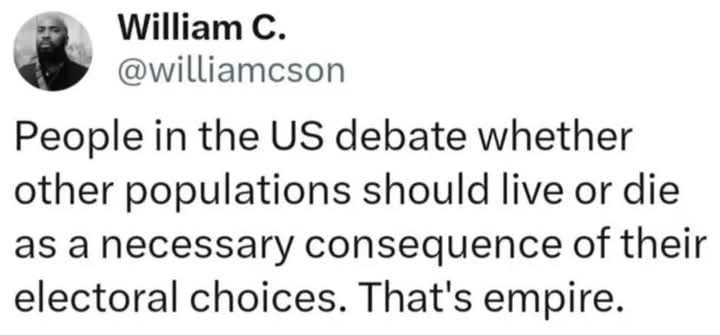
The meme is a screenshot of a tweet from William C. (@williamcson). It features a profile picture of a man, and then the text of the tweet: "People in the US debate whether other populations should live or die as a necessary consequence of their electoral choices. That's empire." The visual is intentionally stark and minimalistic. The focus is entirely on the text, signaling the importance of the statement itself rather than visual rhetoric. The profile picture lends credibility to the claim, implying a thoughtful source.
Foucauldian Genealogical Discourse Analysis
This tweet is deeply relevant to Foucault’s work. The statement “That’s empire” isn't merely a descriptor; it's a claim about the production of truth and the mechanisms of power that define what is considered legitimate debate.
- Discourse of Sovereignty: The statement points to how the very framing of US electoral politics produces a discourse of sovereignty. The US electorate is positioned (and positions itself) as having power over life and death, not just within its own borders, but globally. The “debate” itself is not about policy, but about who deserves to live.
- Genealogy of Power/Knowledge: Foucault’s genealogy would trace how this mode of thinking developed. It would ask how historically, the US has constructed itself as a global decision-maker, justifying interventions and policies based on its perceived right to determine the fate of others. This isn’t a natural outcome; it’s a historically contingent power relation that has become naturalized through discourse.
- Biopower: This relates directly to biopower – the ways in which modern states regulate life, manage populations, and ultimately decide who lives and who dies. US foreign policy (and the debates around it) exemplify this; decisions about aid, sanctions, military intervention, etc., directly impact life expectancy and quality of life in other regions. The "debate" about whether other populations should live or die normalizes this biopolitical function.
Critical Theory
The meme embodies a core tenet of Critical Theory: the critique of ideology.
- False Consciousness: The tweet argues that the “debate” itself is an ideological construction that obscures the realities of power. It suggests that US citizens are led to believe their electoral choices are simply about domestic policy, when in fact, those choices have immense, often lethal, consequences for people elsewhere.
- Instrumental Reason: The focus on electoral outcomes as a "necessary consequence" points to a problem of instrumental reason (Horkheimer and Adorno). This is the application of rational-technical thinking to all areas of life, resulting in a cold, calculating logic that devalues human life and treats people as means to an end.
- Critique of Enlightenment: Anti-imperialist critical theory often questions the universality of Enlightenment ideals. The meme challenges the notion of "democracy" as inherently good if that democracy is used to justify domination and control over others.
Marxist Conflict Theory
The meme highlights the underlying power dynamics of imperialism through a Marxist lens.
- Core-Periphery Model: The US (the “core”) maintains its wealth and power by exploiting resources and labor in the “periphery” (other countries). The electoral "debate" described in the tweet is a way of legitimizing and obscuring these exploitative relationships.
- Imperialism as a Stage of Capitalism: Lenin's theory of imperialism argues that capitalism inevitably leads to imperialism as a way to find new markets and resources. The meme shows how this manifests in the everyday political life of the US, where even seemingly "domestic" debates have global implications.
- Class Struggle on a Global Scale: Imperialism isn’t just about state-to-state relations; it's also about class struggle. The benefits of imperial policies accrue to the ruling class in the US, while the costs are borne by working-class people in both the core and the periphery. The "debate" serves to distract from this fundamental class conflict.
Postmodernism
While seemingly at odds, postmodern thought can illuminate the meme's message.
- Deconstructing Grand Narratives: The statement challenges the "grand narrative" of US exceptionalism and the idea that the US is a benevolent global actor. It exposes the contingent and constructed nature of this narrative.
- The Instability of Meaning: Postmodernism challenges the notion of fixed meanings. The meme deconstructs the seemingly neutral language of “electoral choices” to reveal the violent power dynamics it masks. The "debate" isn't simply a discussion; it's a performance of power.
- Rejection of Universal Truths: The meme doesn’t offer a solution, but it rejects the idea that there is a single, "correct" way to understand international relations. It encourages a critical questioning of established norms.
In summary, the meme is a concise and potent critique of US imperialism. It draws attention to the ways in which power operates through discourse, ideology, and material exploitation, ultimately arguing that the very act of debating the fate of other populations is a symptom of an imperial mindset.
simple-description (llama3.2-vision_11b)
The meme is a commentary on the US presidential election, where a person is implying that the election is a matter of life and death, as if the outcome will determine the fate of the world. The text "In the US they're going to kill you" is a reference to the idea that the election is a matter of life and death, as if the outcome will determine the fate of the world.
detailed-analysis (gemma3-27b-vision)
Okay, here's an analysis of the Twitter post, broken down into sections based on the theoretical frameworks you requested. Note that some frameworks will be more relevant than others, and I'll indicate where a section isn't strongly applicable.
Visual Description
The image is a screenshot of a Twitter post. It displays a profile picture (a black-and-white portrait of a man) associated with the username "@williamcson." Below the profile is a text-based post: "People in the US debate whether other populations should live or die as a necessary consequence of their electoral choices. That's empire." The overall aesthetic is minimalist, typical of the Twitter platform.
---
Foucauldian Genealogical Discourse Analysis
This post lends itself strongly to a Foucauldian reading. Foucault focused on how power operates not as a top-down, repressive force, but through discourse, knowledge production, and normalization.
- Discourse and Power/Knowledge: The tweet implies that there is a discourse (a system of thought, language, and practice) within the US wherein the lives of "other populations" are debated as outcomes of electoral choices. This isn’t presented as an aberration, but as normal – a constitutive aspect of the US political system. The very framing of life and death as consequences of votes demonstrates how power operates through seemingly neutral mechanisms like electoral processes.
- Genealogy: A genealogical analysis would trace the historical development of this discourse. How did the US arrive at a point where the lives of those outside its borders are perceived as contingent on domestic political decisions? One could look at the history of imperialism, colonialism, interventions, foreign aid, and the rhetoric justifying these actions.
- Biopower: The statement directly relates to biopower, as defined by Foucault—the ways in which political power exercises itself through control and management of life (and death). The tweet isn't about controlling bodies directly, but determining who lives and who dies based on a political calculation.
- Empire as Discourse: The single word "empire" at the end of the tweet is crucial. It's not a description of an objective reality, but a framing that positions the US within a historical and geopolitical context of dominance and control. This is a key element of discursive power—shaping understanding through language.
---
Critical Theory
Critical Theory, originating with the Frankfurt School, seeks to analyze power structures and critique societal norms to promote emancipation. This tweet is well-suited to a Critical Theory analysis.
- Critique of Rationality: The post can be seen as critiquing the instrumental rationality of modern politics. Reducing life and death to "consequences of electoral choices" represents a cold, calculating logic that dehumanizes those affected. It challenges the notion of a "rational" political system if that system is built on the potential for death and suffering.
- Domination and Oppression: The tweet implicitly highlights the asymmetrical power relationship between the US and “other populations.” The ability to debate the lives of others points to a fundamental imbalance of power and a structure of domination.
- Ideology: The framing of electoral choices as directly determining life or death may function ideologically, masking the complex web of factors that contribute to global inequalities and violence. This can lead to a justification of action by framing it as inevitable.
---
Marxist Conflict Theory
While applicable, a strict Marxist reading isn’t the most central lens here. However, elements of Conflict Theory can be applied:
- Class Struggle & Global Capitalism: One could argue that the “electoral choices” referenced are shaped by the interests of dominant classes (e.g., corporations, the military-industrial complex) within the US, and that the suffering of "other populations" is a consequence of the drive for profit and resource control in a global capitalist system.
- Imperialism as Exploitation: Marxist theory historically views imperialism as a stage of capitalism driven by the need for new markets and resources. This tweet can be seen as reflecting the violence inherent in that process.
- Power Dynamics: The tweet highlights a power struggle between the US and the populations affected by its political decisions.
---
Postmodernism
A postmodern reading emphasizes the instability of meaning, the rejection of grand narratives, and the fragmentation of experience. It’s less directly applicable than Foucault or Critical Theory.
- Deconstruction of "Truth": The post can be read as challenging the idea of objective truth or moral certainty in international relations. It suggests that there is no neutral position, and that even seemingly rational choices are embedded in power dynamics.
- Rejection of Grand Narratives: The statement implicitly rejects the idea of a benevolent or universally progressive US role in the world. It exposes the darker side of power and its consequences.
- Relativism: The tweet could be interpreted (though controversially) as hinting that value judgements are relative – that the lives of “other populations” are not necessarily valued equally to those within the US. (However, this is where a responsible reading is crucial—not all deconstruction necessarily leads to moral relativism).
---
Queer Feminist Intersectional Analysis
This framework is the least directly applicable, but potential connections can be made:
- Interlocking Systems of Oppression: A queer-feminist perspective would emphasize how the populations affected by these electoral choices are likely to be marginalized groups – those already subject to overlapping forms of oppression based on gender, race, sexuality, class, and national origin.
- Biopolitics of Reproduction/Death: This framework draws heavily from Foucault and can be used to analyze how power operates through control over life, death, and reproduction. The framing of electoral choices determining life and death can be seen as an extreme example of this.
- Decentering the Subject: A queer feminist analysis would challenge the presumed universality of the "US subject" and highlight the experiences of those who are excluded from or marginalized by that construction.
Let me know if you'd like me to elaborate on any of these analyses or explore a different theoretical lens!
simple-description (llama3.2-vision)
The meme is a tweet from William C. that reads: "People in the US debate whether other populations should live or die based on their electorally chosen leaders. That's empire."