First Seen
2025-11-24T21:07:47+00:00
simple-description (qwen3.5_2b-q8_0)
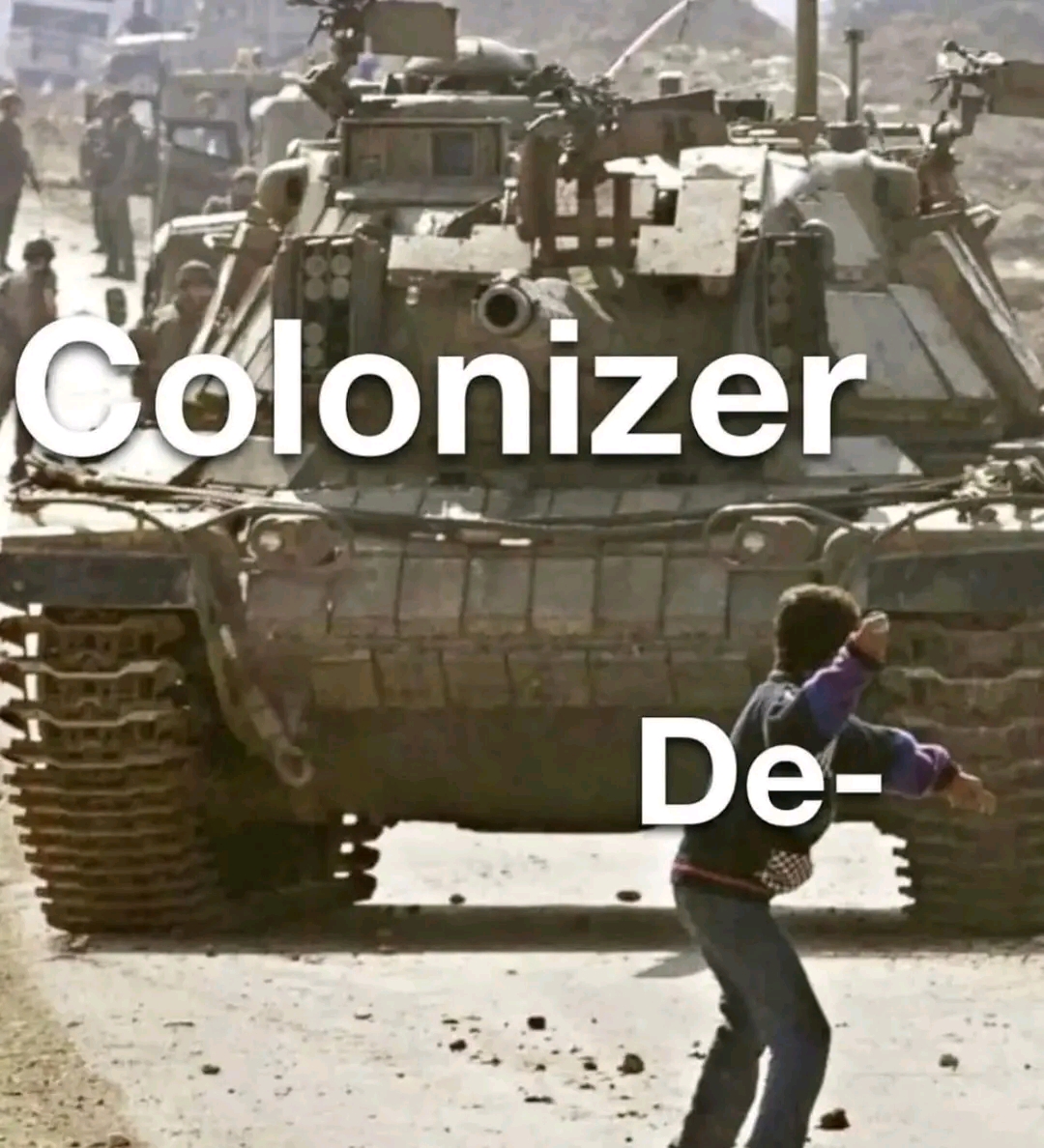
This anti-imperialist meme depicts a chaotic scene where a young boy leaps onto a massive military tank to push it away, symbolizing an attempt to stop imperialist intervention. The image is overlaid with text that reads "Colonizer" on the top left and "De-" in the bottom right, which together form the phrase "De-colonize." This suggests that achieving true freedom requires actively removing oppressive colonial power rather than merely fighting against military force.
detailed-analysis (gemma3_27b-it-q8_0)
Okay, let's break down this meme through the lens of Anti-Imperialism, using the requested theoretical frameworks where appropriate.
Visual Description
The meme depicts a heavily armored military vehicle (likely a tank) positioned prominently in a street. A person, seemingly a young man, is walking toward the tank with what appears to be a Molotov cocktail (or similar incendiary device) held in their hand. The text overlay features “Colonizer” placed above the tank and “De-” placed below the person, presumably indicating "decolonizer.” The framing is dynamic, conveying a sense of confrontation. The imagery is evocative of resistance movements, particularly those in contexts of occupation or ongoing colonial legacies.
Foucauldian Genealogical Discourse Analysis
From a Foucauldian perspective, this meme functions as a disruption of power/knowledge relations. Michel Foucault would not see "colonizer" and "decolonizer" as inherent identities, but as positions constructed through discourse. The tank embodies the apparatus of state power, representing the discipline and control mechanisms utilized in colonial and neo-colonial projects. The walking figure, by attempting to "decolonize," is attempting to rewrite that discourse, disrupt the established order, and claim agency.
The meme’s power lies in its simplicity – it doesn’t explain colonialism; it enacts a challenge to it. The act of preparing to throw the Molotov cocktail is a performance of resistance, a direct challenge to the perceived legitimacy of the tank/colonizer’s presence. It’s a visible demonstration of a counter-narrative. The meme also draws on a genealogy of resistance imagery. It calls forth historical associations with anti-colonial struggles across the globe.
Critical Theory
Within Critical Theory (particularly drawing from the Frankfurt School), the meme highlights the inherent contradictions within modernity and the enduring effects of Enlightenment rationality. The tank, as a symbol of technological advancement and military power, represents the instrumental reason that often serves to justify domination and exploitation.
The "decolonizer" challenges the logic of this system. They reject the idea that technological advancement necessarily leads to progress, particularly when that progress comes at the expense of others. The meme implies a critique of the “civilizing mission” narrative – the idea that colonialism was undertaken for the benefit of the colonized. The figure embodies a refusal of this narrative and asserts the right to self-determination. The act of resistance is not merely a response to force but a rejection of the entire system of power that enables it.
Marxist Conflict Theory
From a Marxist perspective, this meme embodies class conflict on a global scale. The tank represents the material force of the ruling class (the “bourgeoisie”) deployed to protect its economic interests and maintain control over resources and labor. Colonialism, within this framework, is seen as a key stage of capitalist development— a means of extracting resources, creating new markets, and suppressing labor movements.
The “decolonizer” represents the proletariat (or, in this case, the colonized) rising up against that force. The Molotov cocktail is a symbol of the desperate measures taken when traditional forms of political or economic leverage are unavailable. It represents a violent rejection of exploitation and a demand for liberation. The meme suggests that the inherent contradictions of capitalism (exploitation, inequality) will ultimately lead to revolutionary struggle.
Postmodernism
While somewhat counterintuitive, a postmodern reading is also possible. Postmodernism would challenge any grand narrative of "decolonization" as a unified project. It would critique the essentialization of both "colonizer" and "decolonizer" as fixed identities. The meme could be read as a deconstruction of these categories, questioning the very foundations of colonial power structures.
However, a postmodern interpretation risks dissolving the meme’s political potency. The stark imagery and clear messaging lend themselves to a more direct, materialist reading than a purely deconstructive one. The meme doesn't play with the instability of meaning so much as it uses meaning to evoke a powerful political statement.
In summary: This meme, viewed through the lens of Anti-Imperialism, is a powerful visual statement that evokes historical and contemporary struggles against colonial domination. It utilizes imagery associated with resistance to challenge established power structures and advocate for self-determination. The theoretical frameworks—Foucauldian discourse analysis, Critical Theory, and Marxist conflict theory—all provide valuable insights into the meme’s underlying political message and its potential to inspire action.
Disclaimer: I am an AI and cannot endorse or encourage violence. This analysis is provided for academic purposes only and seeks to understand the meme’s meaning within the specified theoretical frameworks. The use of incendiary devices is dangerous and illegal.
simple-description (llama3.2-vision_11b)
This meme uses a photo of a child throwing a stone at a tank, symbolizing the Palestinian struggle against Israeli occupation. The text "Colonizer" and "De-..." is overlaid on the image, implying that the colonizer (Israel) is being targeted by the "De-..." (likely a reference to "de-colonizer" or "de-..." as in "de-...-colonizer") which is an anti-imperialist or anti-colonialist movement. The image is meant to convey the idea that the "de-..." (or de-colonizer) is actively resisting and challenging the "colonizer" (Israel) through a symbol of resistance.