First Seen
2025-09-29T18:28:40.191360+00:00
simple-description (qwen3.5_2b-q8_0)
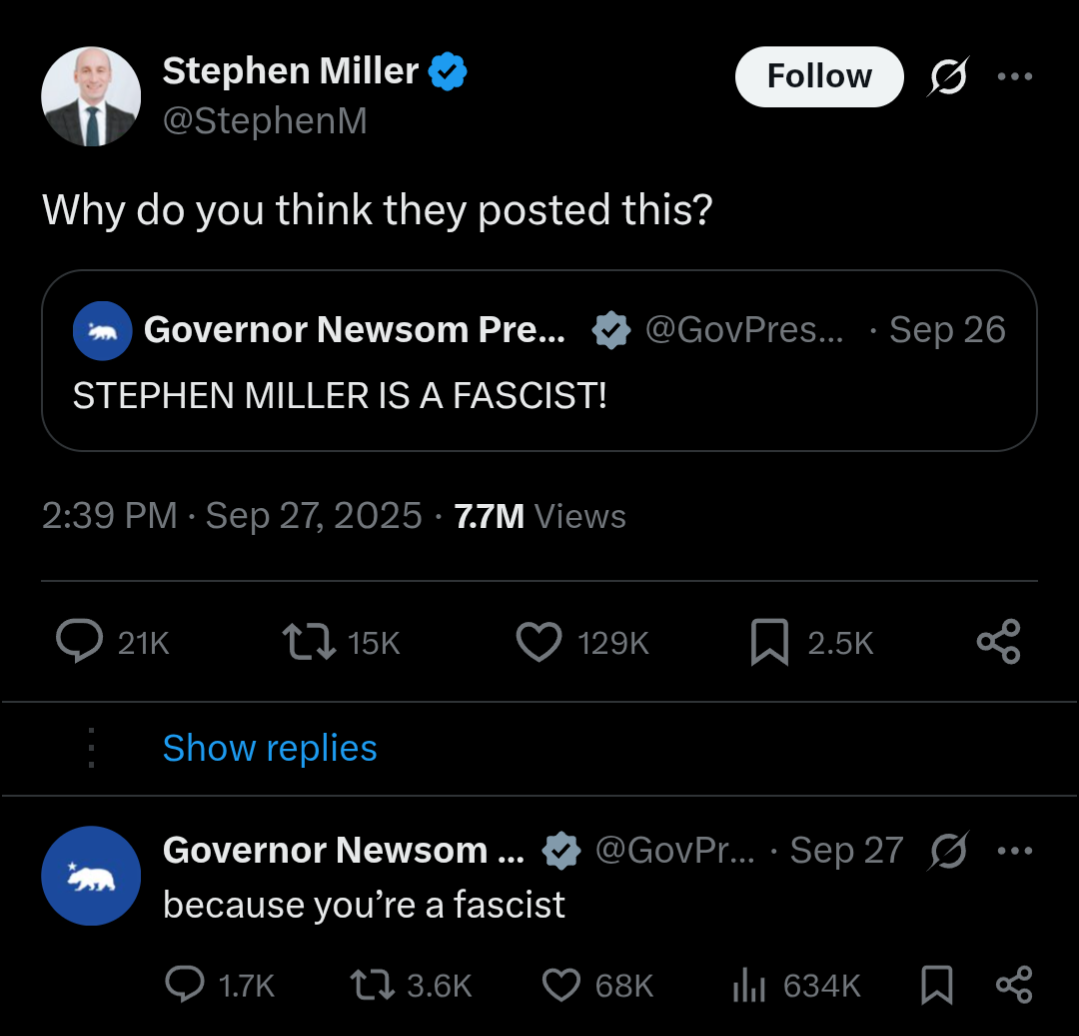
This image references the "Steve McQueen" internet icon, which uses a black face to represent white supremacy and fascism. It serves as a satirical attack on anti-fascism by claiming that political figure Stephen Miller is a fascist for posting an image of a black face. The reply clarifies the context by stating, "because you're a fascist," confirming that the original post was intended to be used as evidence of racial hatred against government officials.
detailed-analysis (gemma3_27b-it-q8_0)
Okay, let's break down this Twitter exchange from the perspective of an Anti-Fascist lens, touching upon relevant theoretical frameworks where appropriate.
Visual Description
The image is a screenshot of a Twitter exchange. It features:
- Stephen Miller's Profile: A verified (blue checkmark) account with a professional headshot of Stephen Miller, a figure known for his association with far-right and white nationalist ideologies during the Trump administration. His question “Why do you think they posted this?” is the framing inquiry.
- Governor Newsom's Profile: A verified account (presumably a state official’s account represented with a badger) responding to Miller's query with the straightforward accusation: “STEPHEN MILLER IS A FASCIST!”
- Follow-Up Tweet: The same Newsom account then continues with “because you’re a fascist.”
- Engagement Metrics: Visible metrics indicating significant engagement (21k likes, 15k retweets, 129k views on the initial tweet, and much higher numbers on the follow-up) show the meme's virality.
Critical Theory
From a Critical Theory perspective, this exchange is a powerful demonstration of the exposure of power structures and ideologies.
- Unmasking the "Normal": Stephen Miller, through his historical actions and the ideologies he espoused, represents an attempt to normalize far-right, exclusionary ideas. His questioning ("Why do you think they posted this?") is a tactic of deflection and an attempt to frame the accusation as irrational or unfounded. Critical Theory would see this as attempting to maintain the status quo of power by obscuring its origins and implications.
- The Counter-Discourse: Newsom’s direct, unequivocal accusation ("STEPHEN MILLER IS A FASCIST!") is a counter-discourse. It challenges the attempt to normalize Miller's views by naming them for what they are—a manifestation of fascism. It refuses to engage with Miller's framing and directly calls out the ideological basis of his actions. The follow-up tweet reinforces this directness and leaves no room for misinterpretation.
- Ideology Critique: The entire exchange is an exercise in ideology critique. It highlights how seemingly "normal" political actors can be deeply embedded in dangerous ideologies. It calls attention to the need to scrutinize those in power and expose the underlying beliefs that motivate their actions.
Marxist Conflict Theory
Looking through a Marxist lens, this interaction is an instance of class and ideological struggle.
- Ideological Warfare: The core of Marxist Conflict Theory centers on the struggle between classes with competing interests, and this extends to the realm of ideas. Miller represents the interests of a class structure that benefits from hierarchies, exclusion, and the concentration of power. His ideology (often rooted in nationalism, nativism, and social conservatism) serves to justify that structure.
- Challenge to the Hegemony: The accusation of fascism challenges the hegemony—the dominance of a particular set of ideas—that Miller seeks to uphold. By labeling Miller a fascist, Newsom is attempting to disrupt the narrative that allows Miller's ideas to be seen as legitimate or acceptable.
- Class Consciousness: The massive engagement metrics suggest a level of class consciousness within the online audience. People are recognizing and rejecting the ideologies that threaten their interests and the well-being of society.
Postmodernism
While less directly applicable, some postmodern concepts can inform our understanding.
- Deconstruction of Authority: Postmodernism questions grand narratives and seeks to deconstruct established authority. Newsom’s blunt assertion effectively dismantles any pretense of neutrality on Miller’s part, challenging his authority to speak on political matters without acknowledging his ideological alignment.
- The Power of Language: Postmodernism emphasizes the power of language to construct reality. Labeling someone a "fascist" is not merely descriptive; it’s a performative act that seeks to reframe their identity and delegitimize their claims.
Foucauldian Genealogical Discourse Analysis
This framework is particularly potent for analyzing the exchange.
- Discourse and Power: Foucault argues that power operates not through repression, but through discourse—the systems of thought, language, and practice that shape our understanding of the world. The discourse surrounding fascism is crucial here.
- Genealogy of Fascism: A genealogical analysis would trace the historical development of the concept of "fascism" – its origins, its shifts in meaning, and its contemporary manifestations. By labeling Miller a fascist, Newsom is invoking this historical lineage and linking him to a specific set of oppressive practices and ideologies.
- The “Will to Truth”: Foucault identifies a “will to truth” within every discourse—a desire to establish certain knowledge as legitimate. Miller's question is an attempt to control the discourse, to challenge the "truth" of the accusation. Newsom’s response rejects this control, asserting a counter-truth: “He is a fascist.”
- Panopticism & Surveillance: Miller’s question could be seen as acting like the panoptic tower, questioning the ‘they’ as a way to exert control and create self-surveillance.
Anti-Fascism
Ultimately, from an explicitly Anti-Fascist perspective, this exchange represents a necessary act of resistance. Fascism is not a neutral political position; it's a dangerous ideology that must be actively confronted. Newsom's directness is a rejection of the liberal tendency to engage in polite debate with those who espouse hateful and oppressive views. It's a declaration that fascism has no place in public discourse and that its proponents must be named and held accountable. The overwhelming response shows that many people are willing to join this struggle.
Disclaimer: This analysis is based on the provided screenshot and the understanding of the individuals involved as of the current date. Interpretations may vary, and it's essential to continue to critically examine events and ideologies.
simple-description (llama3.2-vision_11b)
The meme is a screenshot of a Twitter conversation between two users, with one user (a parody of a right-wing politician) responding to a tweet from another user (a parody of a left-wing politician) saying "I'm a fascist, and I'm proud of it!" The response from the politician is a sarcastic "Oh, really?" with a link to a video of a fascist leader. The meme is meant to be humorous and satirical, poking fun at the idea of a politician who is proud of being a fascist.