First Seen
2025-05-25T19:21:26+00:00
detailed-analysis (gemma3_27b-it-q8_0)
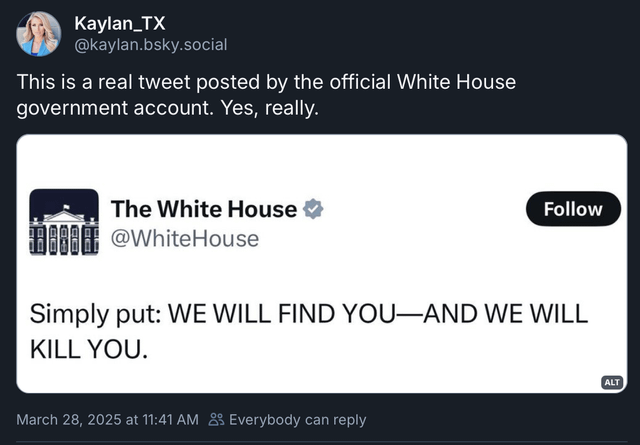
Okay, let's break down this alarming and frankly disturbing tweet from the official White House account through the lens of Anti-Fascism, using the requested theoretical frameworks where appropriate. It’s crucial to acknowledge the gravity of this "meme" before applying these theories. A threat of violence from a governmental body is not something to be taken lightly, and its existence necessitates scrutiny.
Overall Context: Anti-Fascism
From an anti-fascist perspective, this tweet is profoundly disturbing and requires immediate analysis. The core tenet of anti-fascism is opposing ideologies and systems that are inherently oppressive, hierarchical, and reliant on violence. Fascism often relies on the suppression of dissent through intimidation and brutality. This tweet mimics the language and threat of fascist regimes and, importantly, originates from a governing power. The chilling directness – "WE WILL FIND YOU—AND WE WILL KILL YOU"—is precisely the kind of rhetoric employed to instill fear and quell resistance, something directly opposed to principles of liberation and self-determination that anti-fascists champion. The initial shock and the widespread disbelief that this came from an official government account are, in themselves, indicative of how far this deviates from expected norms, making it particularly dangerous.
Visual Description
The visual is simple: a screenshot of a tweet from the verified "The White House" account on X (formerly Twitter). The account icon is the traditional White House building graphic. The text dominates the image, in bold lettering, amplifying the threat. The starkness of the image – only the text and account information – contributes to the message's blunt and menacing tone. The "ALT" label also draws attention to the abnormality of the post, indicating that it might have been flagged.
Foucauldian Genealogical Discourse Analysis
Michel Foucault’s work helps us understand how power operates through discourse. This tweet isn’t just a statement; it's an act of power speaking. A genealogical analysis would trace the historical development of this type of language – the direct, unadorned threat of state-sponsored violence.
- Power/Knowledge: This tweet demonstrates how knowledge (the authority of the White House) is used to exercise power. The credibility of the source – the official White House account – lends weight to the threat, making it far more impactful than if it came from an anonymous source.
- Disciplinary Power: The threat is not about physical enforcement right now, but about creating a constant awareness of surveillance and the potential for violence. It's about "normalizing" the idea that the state can and will eliminate opposition. This is a form of disciplinary power, shaping behavior through the fear of punishment.
- Genealogy of Violence: Tracing the historical roots of such phrasing reveals a lineage of authoritarian rhetoric, from totalitarian regimes to instances of state-sponsored terror. This tweet taps into that history.
Critical Theory
From a Critical Theory perspective, rooted in the Frankfurt School, this tweet represents a breakdown in rationality and the potential resurgence of instrumental reason.
- Instrumental Reason: Critical theorists like Max Horkheimer and Theodor Adorno argued that modern reason had become “instrumental” – focused solely on achieving goals (in this case, suppressing dissent) without regard for ethical considerations. The tweet exemplifies this; the ends (silencing opposition) justify the means (threat of murder).
- Culture Industry: The tweet as a performance within the digital culture industry (social media) is key. It’s deliberately shocking to gain attention and spread a message of intimidation. This uses the mechanisms of cultural production to reinforce power structures.
- Critique of Domination: Critical Theory aims to critique all forms of domination. This tweet is a blatant demonstration of state domination and the use of violence, or the threat of violence, to maintain that dominance.
Marxist Conflict Theory
From a Marxist perspective, this tweet can be interpreted as the ruling class (represented by the state) attempting to suppress the inherent contradictions and conflicts within the capitalist system.
- Class Struggle: Though not explicitly about economic class, the tweet represents a struggle between those in power (the state) and potential challengers to that power, which could include movements for social and economic justice.
- State as a Tool of Oppression: Marxists see the state as a tool used by the ruling class to maintain its dominance. This tweet confirms that view, demonstrating the state’s willingness to employ extreme measures to quell dissent.
- Ideological Control: The tweet can be seen as an attempt to exert ideological control by creating a climate of fear and discouraging opposition.
Postmodernism
A postmodern reading would focus on the breakdown of meaning and the destabilization of grand narratives.
- Simulacra and Simulation: Jean Baudrillard’s concept of simulacra – copies without originals – is relevant here. The tweet simulates the language of authoritarian regimes, blurring the lines between reality and representation. Is it a real threat, a bizarre performance, or a manipulation? The ambiguity is intentional.
- Deconstruction of Power: While the tweet asserts power, a postmodern reading would highlight the inherent instability of that power. The fact that it’s so shocking and unbelievable reveals the fragility of the legitimacy the state relies upon.
- Loss of Meta-Narratives: A postmodern perspective would question the authority of a central “truth” or narrative. This tweet itself undermines the assumed benevolence of the State, thus dismantling the meta-narrative of the state being a protector.
Queer Feminist Intersectional Analysis
While this tweet is broadly threatening, the intersectional lens brings in heightened vulnerability.
- State Violence & Marginalized Groups: State violence disproportionately impacts already marginalized communities – people of color, LGBTQ+ individuals, disabled people, and others. This threat is particularly frightening for those who already experience systemic oppression.
- Threat to Dissident Voices: Queer and feminist movements are often centered around challenging power structures and demanding liberation. This tweet directly threatens those voices.
- Intimidation & Silencing: The tweet seeks to silence dissent, and that silencing will have a disproportionate impact on marginalized communities who are already fighting for recognition and visibility.
Conclusion:
This tweet is not a joke, and it's not simply a bizarre occurrence. It is a deeply disturbing display of power, intimidation, and a potential normalization of state-sponsored violence. Analyzing it through the lens of Anti-Fascism and critical theory reveals its dangerous implications for democratic values and social justice. The shock value of the tweet is the point. It is an act of communicating a power shift, potentially indicating a dangerous turn in governance. It's crucial to monitor, critique, and resist such displays of power and demand accountability from those in authority.
simple-description (llama3.2-vision_11b)
This meme is a screenshot of a tweet from the official White House Twitter account, which is a satirical take on the infamous "I can see your house now" line from the 1985 film "Mad Max 2: The Road Warrior." The tweet is a humorous response to a hypothetical situation where the White House is being attacked by a group of people who are trying to find a specific person. The tweet's tone is lighthearted and playful, and it's likely intended to be humorous and not taken seriously.