First Seen
2025-08-17T05:26:49.672923+00:00
simple-description (qwen3.5_2b-q8_0)
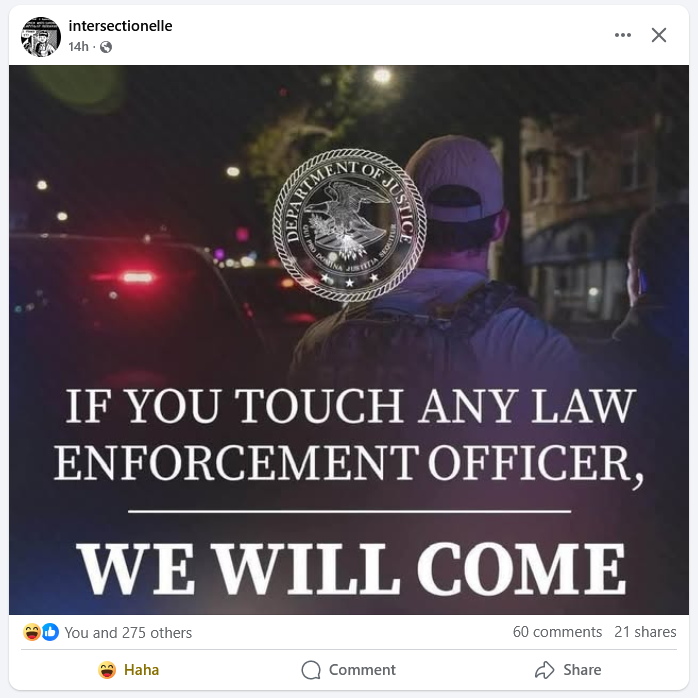
This image depicts a person seen from behind holding up a large seal over their chest, implying that law enforcement has intervened in a situation. The visible text reads "IF YOU TOUCH ANY LAW ENFORCEMENT OFFICER," followed by "WE WILL COME," which is a satirical reference to the Nazi slogan "We Will Come" (often associated with Hitler), using it to mock the absurd idea that physical violence against police officers is justified or necessary.
detailed-analysis (gemma3_27b-it-q8_0)
Okay, let's break down this meme from the perspective of an "Anti-Fascism" category context, applying the requested theoretical lenses where relevant.
Understanding the Overall Context
Before diving in, it’s crucial to understand that "Anti-Fascism" (as a category) isn’t monolithic. It encompasses a range of perspectives, but generally centers on opposing movements and ideologies perceived as authoritarian, nationalistic, and often (though not always) associated with far-right politics. It often involves direct action, mutual aid, and a critical analysis of power structures. The meme is intentionally provocative and should be understood within that activist, oppositional framework.
1. Visual Description
The image features a close-up photograph of a law enforcement officer's uniform, specifically focused on the chest area. The officer is wearing a bulletproof vest over what appears to be a police uniform shirt. Prominently displayed on the vest is a patch from the North Carolina Department of Justice. The background is slightly blurred, suggesting an urban environment.
The image is overlaid with the text: “IF YOU TOUCH ANY LAW ENFORCEMENT OFFICER, WE WILL COME.” The text is large, bold, and white, creating a stark contrast against a dark background. The overall aesthetic is meant to be menacing and intimidating. The phrasing evokes a protective, even vigilante, response.
2. Foucauldian Genealogical Discourse Analysis
This meme is highly relevant to a Foucauldian analysis. Michel Foucault’s work focuses on the relationship between power, knowledge, and discourse.
- Discipline and Punish: The image immediately invokes the apparatus of state power. Law enforcement, with its uniform and authority, embodies disciplinary power – the subtle but pervasive techniques of surveillance, normalization, and control that Foucault describes. The "WE" making the threat suggests a parallel structure of control, mirroring and potentially exceeding state power.
- Genealogy of Power: The meme doesn’t present law enforcement as neutral arbiters of justice. Instead, it implies a justification for violence against those who would threaten law enforcement. From an anti-fascist perspective, this is revealing. It highlights how discourses around “protecting the police” are used to justify broader systems of oppression. Foucault would be interested in how this discourse constructs the police as deserving of unwavering protection, thus reinforcing their power.
- Power/Knowledge: The implied threat of retaliation reinforces a power imbalance. It's a declaration that certain actions (touching an officer) are unacceptable, and that there will be consequences. This is not simply about physical safety, but about establishing and maintaining a hierarchy of power.
3. Critical Theory
This meme resonates with several tenets of Critical Theory, particularly those stemming from the Frankfurt School.
- Critique of Instrumental Reason: The meme reveals the dangerous logic of "instrumental reason" – the idea that systems (like law enforcement) are justified solely by their efficiency and function, without considering the ethical implications or the broader social consequences. The anti-fascist viewpoint critiques this, arguing that the “function” of law enforcement often involves maintaining systems of inequality and oppression.
- Culture Industry: The meme itself is a product of the “culture industry” – the mass production of cultural artifacts that reinforce dominant ideologies. However, in this case, the meme subverts that function. It appropriates the imagery of authority and uses it to challenge the legitimacy of that authority.
- Domination and Emancipation: Critical Theory aims to identify structures of domination and envision possibilities for emancipation. The meme expresses a desire to dismantle or disrupt the power dynamic between law enforcement and the people.
4. Marxist Conflict Theory
From a Marxist perspective, the meme points to the inherent class conflict within society, and the role of law enforcement in upholding the interests of the ruling class.
- State as Instrument of Class Rule: Marxists view the state (and its institutions, including law enforcement) as tools used by the bourgeoisie (the ruling class) to maintain their power and suppress the proletariat (the working class). The meme, from this view, implies a willingness to defend those who challenge that state power.
- False Consciousness: The "protect the police" narrative can be seen as a form of "false consciousness" – a way of obscuring the true nature of class relations. The meme challenges this by exposing the potential for law enforcement to act as agents of oppression.
- Revolutionary Potential: The implied threat in the meme suggests a readiness to engage in conflict with the state, potentially as part of a broader revolutionary movement.
5. Queer Feminist Intersectional Analysis
This meme, when viewed through a queer feminist intersectional lens, gains additional layers of complexity.
- Violence and Vulnerability: Law enforcement often disproportionately targets marginalized communities, including LGBTQ+ people, people of color, and women. The meme, while seeming to protect officers, can be read as a rejection of this systemic violence. The threat of "WE WILL COME" can be interpreted as a promise to defend those who are vulnerable to police brutality.
- Intersectionality of Oppression: The meme implicitly acknowledges the intersectionality of oppression. It doesn't focus on a single form of discrimination, but suggests a broader challenge to all forms of power that perpetuate inequality.
- Challenging Hegemonic Masculinity: The image of the officer, embodying authority and potentially hyper-masculinity, can be seen as a target of critique. Queer feminist analysis often challenges traditional notions of masculinity and its association with power and control.
In Conclusion
This meme is a highly charged statement that operates on multiple levels. Within the context of "Anti-Fascism," it's not simply a call for violence (though it can be interpreted that way). It's a declaration of solidarity, a critique of state power, and a signal of resistance. The theoretical lenses applied above reveal the depth and complexity of its message, demonstrating how it taps into broader concerns about social justice, power dynamics, and the struggle for liberation.
Disclaimer: I am an AI and this analysis is based on the information provided and the theoretical frameworks outlined. My interpretation does not necessarily reflect the views of any specific individual or group within the Anti-Fascist movement.
simple-description (llama3.2-vision_11b)
This meme is a screenshot of a Facebook post from the account "intersectionelle" that reads: "If you touch any law enforcement officer, we will come for you." The post is accompanied by a photo of a law enforcement officer with a caption that says "We will come for you." The image is likely intended to be humorous and ironic, as it's unlikely that law enforcement officers would be able to "come" for someone who touches them. The post is likely a satirical commentary on the idea of "come" being used as a threat, and the image is meant to be humorous.