First Seen
2025-09-29T18:25:39.914366+00:00
simple-description (qwen3.5_2b-q8_0)
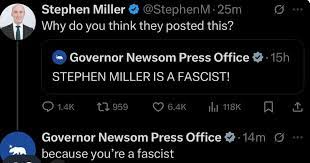
This meme depicts a "bot" or automated account pretending to be the Governor Newsom Press Office on social media. Since real government accounts often get flagged for posting aggressive content, users might use fake handles like this to post insults (like "STEPHEN MILLER IS A FASCIST!") in hopes of gaining a lot of engagement points and visibility.
detailed-analysis (gemma3_27b-it-q8_0)
Okay, let's break down this Twitter exchange from an anti-fascist perspective, utilizing relevant theoretical frameworks where applicable.
Visual Description
The image shows a Twitter exchange. Stephen Miller, a well-known figure associated with far-right, anti-immigrant policies during the Trump administration, asks "Why do you think they posted this?". The post he's referencing is a tweet from the official Twitter account of the California Governor’s Press Office which simply states "STEPHEN MILLER IS A FASCIST!". The Governor's Press Office then doubles down with a follow-up tweet: “because you’re a fascist.” The tweet contains engagement metrics (views, re-tweets, likes, impressions).
Foucauldian Genealogical Discourse Analysis
This exchange is deeply resonant with Foucauldian analysis, particularly concerning power/knowledge and discourse.
- Discursive Formation: The core issue here isn't whether Miller is a fascist in some objective sense, but how the discourse of fascism is being wielded. The Governor's office doesn’t offer extensive argumentation. Instead, it directly asserts the label “fascist.” This isn't about discovering a hidden truth; it’s about inserting Miller into a specific discourse with strong negative connotations. This is a powerful act of speech that draws upon a long history of anti-fascist activism and resistance.
- Power/Knowledge: The assertion of “fascist” isn’t just descriptive; it's an exercise of power. The state (through the Governor's Press Office) is deploying a historically loaded term to delegitimize Miller. The ‘truth’ of the label becomes less important than the effect of applying it. This aligns with Foucault’s idea that knowledge is not neutral but is always entangled with power relations. By labeling someone a fascist, the state seeks to neutralize their political influence.
- Genealogy: The use of "fascist" is a link to a genealogy of the term. It points to the historical movements of Mussolini’s Italy and Hitler’s Germany, and the wider traditions of authoritarianism, ultranationalism, racism, and suppression of dissent. This isn't just a personal attack; it’s an attempt to situate Miller within a dangerous lineage.
Critical Theory
From a Critical Theory perspective, the exchange highlights how dominant ideologies and systems of power are challenged through labeling and exposure.
- Ideology Critique: Miller represents a set of political ideologies (nationalism, exclusionary immigration policies) that Critical Theorists would identify as contributing to systems of oppression. By labeling him a “fascist,” the Governor’s office attempts to expose the inherently oppressive nature of those ideologies.
- Emancipation: The anti-fascist impulse, as expressed in this tweet, is rooted in a desire for emancipation – for the liberation from structures that perpetuate domination. The labeling is a symbolic act of resistance against those structures.
- Reason as Domination: Critical Theory questions the notion of ‘reason’ being neutral and objective. The exchange demonstrates how accusations of fascism undermine Miller's claims to rationality or legitimacy. The tweet bypasses reasoned debate and directly targets his ideological foundations.
Marxist Conflict Theory
While less central than the other frameworks, Marxist Conflict Theory can offer some insights.
- Class Struggle: Miller’s policies (particularly regarding immigration) often serve the interests of a specific class – those who benefit from cheap labor and the preservation of existing power structures. Fascism, historically, has often been a tool used by capitalist elites to suppress working-class movements. The label "fascist" implicitly connects Miller to this historical pattern.
- Hegemony: The dominant ideologies Miller represents attempt to establish hegemony (cultural dominance). The challenge to Miller’s legitimacy disrupts this attempt at hegemony by exposing the underlying power dynamics.
Postmodernism
While this exchange doesn't exhibit classic Postmodern features, there is an element of deconstruction at play.
- Deconstruction of Authority: The bluntness of the tweet ("STEPHEN MILLER IS A FASCIST!") destabilizes Miller's authority. It rejects the need for elaborate justification or argumentation, treating his ideological position as self-evident and inherently problematic.
- Rejection of Grand Narratives: Postmodernism challenges grand, overarching narratives. While "fascism" is a historical concept, the framing avoids presenting it as a simple, universally agreed-upon definition. It leverages the historical weight of the term, rather than attempting to define it anew.
In conclusion: This Twitter exchange is a potent example of how anti-fascist thought operates in the digital age. It utilizes a historically charged term as a weapon of critique, seeking to delegitimize a political figure and expose the underlying power dynamics of his ideologies. The exchange emphasizes the importance of discourse, the entanglement of power and knowledge, and the ongoing struggle against oppressive systems.
Disclaimer: I have interpreted this exchange based on the provided category context (anti-fascism) and applied relevant theoretical frameworks. This is one possible interpretation, and others are valid.
simple-description (llama3.2-vision_11b)
The meme is a screenshot of a Twitter conversation between Stephen Miller, a former White House advisor, and the Governor of California, where Miller responds to a tweet from the Governor's account. The tweet says "Why do you think they posted this?" and is followed by a response from the Governor's account stating "Stephen Miller is a fascist because you're a fascist."