First Seen
2025-09-25T17:27:49+00:00
simple-description (qwen3.5_2b-q8_0)
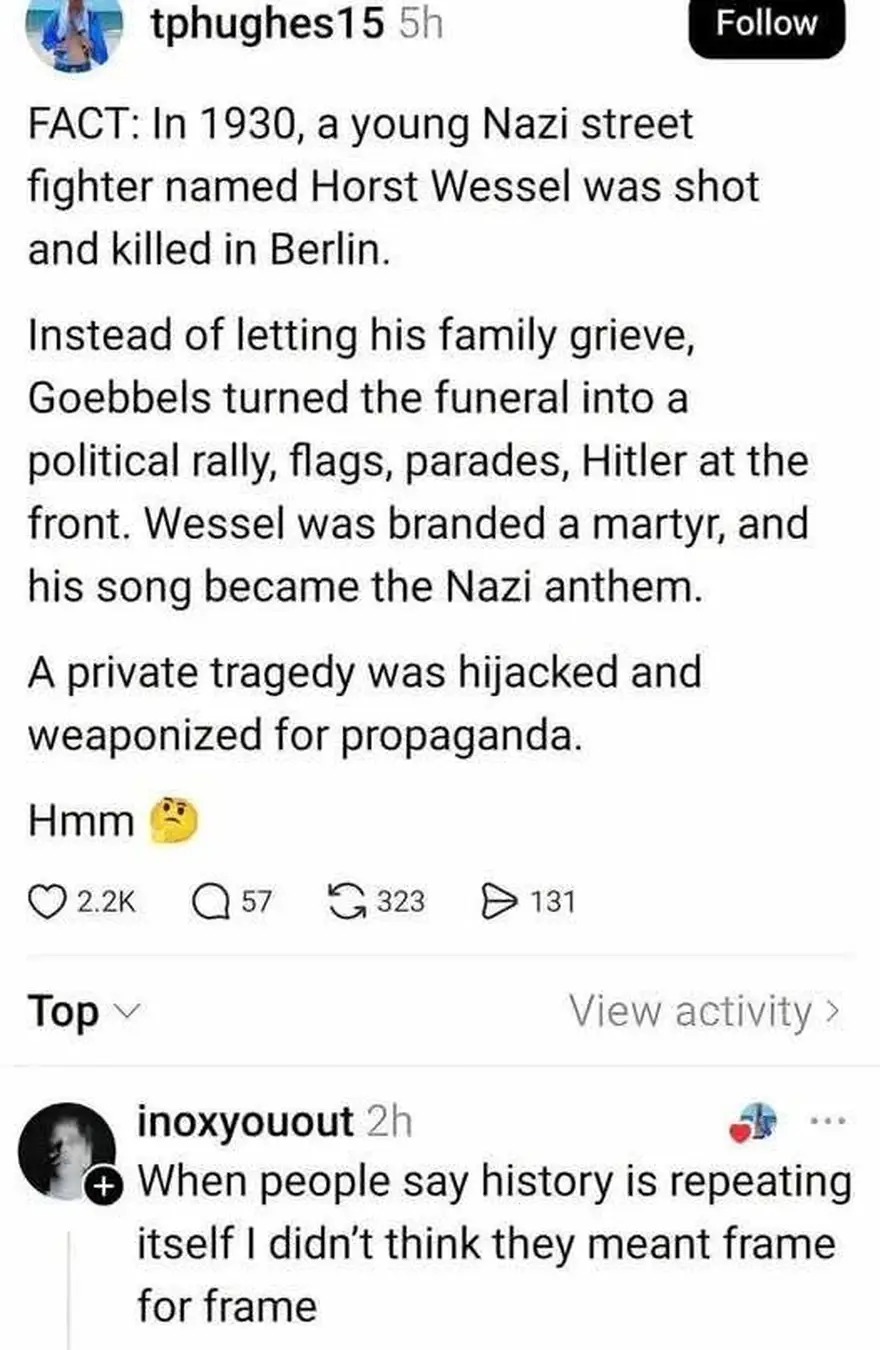
This meme serves as an anti-fascist critique by highlighting how authoritarian regimes often distort genuine historical tragedies into political prophecies and monuments to justify their own power. The post explains that Hitler attempted to assassinate street fighter Horst Wessel in 1930, but instead of mourning his death, Goebbels turned it into a public spectacle filled with propaganda and Nazi flags for rallies. It finishes with a reply clarifying that when people say "history is repeating itself," they literally mean a literal "frame for frame" of violence.
detailed-analysis (gemma3_27b-it-q8_0)
Okay, let's break down this social media post/meme from an anti-fascist perspective, utilizing relevant theoretical frameworks. It’s important to note that anti-fascism draws from many of these theoretical schools, so there will be overlap.
Visual Description
The "meme" is primarily text-based, a screenshot of a social media post (likely X/Twitter, formerly Twitter) by @tphughes15. It lays out a historical fact: The death of Horst Wessel, a Nazi “street fighter,” in 1930. It then details how Joseph Goebbels (the Nazi propaganda minister) immediately exploited this death for political gain, turning the funeral into a spectacle and branding Wessel as a martyr. The post then ends with a dismissive "Hmm 🧐" and a reply from @inoxyouout. The reply "When people say history is repeating itself I didn't think they meant frame" is an observation of the present day, and a point of caution for the viewer.
Foucauldian Genealogical Discourse Analysis
This is probably the most relevant theoretical lens here. Michel Foucault’s work on genealogy and discourse is hugely useful for understanding how power operates.
- Power/Knowledge: The post highlights how power doesn't just repress but produces knowledge, and how knowledge is inextricably linked to power. Goebbels didn’t simply present Wessel’s death as a tragedy; he constructed a narrative around it, a specific discourse of martyrdom and sacrifice for the cause. This discourse then served to legitimize the Nazi party and demonize their opponents.
- Genealogy: The post demonstrates a genealogical impulse. It’s tracing the historical roots of a present-day phenomenon (fascist ideology and its appeal). It’s not looking for an “original” truth about Wessel’s death, but rather how that death was reconfigured and used to create a particular political reality. The historical context is being used to dissect the mechanisms of fascist manipulation.
- Discourse and Subjectivity: The narrative created around Wessel wasn’t simply a matter of "telling lies." It was about shaping the subjectivities of people – making them believe in the Nazi cause, seeing themselves as part of a glorious movement, and potentially becoming willing participants in violence.
Critical Theory (Frankfurt School)
The post engages with key themes of Critical Theory.
- The Culture Industry: While this isn’t a direct example of mass culture (like movies or music) the construction of Wessel’s “martyrdom” is a proto-example of how the Nazis created a “brand” – a compelling narrative – that resonated with people. This anticipates the later manipulation of culture by authoritarian regimes.
- Instrumental Reason: Goebbels’ actions exemplify instrumental reason taken to its most horrifying extreme. A human tragedy is not considered in its own right, but solely as a tool to achieve political ends. Emotion and empathy are disregarded in favor of calculated manipulation.
- Enlightenment Critique: The post implicitly critiques the Enlightenment idea that reason and progress inevitably lead to a better world. It shows how reason can be weaponized for destructive purposes.
Marxist Conflict Theory
While not the primary focus, Marxist theory is relevant.
- Ideology and False Consciousness: The narrative of Wessel's martyrdom is a prime example of ideology in the Marxist sense: a set of beliefs that serve the interests of a ruling class (in this case, the Nazi party). It creates a “false consciousness” – a distortion of reality that prevents people from recognizing their true material interests.
- Class Struggle (in context): The Nazis, while appealing to many, initially gained traction by exploiting the economic anxieties and grievances of the middle and lower classes in post-WWI Germany. The narrative of Wessel’s death, and the promise of national renewal, offered a scapegoat (Communists, Jews, etc.) and a sense of collective purpose.
Postmodernism
- Deconstruction of Grand Narratives: Although not explicitly stated, the post implicitly deconstructs the “grand narrative” of heroism and sacrifice often associated with nationalism. It reveals how these narratives are constructed – they aren’t inherent truths, but rather products of specific power dynamics.
- Simulacra and Simulation (Baudrillard): One could argue that the “martyrdom” of Wessel is a kind of simulacrum – a copy without an original. The event itself is less important than the image of martyrdom created by Goebbels.
Queer Feminist Intersectional Analysis
This lens has a slightly less direct application, but can be useful:
- Intersectionality: The Nazis specifically targeted queer individuals, along with Jews, Roma, disabled people, and political opponents. While Wessel's story doesn’t directly involve queer issues, the broader historical context demonstrates the Nazis’ commitment to a hierarchical social order built on exclusion and oppression. Any analysis of fascism must acknowledge its intersectional nature.
- Deconstructing Masculinity: Wessel, as a “street fighter,” embodies a hyper-masculine ideal that the Nazis actively promoted. This ideal was linked to violence, aggression, and nationalistic fervor. A queer feminist analysis might deconstruct this form of masculinity, highlighting its oppressive aspects and its role in justifying violence.
In Summary:
The post is a concise but powerful example of how fascist ideologies are built on manipulation, distortion, and the exploitation of tragedy. The reply "When people say history is repeating itself I didn't think they meant frame" is a warning. The post is a call to be vigilant and recognize the patterns of manipulation when they reappear in contemporary politics. It's an attempt to equip people with the critical tools to resist those patterns.
simple-description (llama3.2-vision_11b)
The meme is a humorous comparison between the historical events of 1930 and the current situation. The text reads: "In 1930, a young Nazi street fighter named Horst Wessel was shot and killed in Berlin. Instead of letting his family grieve, Goebbels turned the funeral into a political rally, flags, parades, Hitler at the front. Wessel was branded a martyr, and his song became the Nazi anthem. A private tragedy was hijacked and weaponized for propaganda." The meme is poking fun at the historical event and the way it was used to promote the Nazi ideology.